
You prevent overtime burnout by catching repeat overtime early, fixing the schedule that causes it, and protecting rest between shifts. Burnout rarely starts with one long week. It builds when the same people keep picking up the extra hours, shift after shift, with too little time to recover. This guide shows managers of hourly and shift-based teams how to spot the pattern, change it, and check that the change worked.
TL;DR
- Repeated overtime is linked to higher burnout risk, poorer sleep, and more work-family conflict, so treat recurring overtime as a health signal, not just a payroll line.
- Watch for the same names on the overtime report, growing hours, errors, missed deadlines, and falling engagement.
- Fix the cause in the schedule: forecast demand, spread extra hours fairly, and give people a voice in when they work.
- Build in rest. Federal guidance for crisis periods points to at least 10 hours off between shifts and one full day of rest per seven days.
- Know the legal floor: federal law requires time-and-a-half after 40 hours in a workweek for covered, non-exempt employees, but it does not cap hours for adults.
Table of Contents
- Why overtime leads to burnout
- Spot the warning signs early
- Fix the schedule, not just the person
- Build recovery into the schedule
- Give employees a say in their schedules
- Know the overtime rules before you adjust hours
- Our perspective
- How to tell if your changes are working
- Put it into practice with Heyhive
- FAQ
- Sources
Why overtime leads to burnout
Overtime is not harmful in itself. A busy Saturday or a holiday rush is part of running a restaurant, a store, or a service crew. The trouble starts when extra hours become the normal way to get coverage.
A four-year study of healthcare workers in Taiwan found that overtime was associated with a higher risk of developing high personal burnout. The same research links overtime with shorter sleep, poorer sleep quality, and more conflict between work and family life. The workers studied were in healthcare, so treat the figures as a signal, not a promise about your industry. The mechanism is easy to recognize on any shift floor, though: less sleep, less time away from work, and less energy for the next shift.
For managers, the point is practical. Burnout does not show up on a schedule. Overtime does. If you can see who is working long and often, you can act before the exhaustion turns into call-outs, mistakes, and resignations.
The federal health agencies take the same view. A CDC-hosted paper on healthy work strategies describes stress, sleep deprivation, and fatigue as largely employer-level concerns that call for workplace policies, programs, and practices. In other words, it is the manager's system to fix, not the employee's willpower.

Spot the warning signs early
By the time someone says they are burned out, you are late. The better approach is to read the data you already have.
Professional HR guidance says managers can look for expanding working hours, repeated after-hours work, errors, missed deadlines, or reduced engagement in meetings. The same source suggests reviewing after-hours work, deadline extensions, absenteeism, leave use, and turnover to find teams that need a closer look.
On an hourly team, that translates into a short weekly check:
- Who is over 40 hours, and how often? One overtime week is a rush. Four in a row is a pattern.
- Who works "clopens"? Closing late and opening early cuts sleep to the bone.
- Who always says yes? Your most reliable people often absorb the most extra shifts, quietly.
- Whose attendance is changing? Late arrivals, last-minute call-outs, and unused time off all deserve a conversation.
- Where do errors cluster? Mistakes late in long shifts point to fatigue, not carelessness.
For a deeper list of what to watch for beyond hours, these employee burnout signs are a good reference to keep next to your weekly review.
If you track attendance and clock-ins in one place, these checks take minutes. Our guide to employee attendance tracking for hourly teams covers how to set that up.
Fix the schedule, not just the person
Telling a tired employee to take a break does not fix a schedule that needs their hours. Burnout prevention works when you remove the reason the overtime exists.
Forecast demand and schedule to it
Most recurring overtime comes from the same gap: you scheduled for an average week, and the real week was busier. Compare scheduled hours against actual sales or traffic, then build the next schedule to match the pattern. Our walkthrough on overtime forecasting shows how to predict where hours will run over before the week starts.
Catch overtime while you can still change it
A month-end report tells you what already happened. Track hours as the week unfolds, and flag anyone approaching 40 by midweek. Then you can shift a Friday shift to someone with room instead of paying for it and wearing someone out. More tactics are in our guides on how to prevent unnecessary overtime and avoiding scheduled overtime with systems instead of headcount.
Spread the extra hours on purpose
When a shift opens up, the fastest fix is to call the person who always answers. That works for a week and costs you a month later. Keep a simple rotation for extra shifts, and offer open shifts to everyone who is under their hour limits first.
Use a rotation people can plan around
Predictable patterns make rest easier to protect. If your operation runs nights, weekends, or split coverage, see our rotating shift schedule patterns and templates. If your team covers on-call duty, our on-call scheduling guide helps you share it fairly instead of leaving it to the same two people.
Cover absences without piling on
One call-out often triggers overtime for three other people. Having a clear process for absences and a bench of people who want extra hours keeps one gap from becoming a chain reaction. Our roundup of absence management software for shift teams explains what to look for.
Build recovery into the schedule
Rest is the part of burnout prevention that managers can enforce directly through the schedule.
NIOSH guidance on managing fatigue during crises says managers should provide at least 10 hours off between shifts in each 24-hour period and one full day of rest per seven days. That guidance was written for crisis periods, but it is a sensible benchmark for any team running long weeks. The same page lists sleep education, short naps, and daily communication rounds with staff as part of recovery support.
An academic consensus statement from the Working Time Society adds that at least two consecutive days of recovery between shift sequences can offset accumulated fatigue. It also notes that very demanding work, severe sleep loss, or disrupted body clocks may need more time.
Here is what that looks like in practice:
| Rule of thumb | What to do on the schedule |
|---|---|
| 10 hours between shifts | Block closing-to-opening turnarounds shorter than 10 hours |
| One full rest day in seven | Check that no one is scheduled seven days running |
| Two consecutive days off after a run of shifts | Pair days off at the end of a shift sequence |
| Heavier workload or night work | Add more recovery time than the minimum |
When a heavy stretch is unavoidable, there are other levers beyond time off. OSHA's mental health checklist for managers suggests they can reassign work, prioritize tasks, and allow more time or reschedule deadlines. For a restaurant or retail team, that can mean pausing a nonessential project like a stockroom reorganization until the rush ends.
Leaders set the tone too. OSHA guidance for senior managers says they can model self-care, take time off, and define and keep work schedule boundaries. If you answer messages at midnight, your team will assume they should as well.
Give employees a say in their schedules
People cope better with long weeks when they have some control over them. NIOSH guidance recommends that managers communicate flexibility about when staff can work, without repercussions for restricted availability. Employees who can say "I can't close Thursday" without fear of punishment are far less likely to burn out silently.
The Working Time Society statement points the same way. It says schedule design should balance operational, financial, and social obligations, and that a participatory approach involving workers and management may be needed.
Simple ways to put this to work:
- Collect availability and time-off requests before you build the schedule, not after.
- Let employees swap shifts within clear rules, with manager approval where you need it.
- Post schedules early so people can plan sleep, childcare, and second jobs.
- Run a short daily or per-shift huddle on workload and coverage.
If you want to go further, our self-scheduling playbook for hourly teams lays out a four to eight week rollout.
Know the overtime rules before you adjust hours
Reducing burnout should never create a pay or compliance problem. Check these basics for U.S. employers.
- Overtime pay. According to the Department of Labor, unless specifically exempted, covered employees must receive at least time-and-one-half their regular rates for hours over 40 in a workweek. The FLSA sets no limit on hours for employees aged 16 or older.
- Breaks. The DOL's FAQ states that the FLSA generally does not require breaks or meal periods, apart from its nursing-mothers break-time provision, and does not require extra pay for weekend work.
That second point matters. Federal law will not stop a tired employee from working a sixth straight day. Protecting rest is a management decision, and your state may have its own rules on breaks, rest periods, and scheduling. Check your state labor department and, where unsure, an employment attorney or HR professional before changing pay practices or exempt classifications.
Our perspective
We built Heyhive because we kept seeing the same loop. A manager builds the schedule by hand, a gap appears, and the same dependable people fill it. Nobody planned for them to burn out. The schedule just had no way to show the cost.
Our view is that overtime burnout is a planning problem first. When a schedule respects availability, certifications, and overtime limits from the start, fewer gaps turn into extra shifts. That is why our AI Scheduling is designed to generate a full week of shifts in seconds with those rules built in, and why you approve every shift before it publishes. The AI does the heavy lifting. You keep the judgment.
Visibility matters as much as generation. With real-time attendance tracking, a GPS-verified time clock, and payroll-ready hours in one place, you can see who is trending toward 40 hours by Wednesday instead of discovering it on payday. Open shifts can be filled quickly, and shift swaps and team messaging keep coverage moving without a chain of late-night texts.
Rest and fairness are not extras on a schedule. They are what keeps good people on your team.
Heyhive
How to tell if your changes are working
Burnout prevention is not a one-time fix. The Working Time Society consensus says managers can judge the effectiveness of fatigue management through regular monitoring and evaluation, and that sustainable programs need ongoing feedback and adaptation.
Track a small set of numbers monthly:
- Overtime hours per employee, not just in total. A flat total can hide one person doing more.
- Short turnarounds, meaning shifts with fewer than 10 hours between them.
- Call-outs and last-minute absences, compared with the previous period.
- Turnover and unused time off on teams that run heavy overtime.
- Open-shift fill time, to see whether you can cover gaps without leaning on the same people.
Then add the human side. Professional HR guidance notes that pulse surveys and regular check-ins can complement workforce data by showing how employees view their workload and their ability to disconnect. Ask two or three plain questions: Is your schedule workable? Do you get enough time off between shifts? Do you feel pressure to say yes to extra hours?
Use the numbers to support people, not to watch them. If employees feel monitored rather than helped, they stop telling you the truth, and the data loses its value.
Put it into practice with Heyhive
If your overtime still depends on spreadsheets, text threads, and memory, the quickest gain is a system that builds rules into the schedule. Heyhive generates a week of shifts that respects availability, certifications, and overtime limits. You review and approve before anything goes out, and you can adjust on the fly.
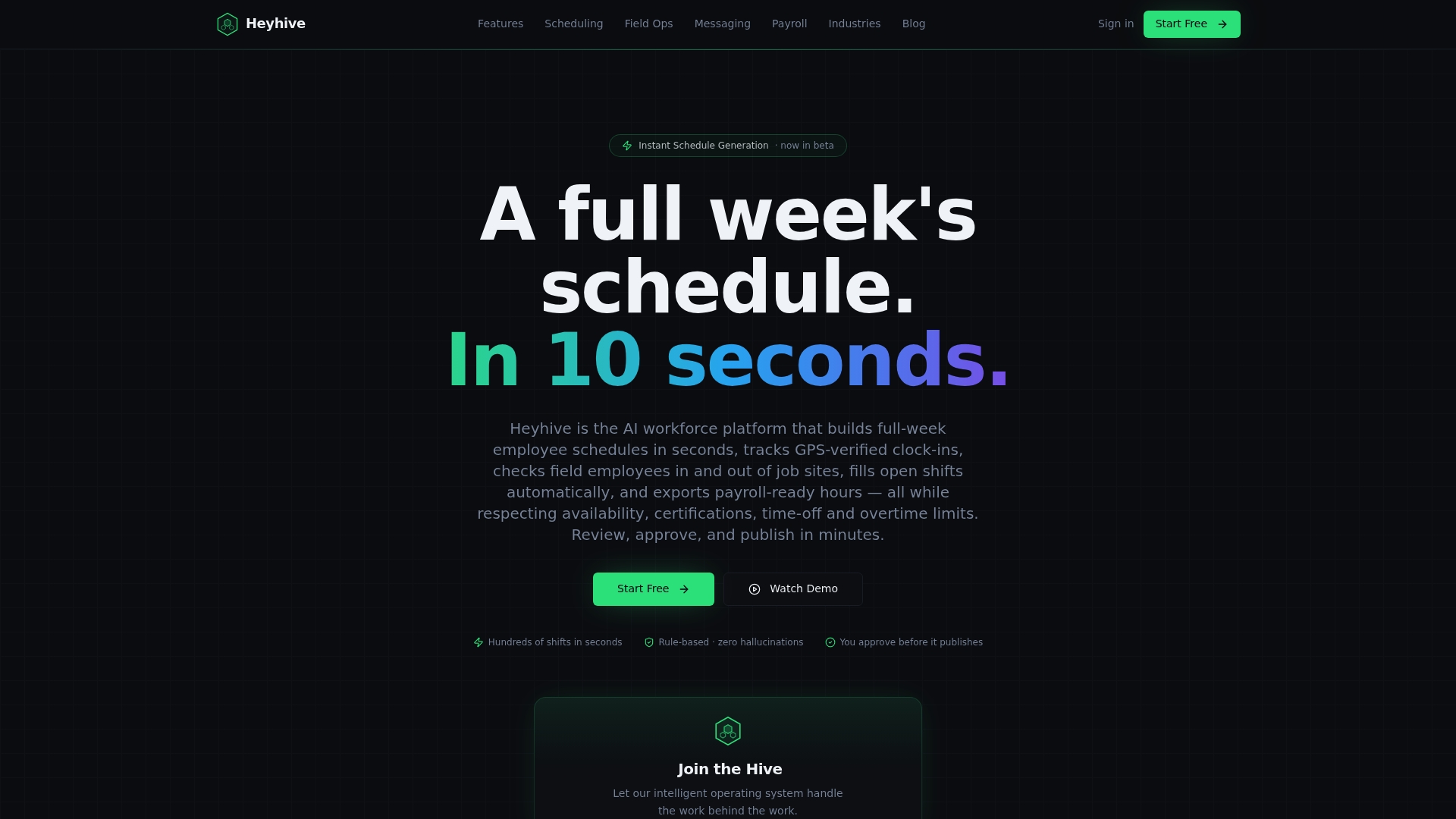
From there, the GPS time clock and attendance tracking show who is working what, and payroll-ready hours save you the end-of-period cleanup. Start free and see what next week's schedule looks like with overtime flagged before it happens.
FAQ
How many overtime hours cause burnout?
There is no single threshold that applies to every worker or job. Research links repeated overtime, rather than one long week, with higher burnout risk, shorter sleep, and more work-family conflict. Watch for patterns such as the same employees over 40 hours week after week, and talk with them about their workload.
Is there a federal limit on how many hours an employee can work?
No, not for employees aged 16 or older. The Department of Labor says the FLSA sets no limit on hours for that group, but it does require overtime pay at time-and-one-half for covered, non-exempt employees over 40 hours in a workweek. Some states have additional rules, so check yours.
How much rest should employees get between shifts?
NIOSH guidance for crisis periods recommends at least 10 hours off between shifts and one full day of rest per seven days. A consensus statement from the Working Time Society suggests at least two consecutive days of recovery between shift sequences. Use those as benchmarks when you build schedules, and allow more for night or very demanding work.
What should I do first if my team is already burned out?
Start with a conversation, then lighten the load. Listen without judgment, reassign or reprioritize work, and remove short turnarounds from the next schedule. Then fix the cause by forecasting demand and spreading extra shifts more evenly. If an employee shows signs of serious distress, point them to your employee assistance program or a qualified health professional.
Sources
- Prolonged Overtime Predicts Worsening Burnout Among Healthcare Workers
- Can Managers Spot Burnout Before Employees Say They Are Struggling?
- Healthy Work Strategies for a "Coronanormal" Society
- Managing Fatigue During Times of Crisis: Guidance for Nursing Employers
- Working Time Society consensus statements
- Supporting Mental Health in the Workplace: Checklist for Senior Managers
- Supporting Mental Health in the Workplace: Getting Started for Senior Managers
- Fact Sheet #23: Overtime Pay Requirements of the FLSA
- Questions and Answers About the Fair Labor Standards Act