
Rotating shift schedules cycle employees through different shifts, usually days, evenings, and nights, on a fixed calendar so no single team gets stuck on the worst hours forever. For most continuous-operation teams, two patterns cover most common use cases: the 2-2-3 (Panama) schedule for balanced recovery and frequent long weekends, and the DuPont schedule when a full week off per cycle matters more than short-term fairness. A 4-on-4-off pattern works best for smaller shops running just two teams.
Your next move is simple: pick a pattern based on headcount and how much recovery time your crew needs, then pilot it for 4 to 8 weeks before locking it in.
- Small team (2 crews): Start with 4-on-4-off. It's the easiest pattern to explain and audit.
- Medium to large team (4 crews), fairness priority: Use 2-2-3/Panama.
- Medium to large team, long-break priority: Use DuPont, but model overtime first.
- High-risk or specialized ops (fire, EMS): Consider 24/48 or Kelly patterns, covered below.
Key Takeaways
Rotating shift schedules succeed when the pattern matches team size and recovery needs, overtime is modeled across the full cycle, and fatigue mitigation is built in from day one.
| Point | Details |
|---|---|
| Match pattern to headcount | Use 4-on-4-off for two teams, 2-2-3 or DuPont for four teams with different fairness priorities. |
| Model overtime across the full cycle | Check weekly totals against FLSA rules, not cycle averages, before publishing any rotation. |
| Rotate forward and protect recovery time | Give at least 48 hours off after night runs and avoid quick day-to-night flips. |
| Pilot before full rollout | Test a new pattern with one team for 4 to 8 weeks and track absenteeism and overtime. |
| Automate the build, keep manager approval | Heyhive generates rotating schedules in seconds while managers still approve every shift before publication. |
Table of Contents
- What Are Shift Rotation Schedules and When Do Teams Need Them?
- Which Rotating Shift Patterns Should You Consider?
- How Do You Design a Rotating Schedule From Scratch?
- Managing Fatigue and Transitions Between Rotating Shifts
- What Legal and Payroll Rules Apply to Rotating Schedules?
- Which Industries Rely on Rotating Shift Patterns Most?
- Sample Rotas and a Deployment Checklist You Can Copy
- Beyond Fatigue: Protecting Mental Health and Physical Wellness on Rotations
- What We've Learned Running Rotations at Scale
- Automate the Hard Part of Rotating Schedules
- Sources
What Are Shift Rotation Schedules and When Do Teams Need Them?
A rotating shift schedule assigns employees to different shifts, such as morning, evening, and night, across a repeating cycle instead of locking each person into one fixed shift permanently. The goal isn't complexity for its own sake. It's coverage: keeping a facility staffed 24 hours a day, 7 days a week, without burning out the same three people who always draw the night shift.
Rotation solves three problems at once: continuous coverage, equitable workload distribution, and flexibility when someone calls out. Fixed schedules work fine for a retail store that closes at 9 p.m. They fall apart for hospitals, manufacturing plants, security firms, and utilities that never stop running.
Choose rotation over a fixed or compressed schedule when:
- Operations run 24/7 or close to it, and no single shift can be permanently "assigned" without creating resentment.
- Your workforce is large enough to split into 2 to 5 crews without leaving any shift dangerously thin.
- Cross-training matters, since rotation naturally exposes staff to different shift conditions and colleagues.
The trade-off is administrative load. Rotating schedules take more planning time, more overtime modeling, and more communication overhead than a static roster. Payroll gets more complicated too, especially when night differentials and overtime interact across a multi-week cycle. Managers who skip that modeling step are the ones who get blindsided by a labor cost spike in month two.
Which Rotating Shift Patterns Should You Consider?
Most rotation problems get solved by one of five well-tested patterns. Each has a defined cycle length, team count, and average weekly hours, so you can hold your headcount up against it and see immediately whether it fits.
The 2-2-3 pattern, often called the Panama schedule, runs a 14-day cycle across 4 teams. Employees work two days, get two off, work three, then flip the sequence. Average weekly hours land around 42, and every employee gets a three-day weekend every other week. It's the most popular pattern in manufacturing and healthcare because it balances fairness with predictability, according to the 12-hour shift pattern comparison from ShiftScheduleUp.
Pitman schedules look similar to 2-2-3 on paper but can be run as fixed-days or fixed-nights rotations instead of alternating. That distinction matters for circadian health. A team member who stays on nights for the full cycle adjusts their sleep once instead of fighting it every few days.
The DuPont schedule runs a longer 28-day cycle across 4 teams and is the only common pattern that builds in a full week off every rotation. The cost is heavier work weeks elsewhere in the cycle, with a stretch of four consecutive night shifts for some teams. Plants that value long recovery blocks over short-term fairness tend to prefer DuPont.
4-on-4-off is the simplest pattern to run with just two teams. Employees work four consecutive days, get four off, and repeat, whether the shifts are 8 hours or 12. It requires the least explanation during onboarding, which matters if you're managing high turnover.
Specialist patterns exist for specific risk profiles:
- 24/48, common among firefighters, means one 24-hour shift followed by 48 hours off.
- Kelly schedules extend that logic across a longer cycle with a periodic extra day off (a "Kelly day").
- DDNNOO (two days, two nights, two off) compresses a full rotation into six days, which suits crews that want fast cycling over long stretches on one shift type.
How Do You Design a Rotating Schedule From Scratch?
Building a rotation isn't a matter of picking a pattern off a chart and dropping names into it. Get the sequence wrong and you'll spend the next three months firefighting instead of running the floor.
- Map hourly coverage demand. Chart out your minimum staffing level for every hour of the day, not just a rough day/night split. A distribution center might need six people at 2 p.m. and only two at 3 a.m.
- Decide shift length and rotation speed. Fast rotations (2 to 3 days per shift type) reduce the depth of circadian disruption per phase but demand more schedule changes. Slow rotations (a full week or more per shift type) let the body adjust more fully but concentrate fatigue during transitions.
- Match pattern to team count and simulate the full cycle. Run the numbers on weekly hours, not just per-shift hours. A pattern that looks fine on a single week can generate unplanned overtime once you total an entire 28-day DuPont cycle.
- Set overtime caps, minimum rest periods, and swap rules before publishing anything. Decide now, not during a crisis, how many hours' notice a swap request needs and who has final approval.
- Pilot with one team first. Run the new pattern with a single crew for 4 to 8 weeks, track absenteeism and overtime spend, then adjust before rolling it company-wide.
Pro Tip: Build your first draft in a spreadsheet and total every employee's hours across the full cycle, not just one week. A pattern that averages 40 hours weekly can still trigger overtime in individual weeks, and the FLSA calculates overtime week by week, not by cycle average.
Managing Fatigue and Transitions Between Rotating Shifts
Circadian disruption is the single biggest operational risk in rotating schedules, and it's not just a wellness talking point. Fatigued workers make more errors, get hurt more often, and call out more frequently. CDC and NIOSH guidance on shift work identifies poorly managed rotation, particularly frequent night-to-day flips, as a direct contributor to workplace injury risk.
A few adjustments cut that risk substantially:
- Rotate forward (days to evenings to nights) rather than backward whenever the pattern allows it. Forward rotation aligns better with the body's natural tendency to delay its clock rather than advance it.
- Give at least 48 hours off after a run of night shifts before flipping someone back to days. Anything shorter doesn't allow real recovery.
- Limit consecutive quick-turn transitions. A schedule that bounces someone from a night shift to a morning shift with only 8 hours in between is a fatigue incident waiting to happen.
Handoffs matter just as much as the rotation pattern itself. A structured handover checklist, a short written summary of open issues, and a critical-tracking log for anything unresolved prevent the kind of information gaps that turn into safety incidents on the next shift.
Track a small set of KPIs to catch problems early: absenteeism rate by shift type, error or incident rate by shift type, and any reported fatigue-related near-misses. If those numbers trend the wrong way after a rotation change, involve occupational health before the pattern causes real harm, not after.
What Legal and Payroll Rules Apply to Rotating Schedules?
Federal overtime rules don't bend for rotation patterns. The FLSA calculates overtime on a workweek basis, meaning any hours over 40 in a single workweek trigger time-and-a-half regardless of how the rest of the cycle averages out. A DuPont schedule with one 48-hour week and one 32-hour week still owes overtime for that heavy week, even though the two average to 40.
Check these before you publish any rotation:
- State-level daily overtime rules. Some states require overtime after 8 hours in a single day regardless of weekly totals, which changes the math for 12-hour shift patterns entirely.
- Predictive scheduling laws. A growing number of cities and states require advance notice of schedule changes and penalty pay for late adjustments.
- Night differential stacking. Confirm how your night-shift premium interacts with overtime pay, since some payroll systems calculate the overtime rate before differentials are added, and some after.
- Recordkeeping. Keep time records that clearly show shift start and end times, breaks, and any swaps, since accurate records are your best defense in a wage dispute.
Which Industries Rely on Rotating Shift Patterns Most?
Healthcare and public safety lean heavily on 12-hour DuPont and Pitman variants because those patterns minimize the number of handoffs per patient or case, reducing the chance that critical information gets lost between shifts.
Manufacturing and logistics operations tend to split between 2-2-3 and 4-on-4-off, trading off fairness against simplicity depending on how large the workforce is and how often absences occur.
- Small operations and security firms often default to two-team models like 4-on-4-off because they don't have the headcount to support a four-team rotation without leaving shifts dangerously thin.
- Field service and multi-site operations face a different challenge entirely: coordinating rotations across locations so that a technician's schedule at Site A doesn't conflict with an on-call rotation at Site B.
Sample Rotas and a Deployment Checklist You Can Copy
A 2-2-3 rotation for one team looks like this across a two-week span: Days 1 to 2 on, Days 3 to 4 off, Days 5 to 7 on, Days 8 to 9 off, Days 10 to 11 on, Days 12 to 14 off. The next team runs the mirror image, so coverage never drops.
A DuPont cycle for a single crew spans 28 days: four night shifts, three days off, three day shifts, one day off, three night shifts, three days off, four day shifts, then a full seven days off before the cycle restarts.
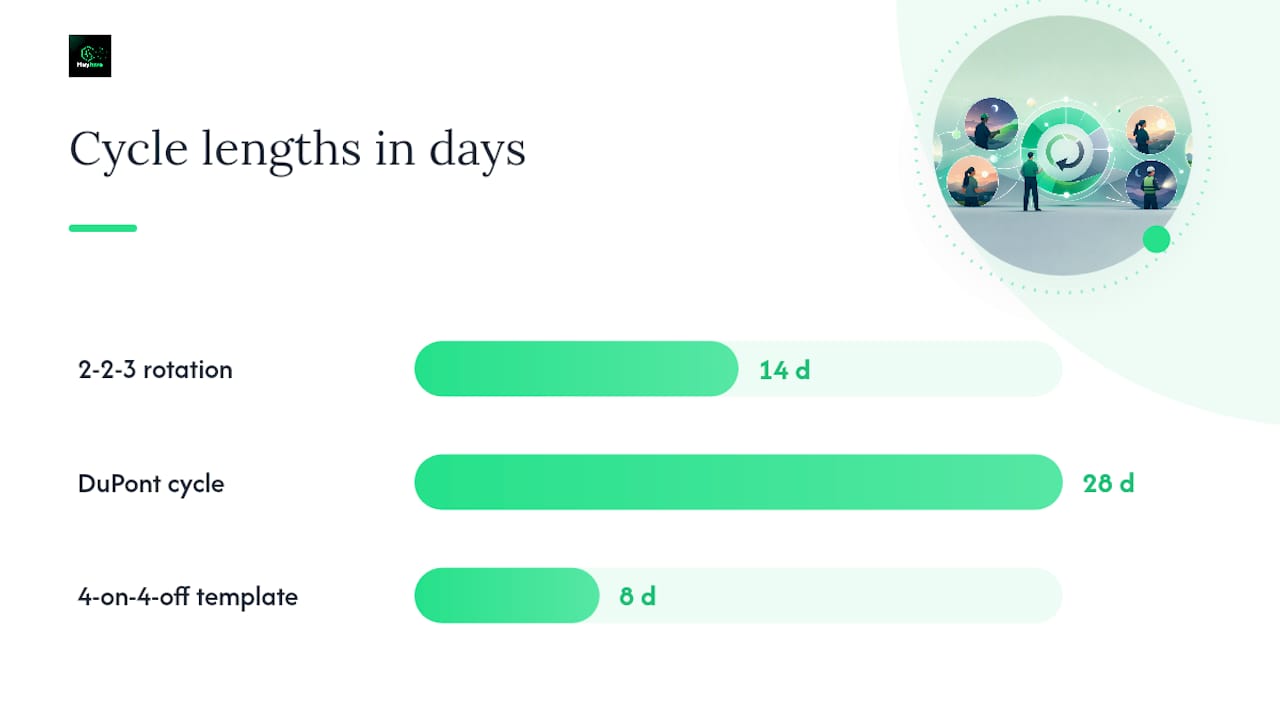
A 4-on-4-off template is the shortest to write out: Days 1 to 4 on, Days 5 to 8 off, repeat indefinitely, with a second team offset by four days to cover the gap.
Before you roll any of these out, run through a short deployment checklist:
- Get sign-off from finance on projected overtime costs for the full cycle, not just one week.
- Pick a pilot start date that avoids your busiest seasonal period.
- Draft a one-page communication explaining the new pattern, the pilot timeline, and who to contact with concerns.
- Set clear swap rules: minimum notice period, who approves swaps, and a cap on consecutive shifts even after a swap.
- Define a last-minute call-out protocol so supervisors know exactly who to call first when a shift goes unfilled.
Keep the swap and call-out rules simple enough that a new supervisor could apply them without a training session. Overengineered rules are the first thing that breaks down during a holiday week or a flu outbreak.
Beyond Fatigue: Protecting Mental Health and Physical Wellness on Rotations
Fatigue gets most of the attention, but rotating shifts carry other health costs that deserve equal weight. Workers on rotating patterns, especially those with frequent night shifts, report higher rates of digestive issues, disrupted eating patterns, and social isolation from friends and family on fixed daytime schedules.
Encourage a few habits that make a measurable difference. Eating a light, protein-forward meal before a night shift rather than a heavy one keeps energy steadier through the early morning hours. Limiting caffeine intake to the first half of a night shift helps workers actually fall asleep once they get home instead of lying awake past sunrise. Blackout curtains and phone silencing during daytime sleep aren't optional extras for night-shift workers; they're the difference between four hours of real sleep and eight hours of interrupted rest.

Mental health deserves direct attention too. Rotating shift workers lose access to a lot of ordinary social infrastructure, since standard support groups, gyms, and even family dinners run on a daytime clock. Managers who build in occasional flexibility around personal appointments, and who normalize talking about sleep and stress openly during team check-ins, tend to see lower turnover on their rotating crews. A quick monthly pulse check on how the schedule is affecting people costs almost nothing and surfaces problems long before they show up as absenteeism.
What We've Learned Running Rotations at Scale
Heyhive builds rotating schedules automatically while keeping every shift subject to manager approval before it publishes. The pattern matters less than the workflow around it. Teams that thrive on rotation keep swap requests simple, keep team messaging in one place, and treat every schedule change as a communication event, not just a calendar update.
— Heyhive
Automate the Hard Part of Rotating Schedules
Building and maintaining a rotation by hand, especially a 28-day DuPont cycle across four teams, eats hours every single week that a manager could spend on the floor instead. Heyhive generates a full week of shifts in seconds, respecting availability, certifications, and overtime limits automatically, so the overtime modeling that used to take a spreadsheet and an afternoon happens before you even hit publish.
You still approve every shift before it goes live, which means the AI handles the grind while you keep the final say. Swap requests, open-shift coverage, and GPS-verified clock-ins for field teams all run through the same platform, cutting the back-and-forth that usually kills a rotation pilot in its first month. If you're planning to test a new pattern like 2-2-3 or 4-on-4-off, start by building your first automated schedule with Heyhive and see how much of the planning work disappears.