
Open shift management is the process of publishing unassigned shifts to a pool of eligible staff, then routing pickup requests through automated eligibility and approval rules instead of manual phone calls. In nursing units, the single biggest lever is speed: post the open shift in a real-time system and filter it by credentials before anyone sees it.
Check these before you post any shift:
- Credentials. Confirm the license, certification, or specialty match required for that unit.
- Availability and overtime. Cross-check who's actually free and who's already near their overtime threshold.
Key Takeaways
Open shift management works when eligibility rules, manager approval, and real-time notifications operate together instead of relying on any single control.
| Point | Details |
|---|---|
| Post fast, filter first | Publish the open shift immediately and apply credential and availability filters before notifying staff. |
| Match approval to risk | Use manager approval for high-risk or overtime-triggering shifts; auto-assign routine pickups. |
| Track fill rate and premium labor | These two metrics tell you whether the program is actually reducing agency spend. |
| Rotate to prevent favoritism | Tiered notifications and rotation policies keep the process fair and reduce disputes. |
| Pilot before full rollout | Test on one unit for two to four weeks and collect staff feedback before expanding. |
| Heyhive operationalizes the checklist | Heyhive maps eligibility filters, credential checks, and manager approvals directly into automated scheduling workflows. |
Table of Contents
- What Is Open Shift Management in Nursing?
- How Does Open Shift Scheduling Actually Work?
- What Are the Benefits of Managing Open Shifts Well?
- What Are the Best Practices for Managing Open Shifts?
- How Do You Roll Out an Open Shift Program?
- What Metrics Prove Open Shift Management Is Working?
- What Pitfalls Should You Watch For?
- How Does AI Scheduling Software Operationalize This?
- Where Can You Learn More About Open Shift Scheduling?
- What Healthcare Managers Get Wrong About Open Shifts
- Fill Shifts Fast Without Losing Manager Control
- Frequently Asked Questions About Open Shift Management
- Sources
What Is Open Shift Management in Nursing?
Open shift management means a shift with no assigned worker gets posted to a pool of qualified staff who can claim it, rather than being manually assigned by a scheduler. That's the core operational shift from traditional scheduling: instead of one person building a rigid roster and defending it against last-minute call-outs, the system exposes gaps and lets eligible staff fill them.
The difference shows up in three places:
- Control. Traditional schedules centralize every decision with the manager; open shifts distribute the first move to staff while keeping approval with the manager.
- Flexibility. Staff can pick up extra hours that fit their availability instead of waiting to be asked.
- Workload. Managers spend less time cold-calling and more time reviewing and approving.
Eligibility rules, meaning certifications, unit roles, and availability windows, are what keep an open shift from becoming a free-for-all.
How Does Open Shift Scheduling Actually Work?
The workflow follows a predictable sequence, whether it's triggered by a call-out or a forecasted staffing gap:
- Detect the gap (a nurse calls in sick, or forecasting flags a coverage hole).
- Post the open shift into the scheduling system.
- Notify eligible staff, usually by push notification or text.
- Staff accept or request the shift.
- A manager approves the pickup, or the system auto-assigns based on preset rules.
- The shift is confirmed and logged for payroll and compliance records.
The technology layer is what separates modern shift scheduling software from a group text chain. Look for eligibility filters that block unqualified pickups automatically, credential verification tied to each role, availability matching against existing schedules, instant push notifications, a manager approval step, and audit logs that record who requested what and when.
Human approval still matters most for high-risk roles, ICU coverage, charge nurse shifts, or anything touching overtime limits. Auto-assign works fine for routine, lower-risk shifts where speed matters more than a second set of eyes. According to When I Work's documentation, some systems support both models, first-come-first-served claims and manager-gated bidding, so the choice comes down to how much risk a given shift carries.
What Are the Benefits of Managing Open Shifts Well?
A well-run open shift system pays off in ways that show up on both the schedule and the budget:
- Faster time-to-fill. Gaps close in minutes instead of hours of phone tag.
- Lower premium labor spend. Fewer shifts fall through to agency staff or overtime rates.
- Better staff flexibility and retention. People pick up hours that match their real availability.
- Reduced admin time. Managers stop being the bottleneck for every schedule change.
- Stronger compliance. Credential checks happen automatically instead of relying on memory.
The metric worth tracking closest is reduced premium labor per shift filled internally versus sent to agency staff. Fill rate matters just as much, because an open shift left unfilled on a nursing unit isn't just a budget problem. It's a direct hit to patient-to-staff ratios and quality of care.
What Are the Best Practices for Managing Open Shifts?
Getting this right isn't complicated, but it requires discipline. These practices, drawn in part from documented leading practices for open shift management, consistently separate fair, low-friction programs from chaotic ones:
- Enforce eligibility rules without exception. If a role requires a specific certification, the system should block anyone who doesn't have it, no manual override without a reason logged.
- Publish shifts as early as possible. The earlier staff see an open shift, the more choices they have to plan around it.
- Prioritize internal staff before external or agency options. This keeps labor costs down and rewards your own team first.
- Rotate opportunities to prevent favoritism. The same three nurses shouldn't get first crack at every extra shift.
- Require manager approval for high-risk or high-cost pickups. Overtime-triggering shifts and specialty units need a second look.
Enforcement comes down to three tools: audit logs that show exactly who was notified and who claimed the shift, eligibility tags attached to every staff profile, and a tiered notification strategy that reaches your most qualified, least-overtime staff first before opening it wider.
Pro Tip: Set a "cooling-off" rule that caps how many consecutive open shifts one person can claim in a week. It sounds counterintuitive, but it's one of the fastest ways to kill resentment among staff who feel shut out of extra hours.

How Do You Roll Out an Open Shift Program?
A pilot is the safest way to test open shift management before rolling it out house-wide. Structure it in five steps:
- Scope a single unit or shift type to pilot.
- Set eligibility rules specific to that unit's credentialing needs.
- Configure notification tiers and approval workflows.
- Run the pilot for two to four weeks.
- Collect fill-rate data and direct staff feedback before expanding.
While you're piloting, evaluate the technology against a checklist built for clinical environments, not generic retail scheduling:
- Credential and continuing-education tracking built in
- Role tags that map to specific unit requirements
- Manager approval workflows for high-risk shifts
- A full audit trail of every action
- Mobile notifications that actually reach staff on shift
- Integration with payroll and timekeeping systems
During vendor demos, ask directly how credential expiration is flagged, whether approval workflows can vary by role, and how the audit trail exports for compliance reviews. 7shifts' documentation notes that shift sharing across schedules or locations is another feature worth testing during a pilot, since it widens your coverage pool without adding headcount.
What Metrics Prove Open Shift Management Is Working?
Track a small set of numbers consistently rather than a dashboard full of vanity metrics:
- Time-to-fill: how long a shift stays open before it's claimed.
- Fill rate: the percentage of open shifts filled internally.
- Premium labor hours avoided: overtime or agency hours you didn't need.
- Agency shifts reduced: month-over-month comparison.
- Manager hours saved: time no longer spent on manual outreach.
- Staff satisfaction: pulse surveys on scheduling fairness and flexibility.
A simple ROI structure works without needing invented dollar figures: take your baseline premium labor cost per shift, multiply it by the reduction in premium shifts after adopting open shift scheduling, and that product is your estimated savings. Pull this data monthly from your scheduling and payroll systems, since seasonal staffing swings can distort a single snapshot.
What Pitfalls Should You Watch For?
The most common failures aren't technical, they're operational. Watch for:
- Overloading the same willing staff with too many extra shifts
- Credential mismatches slipping through when eligibility rules aren't enforced
- Bias in who gets notified first or approved fastest
- Staff gaming the system by claiming shifts they can't actually cover
- Missed overtime limits triggering unplanned premium pay
A short compliance routine closes most of these gaps:
- Verify credentials before every assignment, not just at hire.
- Log every approval decision with a timestamp and manager name.
- Monitor accumulated hours against overtime thresholds in real time.
- Retain records long enough to satisfy audit requirements.
Fairness holds up when rotation policies are visible, eligibility criteria are transparent to staff, and there's a clear path to dispute a decision.
How Does AI Scheduling Software Operationalize This?
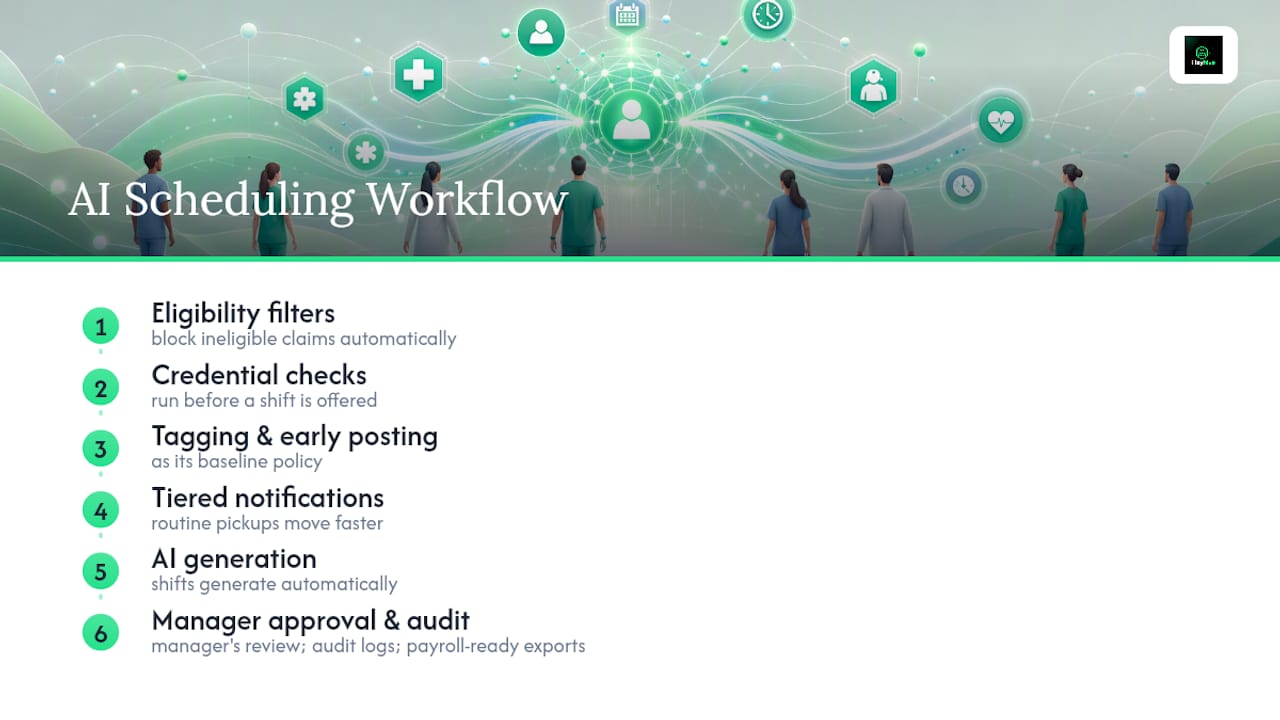
Every policy above needs a system to execute it, and that's where a platform like Heyhive maps features directly to the rules you set. Eligibility filters block ineligible claims automatically. Credential checks run before a shift is offered, not after. Manager approvals sit exactly where you place them, on high-risk shifts, while routine pickups move faster. Audit logs capture the full trail, and payroll-ready exports mean approved shifts flow straight into hours worked.
Picture a med-surg unit that adopts eligibility tagging, early shift posting, and tiered notifications as its baseline policy. Following that structure consistently is what shifts a unit away from last-minute agency calls toward staff covering more of their own gaps.
Managers stay in the loop by design: shifts generate automatically, but nothing publishes without a manager's review. That's the balance between speed and oversight that healthcare scheduling actually needs.
Heyhive was built around that principle, letting AI handle the scheduling grind while managers keep final say on every shift.
Where Can You Learn More About Open Shift Scheduling?
- Five leading practices to streamline your open shift management process: operational tactics for healthcare scheduling teams.
- Inovalon developer documentation: technical detail on credential verification integrations.
What Healthcare Managers Get Wrong About Open Shifts
Most guidance on open shift management treats it as a technology problem: buy software, turn on notifications, done. That's backward. The technology only works as well as the eligibility rules and approval logic a manager sets up before the first shift ever posts.
The conventional advice to "notify everyone eligible as fast as possible" also misses a real tradeoff. Speed without tiering creates a first-come-first-served scramble that rewards whoever's fastest on their phone, not whoever's best suited for the shift. A tiered notification strategy, sending to your most qualified, least-overtime staff first, solves this without slowing anything down.
What should come first isn't the software demo. It's writing down your eligibility rules and approval thresholds on paper, unit by unit, before you evaluate any platform. A tool can enforce discipline you already have. It can't invent discipline you don't.
Fill Shifts Fast Without Losing Manager Control
Heyhive gives healthcare schedulers the speed of automated shift posting without giving up the approval step that keeps clinical staffing safe. Instead of building a week of shifts by hand or chasing coverage gaps over text, Heyhive generates schedules in seconds while respecting certifications, availability, and overtime limits automatically.
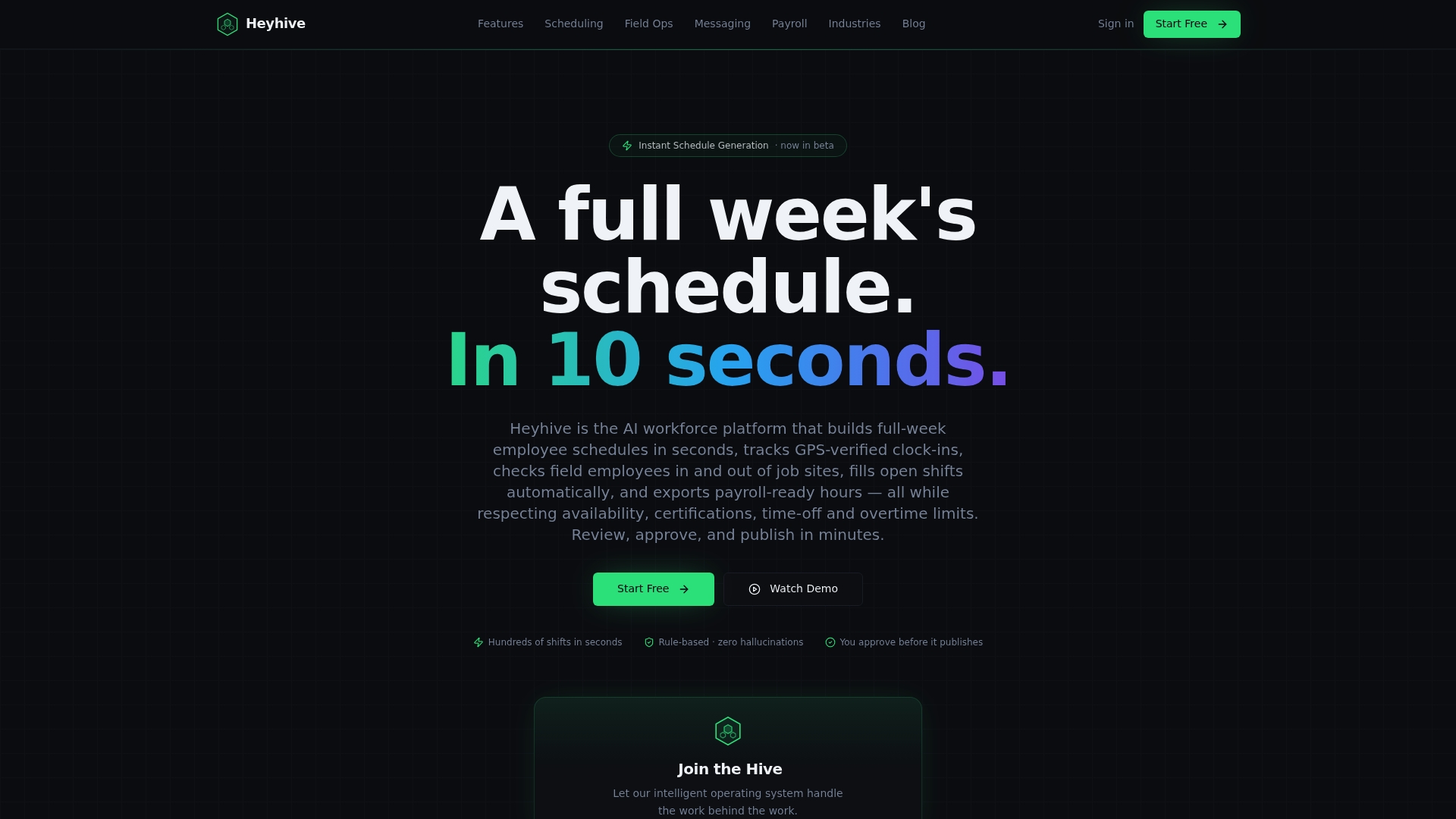
You still approve every shift before it publishes, so nothing goes live without a manager's sign-off. GPS-verified clock-ins keep attendance accurate for mobile and multi-site teams, and payroll-ready exports cut the hours managers spend reconciling time worked against what got scheduled. If your unit is still filling open shifts through phone calls and group texts, see how Heyhive fills coverage gaps and start a free trial to test it on your own schedule this week.
Frequently Asked Questions About Open Shift Management
What is the fastest way to fill an open shift in nursing? Post it into a real-time scheduling system with eligibility filters already applied, then send tiered push notifications to your most qualified, lowest-overtime staff first.
Should managers approve every open shift pickup? Not necessarily. Reserve manual approval for high-risk roles, overtime-triggering shifts, and specialty units. Routine shifts can auto-assign to save time.
How do you prevent favoritism in open shift assignments? Use rotation policies and transparent eligibility criteria so every qualified staff member sees the same shifts at the same time, and keep an audit log of who was notified and when.
What technology features matter most for healthcare open shift management? Credential verification, eligibility filters by role, manager approval workflows, audit trails, and mobile notifications matter most, since they directly address compliance and patient safety.
How is open shift management different from traditional scheduling software? Traditional scheduling assigns every shift manually in advance. Open shift management publishes unfilled shifts to eligible staff and routes pickups through automated or manager-approved rules.
Sources
- Five leading practices to streamline your open shift management process
- Inovalon developer documentation