
Free Excel and Google Sheets templates are the best starting point for building a retail schedule. They cost nothing, customize in minutes, and cover the fields that actually matter: roles, shifts, breaks, and total hours.
Three picks worth grabbing right now: a week-at-a-glance rota for standard staffing, a rotating-shift template for stores open extended hours, and an annual retail scheduling calendar for tracking promotions and holiday coverage. Each comes in multiple file formats suitable for different uses: Excel for formulas and payroll export, Google Sheets for sharing and mobile viewing, and PDF or Word for printing.
Key Takeaways
Free Excel and Google Sheets templates cover most retail scheduling needs, but stable, well-structured schedules directly improve staff retention and sales performance.
| Point | Details |
|---|---|
| Start with free templates | Excel and Google Sheets templates handle roles, hours, and breaks without any cost. |
| Match format to purpose | Use Excel for formulas and payroll export, Sheets for sharing, PDF for printing. |
| Build in overtime flags | Conditional formatting that highlights hours over 40 catches problems before payroll. |
| Add people-first fields | Availability, certifications, and shift notes reduce coverage gaps and turnover. |
| Automate once it scales | Heyhive builds and approves full weeks automatically once spreadsheets become too manual. |
Where to Find More Templates and Research
- Microsoft Excel template hub — free, previewable schedule templates.
- Smartsheet — rotating and multi-length shift templates.
- Template.net — editable daily store schedules.
- Clockify — templates with automatic hour calculations.
Table of Contents
- Free Retail Schedule Template Options and What Each One Does
- How to Customize a Schedule Template in Excel or Sheets
- Building Schedules That Actually Keep Staff Around
- Common Retail Shift Patterns Explained
- Publishing Checklist Before You Send the Schedule Out
- From Spreadsheet to Automated Schedule in One Step
- Frequently Asked Questions
- Sources
Free Retail Schedule Template Options and What Each One Does
Not every template solves the same problem. A weekly rota that works beautifully for a five-person boutique will fall apart trying to manage a 24-hour grocery operation. Here's how the main formats break down.
The weekly rota template is the workhorse. It typically includes columns for employee name, role, start and end time, break window, and total hours worked. Clockify's retail schedule template builds in automatic hour calculations so you're not doing that math by hand every Sunday night. This format is best for single-location stores running consistent weekly patterns.

Rotating and 8/10/12-hour templates exist for stores that need round-the-clock coverage: pharmacies, big-box retail, grocery chains. Smartsheet's shift schedule library includes these longer-shift formats specifically so you can plan continuity across overnight and weekend gaps without gaps in coverage. Because these shifts run longer, build in a visible overtime flag from the start rather than catching it after the pay period closes.
For big-picture planning, a monthly or annual retail calendar works better than a weekly grid. An Excel-based retail scheduling calendar with daily, monthly, and annual views lets you mark promotional periods, holiday blackout dates, and seasonal hiring windows months in advance.
| Format | Best for | Trade-off |
|---|---|---|
| Excel | Formulas, automatic hour totals, payroll export | Requires desktop software |
| Google Sheets | Team sharing, mobile viewing, live edits | Fewer advanced formula options than Excel |
| PDF/Word | Printing, posting on a staffroom board | Not editable once exported |
| CSV | Payroll and time-clock imports | No formatting or visual coverage view |
Quick examples of how this plays out in real stores: a clothing retailer facing a weekend rush uses a weekly rota with extra floor coverage built into Saturday and Sunday blocks. A grocery store bracing for holiday traffic leans on the annual calendar to lock in extra shifts weeks ahead. A single-location boutique with three part-timers just needs the simplest weekly template with roles and hours, no rotation logic required.
If typing everything from a blank grid sounds tedious, an AI-driven schedule generator can produce a color-coded starting draft from a short prompt, which you then adjust and export to PDF. It's a reasonable shortcut, but always double-check the coverage logic before you publish anything a generator hands you.
How to Customize a Schedule Template in Excel or Sheets
Grab any of the templates above and you can have it running your store's week in about twenty minutes. Here's the order that works:
- Add your staff list. One row per employee, with a column for role (cashier, floor, keyholder).
- Set your store hours. Block out open, mid-shift, and close so every shift maps to one of those blocks.
- Assign shifts to the grid. Drag names into time slots, or type them directly if you're keeping it simple.
- Build the hours formula. A basic
=end time - start time - break lengthcalculates worked hours per shift; sum the row for weekly totals. - Flag overtime. A conditional formatting rule that highlights any weekly total over 40 hours catches problems before they hit payroll.
- Add dropdowns. Data validation lists for role and availability keep entries consistent and make the sheet faster to fill out.
- Export or print. Save as CSV for payroll import, or print to PDF for the staffroom wall.
Switching between Excel and Google Sheets is painless. Google Sheets opens .xlsx files directly and preserves most formulas, so you can build in one and hand off in the other without starting over.
Pro Tip: Lock your formula cells before sharing the sheet with assistant managers. Protecting just the hours-calculation and overtime-flag columns stops someone from accidentally deleting a formula mid-week.
Building Schedules That Actually Keep Staff Around
Research from Harvard Business School found that retail stores with more predictable, stable schedules saw measurable gains in both sales and productivity. That's not a soft HR benefit. It shows up on the register.
Translate that into your template with a few concrete fields:
- Availability and preference column — so you're not guessing who can work Saturdays.
- Certifications/skills flag — useful for stores where only certain staff can run the register or handle returns.
- Shift-note field — a quick space for "training shift" or "covering for Maria."
- Peak-hour staffing target — a row showing how many people you need on the floor during your busiest two hours.
Pro Tip: Add one manager-summary row at the bottom of your weekly sheet totaling scheduled staff per shift. A quick glance catches an under-staffed Saturday afternoon before it becomes a problem on the floor.
Common Retail Shift Patterns Explained
Most retail rotations fall into a handful of recognizable patterns, and picking the right one depends more on your staffing size than on tradition.
- 5-2-5-3 — five days on, two off, five on, three off. Gives longer stretches of rest periodically while keeping weekly totals close to full-time.
- 4-3-3-4 — four days on, three off, alternating. Spreads weekend duty more evenly across a larger team.
- Fixed weekly rota — same days every week. Best for small boutiques where predictability matters more than fairness of rotation.
- Rotating pattern — days off shift each week. Better for grocery and big-box stores that need to distribute weekend and holiday coverage fairly across a bigger staff.
If you run a three-person shop, skip the rotation complexity and use a fixed weekly template. If you're managing fifteen people across seven-day coverage, a rotating pattern keeps morale higher because nobody's stuck working every Saturday indefinitely.
Publishing Checklist Before You Send the Schedule Out
Run through this before hitting send on next week's schedule:
- Confirm no one is scheduled past 40 hours without an intentional overtime approval.
- Check that every shift requiring a certification (register lead, keyholder) has a qualified person on it.
- Verify weekend and peak-hour blocks are fully staffed.
- Add a swap log column so last-minute trades get recorded, not just texted between two employees.
- Set one clear approval and contact method for swap requests, whether that's a shared message thread or a simple sign-off from you.
- Before payroll, export to CSV, confirm breaks were deducted correctly, and reconcile totals against your time-clock system.
Why spreadsheets beat software for your first month
Editable templates cost nothing and adapt instantly. Before paying for a platform, use a spreadsheet to test your actual coverage rules and peak-staffing targets. Once you're juggling multiple locations or constant last-minute changes, that's your sign to look at scheduling software built for retail.
From Spreadsheet to Automated Schedule in One Step
Once your template earns its keep, the manual re-entry every week gets old fast. Heyhive is the shortcut past that: instead of rebuilding the grid, filling dropdowns, and manually flagging overtime, an AI-built week factors in availability, certifications, and overtime limits automatically, and you just review and approve before it goes live.
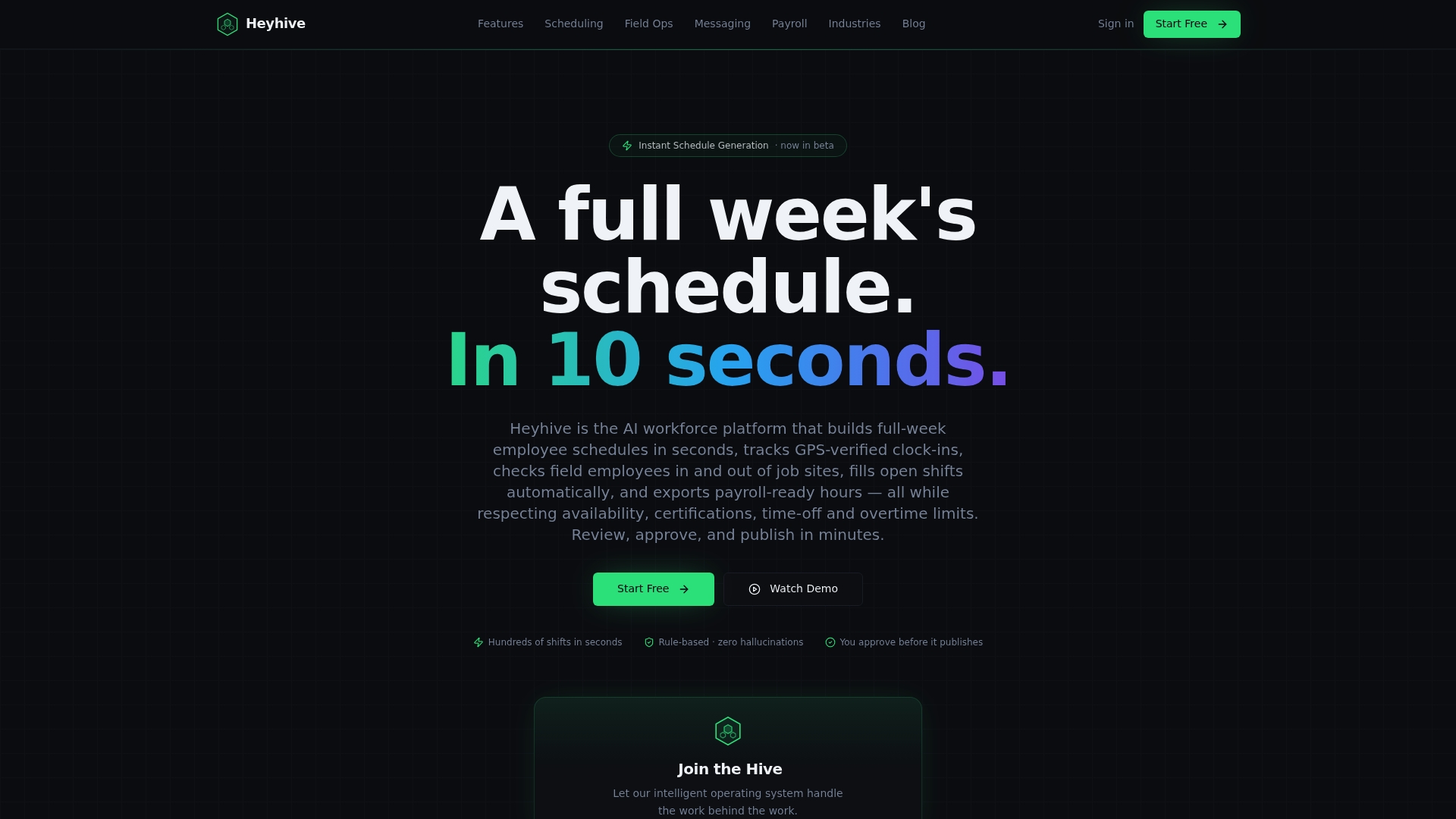
What that looks like in practice:
- AI-built weeks — full schedules generated in seconds instead of built cell by cell.
- Availability and certification-aware assignments — no more manually cross-checking who's qualified for which shift.
- Overtime protection — limits are respected automatically, not caught after the fact.
- Payroll-ready exports — hours flow straight out for processing, no CSV cleanup required.
If your spreadsheet is already telling you what your coverage rules and peak-staffing needs look like, Heyhive takes those same rules and runs them without the manual rebuild every Sunday. Start a free trial and generate your first automated week today.
Frequently Asked Questions
What's the best free retail schedule template? A weekly Excel or Google Sheets template with employee, role, shift time, and break columns covers most single-location retail needs. Add an overtime-flag formula and you've got a functional system with zero cost.
Can I use a retail schedule template without Excel? Yes. Google Sheets opens Excel files directly and works well for teams that need to share and edit from multiple devices. Free alternatives like LibreOffice Calc also support the same spreadsheet functions for offline editing.
How do I calculate overtime in a schedule template? Sum each employee's weekly hours in a total column, then apply conditional formatting to highlight any total over 40 hours. That visual flag catches overtime before the schedule goes out, not after payroll runs.
What shift pattern works best for a small retail store? A fixed weekly rota usually works best for stores with three to six employees, since predictability matters more than rotating fairness at that size. Larger teams needing seven-day coverage tend to do better with a rotating pattern like 4-3-3-4.
When should I move from a template to scheduling software? Once you're managing multiple locations, complex certification requirements, or frequent last-minute changes, a spreadsheet starts costing more time than it saves. That's the point where AI scheduling tools start paying for themselves.
Sources
- Research: When Retail Workers Have Stable Schedules, Sales and Productivity Go Up — Harvard Business Review
- Free customizable schedule templates — Microsoft Excel templates
- Free Shift Schedule Templates — Smartsheet
- Free Work Schedule Templates (Excel, Google Sheets & PDF) — Clockify