
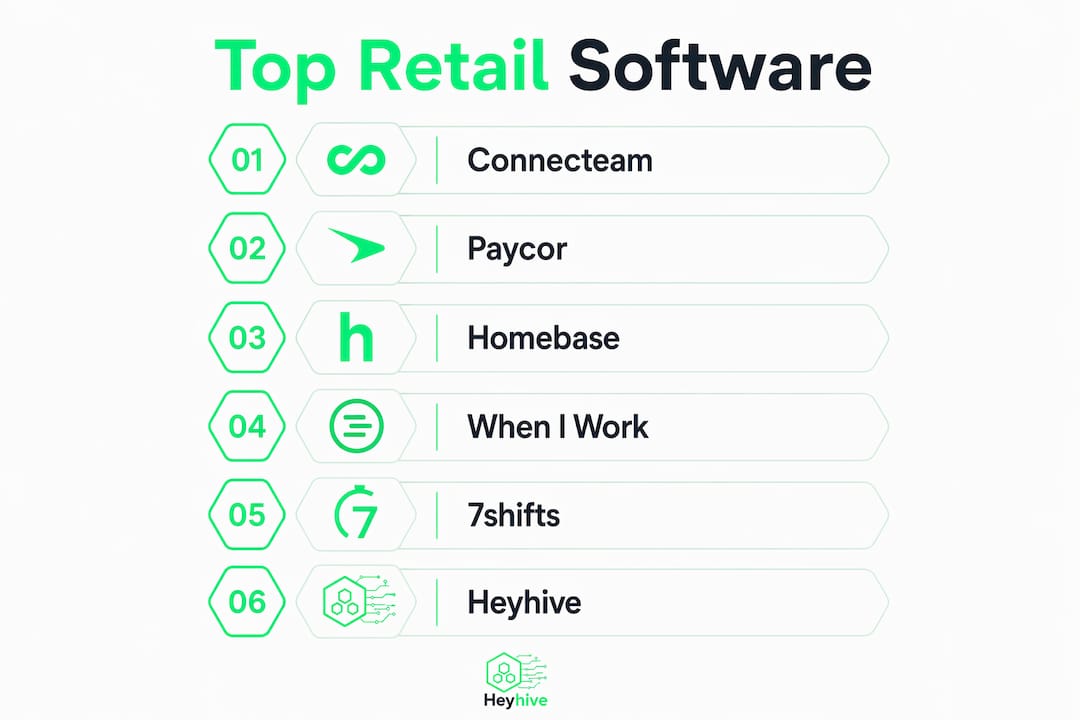
Retail managers who need a fast answer: Connecteam leads for full-featured mobile teams, Homebase is the top pick for small businesses starting free, When I Work wins for GPS-based shift tracking, Paycor suits mid-to-large operations needing integrated HR, 7shifts serves food service retail, and Shiftboard handles complex enterprise shift patterns. Here is the full breakdown.
- Connecteam — All-in-one scheduling, time tracking, communication, and training. Capterra 4.7 stars with 1,500+ reviews. Free plan for small teams.
- Homebase — Simple scheduling, payroll, and hiring for hourly teams. Free plan available with no credit card required.
- When I Work — Mobile-first with GPS clock-ins and geofencing for shift-based retail.
- Paycor — Full HR, payroll, compliance, and workforce management. 4.5 stars on Capterra with 2,065 reviews.
- 7shifts — Built for restaurant and food service retail. Free plan, no credit card required.
- Shiftboard — Automation and labor demand planning for complex shift operations.
What is the best retail scheduling software in 2026?
Six platforms consistently stand out when retail managers compare scheduling tools on features, pricing, and real-world fit. Each one targets a different slice of the retail workforce.
| Software | Best For | Core Features | Free Plan | Rating (App Store/Capterra) |
|---|---|---|---|---|
| Connecteam | Deskless and mobile retail teams | Scheduling, time tracking, messaging, training, HR | Yes (small teams) | Capterra 4.7 stars (1,500+ reviews); App Store 4.8 stars (41,000+ reviews); Google Play 4.7 stars (14,000+ reviews) |
| Paycor | Mid-to-large retail with HR needs | Payroll, compliance, talent acquisition, scheduling | No | Capterra 4.5 stars (2,065 reviews); G2 4.5 stars (532 reviews) |
| Homebase | Small retail and hourly teams | Scheduling, time clock, payroll, hiring | Yes | Free plan; strong small business ratings |
| When I Work | Shift-based and field retail | GPS clock-ins, geofencing, team messaging | No | Mobile-first; field workforce focus |
| 7shifts | Food service and restaurant retail | Hiring, training, scheduling, payroll, retention | Yes (no card) | Free plan for restaurants; food service specialization |
| Shiftboard | Complex, high-volume shift operations | Automation, labor demand planning, coverage tools | No | Enterprise scheduling expertise |
Connecteam is the most versatile option for retail teams that work away from a desk. It covers scheduling, time tracking, internal messaging, digital checklists, and employee training inside one app. The platform's retail workforce tools are built specifically for industries like retail, food and beverage, and field services, which means you are not adapting a generic HR tool to fit your floor.
Paycor takes a different approach. It is a full human capital management (HCM) suite, so scheduling is one module inside a larger system that also handles payroll processing, benefits administration, talent sourcing, and regulatory compliance. Retail businesses with 50 or more employees who need everything under one roof will find it worth the investment.
Homebase keeps things simple. You can post a schedule, track hours, run payroll, and post a job listing without ever leaving the app. The free tier covers one location with unlimited employees, which makes it the most accessible starting point for a single-store owner.
When I Work focuses tightly on shift management and attendance. GPS clock-ins and geofencing prevent buddy punching and confirm that employees are actually on-site before clocking in. For retailers with multiple locations or a mix of in-store and delivery staff, that verification layer matters.
7shifts is purpose-built for food service, so its scheduling logic accounts for prep shifts, closing duties, and tip pooling in ways that generic tools do not. If you run a bakery, café, or quick-service restaurant, the free plan gets you scheduling, shift feedback, and basic reporting at no cost.
Shiftboard targets operations where scheduling errors carry real consequences: manufacturing floors, corrections facilities, and large retail distribution centers. Its labor demand planning engine builds schedules from forecasted workload rather than last week's template, which is the right approach when staffing needs shift daily.
Unique selling points at a glance:
- Connecteam: built-in training courses and a knowledge base alongside scheduling
- Paycor: automated talent sourcing and career planning integrated with workforce management
- Homebase: the most complete free tier for a single retail location
- When I Work: geofencing that locks clock-ins to a physical radius around the store
- 7shifts: employee retention tools including engagement surveys and performance tracking
- Shiftboard: self-service shift swapping and coverage optimization for large, complex rosters
How to choose the right retail scheduling software for your business
The right tool depends on your team size, how your shifts are structured, and what you need beyond a basic calendar.
Key evaluation criteria:
- Scalability: Can the software grow from one location to ten without a platform change?
- Mobile access: Do your employees need to view and swap shifts from their phones? Most hourly retail workers do.
- Integrations: Does it connect to your POS system, payroll provider, or HR platform?
- Pricing model: Is there a free tier, a per-user fee, or a flat monthly rate? Per-user pricing scales up fast for large teams.
- Ease of use: A tool your staff will not adopt is a tool that will not work. Look for an app store rating above 4.0 and a short onboarding timeline.
Common retail use cases that shape the decision:
- Single-store with hourly staff: Homebase or Connecteam free tier
- Multi-location chain with field workers: When I Work or Connecteam paid plans
- Food service or café: 7shifts
- Mid-market retail with payroll and compliance needs: Paycor
- Large distribution or warehouse retail: Shiftboard
Questions to ask vendors before you buy:
- How long does onboarding take, and is there a dedicated implementation contact?
- Does the mobile app work offline for employees in low-signal areas?
- Can managers approve schedule changes before they go live?
- How does the system handle overtime alerts and labor law compliance?
- What does the contract look like? Month-to-month or annual commitment?
Red flags to watch for: vendors who cannot give you a clear onboarding timeline, platforms that charge per-location fees on top of per-user fees, and any tool that does not offer a live demo or free trial before purchase.
Most platforms take 1–2 weeks to implement for a small team. Larger operations with payroll integrations can take 4–6 weeks. Budget time for data migration, manager training, and a parallel-run period before going fully live.
Pro Tip: The biggest adoption hurdle is not the software. It is getting your team to stop using text messages and group chats for shift swaps. Pick one platform and make it the single source of truth for all scheduling communication. When availability, swap requests, and schedule updates all live in one place, the "I told you I couldn't work Tuesday" problem disappears.
Why AI-powered scheduling gives retail managers a real edge
AI scheduling is not just faster than building a spreadsheet. It produces better schedules by matching staffing levels to actual customer demand rather than repeating last week's pattern.

Published case studies across retail and QSR chains show that AI scheduling reduces labor costs by 8–12% and staff hour usage by up to 11%, while maintaining or improving service levels. The ROI typically covers the platform cost within the first quarter.
What Heyhive's AI scheduling does differently:
- Generates a full week of shifts in seconds, respecting each employee's availability, certifications, and overtime limits
- Flags coverage gaps and fills open shifts automatically before they become a problem
- Keeps managers in control: you review and approve every schedule before it publishes
- Tracks attendance with GPS-verified clock-ins so payroll hours are accurate from the start
- Exports payroll-ready hours directly, cutting the manual reconciliation step
The manager approval step is what separates Heyhive from fully automated tools. AI builds the schedule; you confirm it. That combination of speed and oversight is particularly valuable for retail managers who need to move fast but cannot afford a coverage error on a Saturday.
Retail's core scheduling challenge is that customer traffic is unpredictable. A tool that schedules from historical templates will consistently understaff peak periods and overstaff slow ones. Heyhive's labor forecasting connects staffing decisions to real demand signals, which is how you stop leaving money on the floor during a busy afternoon.
Heyhive builds your retail schedule in seconds, not hours
The tools compared above are all solid options for retail workforce management. If you want a platform that goes further by using AI to generate, fill, and verify schedules automatically, Heyhive offers a different path.
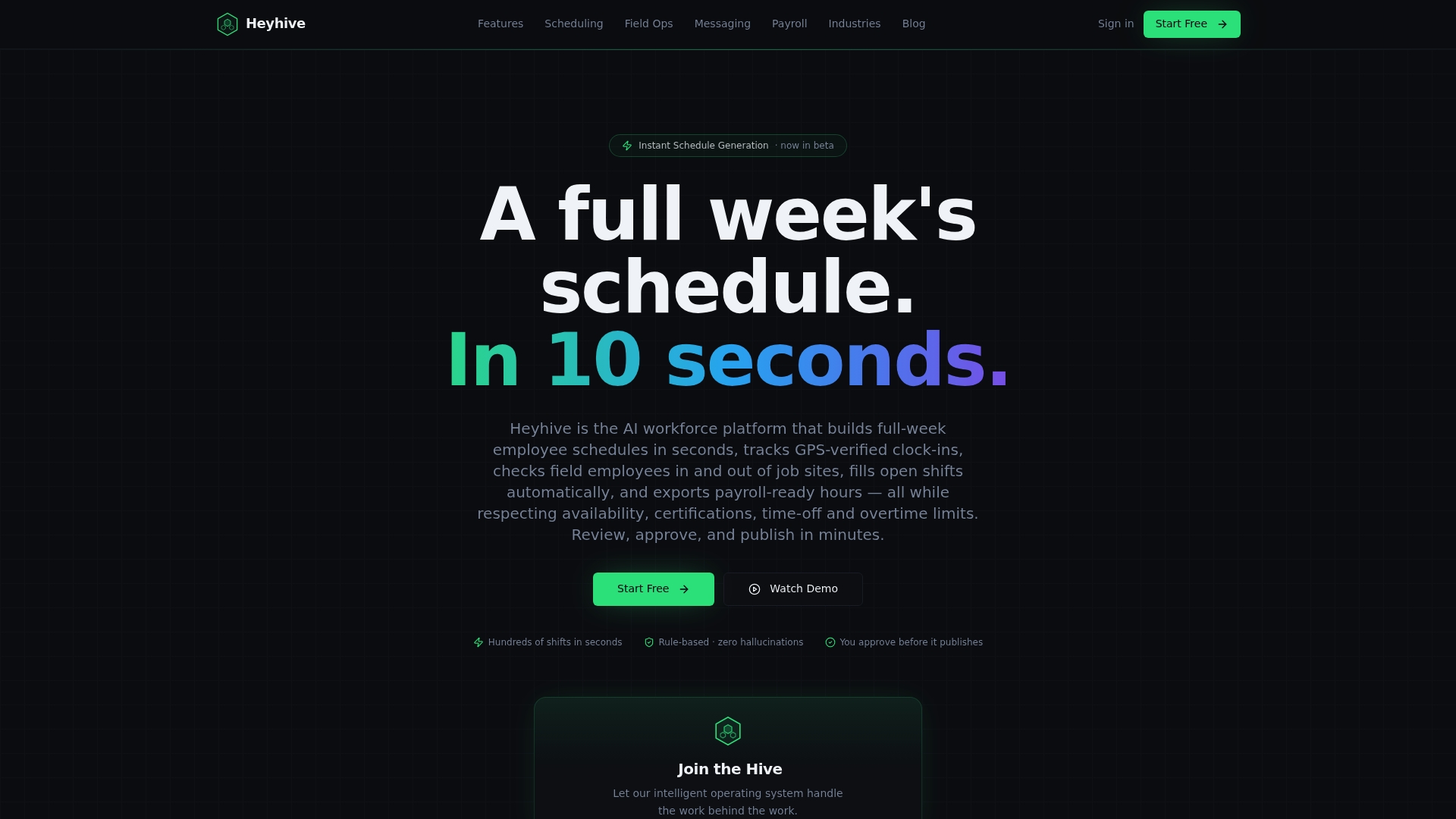
Heyhive is built for retail managers who spend too much time on scheduling and not enough time on the floor. The AI generates your full week of shifts in seconds, respects every employee's availability and overtime cap, and holds the schedule for your approval before anyone sees it. Open shifts get filled fast. Payroll hours export clean. GPS clock-ins confirm your team is where they need to be.
You stay in control. Heyhive handles the work behind the work. See how it works and get your first schedule built today.
Key Takeaways
The best retail scheduling software matches your team size, shift complexity, and budget — and AI-powered tools like Heyhive can reduce labor costs by 8–12% by aligning staffing to real customer demand.
| Point | Details |
|---|---|
| Top pick for most retail teams | Connecteam covers scheduling, time tracking, messaging, and training in one mobile app. |
| Best free starting point | Homebase offers a free plan for one location with unlimited employees and no credit card required. |
| AI scheduling cuts labor costs | AI-optimized schedules reduce retail labor costs by 8–12% and staff hours by up to 11%. |
| Adoption requires a single platform | Moving all shift communication to one app eliminates the scheduling errors that text chains create. |
| Heyhive for AI-first scheduling | Heyhive generates full-week schedules in seconds with manager approval before publication. |