
The fastest way to avoid unnecessary overtime is to combine demand-aligned scheduling with automated enforcement and real-time visibility, so overtime risk shows up before a shift is published, not after payroll runs. Supporting levers include clear overtime policies, automated coverage for open shifts, earlier published schedules, and a wider cross-trained staff pool. Some platforms build these capabilities directly into the scheduling process, which is why more operators are treating overtime as a system to design rather than a cost to absorb, illustrating the key benefits of online scheduling in boosting operational efficiency.
TL;DR:
- Publishing schedules at least seven days in advance and setting automated overtime alerts significantly reduce last-minute schedule changes and unplanned overtime.
- Demand forecasting based on historical data and staggered shift start times help prevent last-minute gaps that lead to overtime.
- Enforcing specific, role-based overtime thresholds within scheduling tools and automatically flagging violations minimize policy breaches and payroll errors.
- Weekly tracking of overtime hours, open-shift fill times, and weekly labor costs enables early detection of overtime drift, facilitating prompt corrective actions.
- Implementing AI-driven scheduling platforms like Heyhive can proactively identify overtime risks, route open shifts efficiently, and cut overtime costs through automation.
Table of Contents
- Quick Wins to Avoid Overtime Scheduling This Week
- How Automation and Real-Time Tracking Prevent Overtime
- Building Overtime Policies That Actually Get Enforced
- Scheduling Tactics That Reduce Reactive Overtime
- Tracking the Metrics That Catch Overtime Drift Early
- Why Overtime Is a Systems Problem, Not a Staffing Failure
- Try Heyhive's AI Scheduling Before Overtime Becomes a Habit
- Sources
Quick Wins to Avoid Overtime Scheduling This Week
You don't need a new system to cut overtime this week. You need better timing and tighter thresholds on the one you already have.
Start with these five moves:
- Publish schedules earlier and enforce a minimum notice window, ideally seven days out, so employees can plan around their shifts instead of scrambling near the deadline.
- Turn on real-time overtime alerts and require manager approval for any hours that push a worker past your weekly threshold.
- Push open shifts to eligible workers automatically before defaulting to overtime, filtering by certification and availability so you're not guessing who can legally cover the gap.
- Cap voluntary overtime temporarily and add a request-and-approval log, even a simple one, so extra hours stop being a default and start being a decision.
- Build shift templates by role so last-minute scheduling doesn't accidentally assign a task to the only certified person left, forcing overtime by default.
Replacing reactive, last-minute scheduling with structured coverage workflows measurably cuts emergency overtime and improves retention, largely because employees stop absorbing the gaps managers didn't see coming.
Pro Tip: Run your open-shift notice before you approve any overtime request, not after. Most managers do it backward: they approve the overtime, then post the shift as a formality.
How Automation and Real-Time Tracking Prevent Overtime
Overtime rarely happens because a business is understaffed. It happens because nobody saw the hours accumulating until the pay period closed. Root causes usually trace back to visibility and policy gaps, not a genuine lack of available labor. Fix the visibility problem and the overtime problem shrinks with it.
Demand forecasting is where that fix starts. Instead of building next week's schedule off habit or gut feel, forecast-driven scheduling matches shift counts to expected order volume, foot traffic, or job load, which closes the last-minute coverage gaps that usually get patched with overtime.
From there, enforcement has to be automatic, not a manager's memory. That means:
- Eligibility checks that block a shift assignment before it triggers overtime, rather than flagging it after the fact.
- Real-time labor cost previews on the schedule builder itself, so a manager sees the dollar impact of a shift swap before publishing it, not after the pay run.
- Open-shift workflows with eligibility filters that route coverage to available, qualified staff instead of defaulting to whoever already worked 38 hours this week.
- GPS-verified clock-ins tied directly to payroll export, which closes the gap between scheduled hours and actual hours worked.
Here's the number that makes this concrete: overtime tends to look invisible right up until payroll, then it looks like a five-figure line item nobody planned for. Real-time cost previews close that blind spot by putting the dollar figure on the schedule screen, not the invoice.
Heyhive builds each of these into one workflow. Its AI generates draft schedules that respect availability and certification limits, flags overtime risk before you hit publish, and routes open shifts to eligible workers automatically. Managers still approve every shift, which keeps a human check on the automation without slowing the process down. Meanwhile, GPS-verified time tracking and payroll-ready exports mean fewer disputed timecards and fewer after-the-fact corrections that quietly turn into extra pay.
Building Overtime Policies That Actually Get Enforced
A policy that lives in an employee handbook does nothing. A policy embedded in the tool that builds your schedule enforces itself.
Start with thresholds that are specific, not vague:
- Set daily limits (commonly 8 hours before overtime kicks in for hourly staff, depending on your state).
- Set weekly limits (typically 40 hours under federal rules, though several states apply daily overtime rules too).
- Set role-based exceptions where certain positions carry different thresholds due to union agreements or state-specific rules.
- Require a documented reason any time a manager approves hours past the threshold.
The enforcement piece matters more than the policy language. If your scheduling software lets a manager publish a shift that blows through the weekly cap without so much as a warning, the policy is decorative. Automated validation rules that flag overtime thresholds before publishing close that gap and reduce the compliance risk that comes with it.
That same system should generate your audit trail automatically. Every published schedule, every approval, every punch, and every exception needs to be logged and exportable, because payroll disputes and labor audits both hinge on documentation you can produce in minutes, not hours of digging through spreadsheets.
Pro Tip: If two managers at the same company enforce overtime differently, the rule isn't the problem. The lack of automated enforcement is. Fix the system, not the manager.
Scheduling Tactics That Reduce Reactive Overtime
Sustainable overtime reduction comes from how you build the schedule in the first place, not from catching problems after they start.
- Forecast demand using your own history. Pull last year's sales data, seasonal patterns, and known upcoming events to size shifts accurately instead of scheduling on instinct.
- Build templates with float roles baked in. A template that includes one flexible, cross-trained position absorbs demand spikes without anyone working a double.
- Publish earlier and require acknowledgment. Predictable rostering reduces absenteeism, and fewer no-shows means fewer emergency overtime assignments to fill the gap.
- Cross-train aggressively and track certifications. Widening your eligible-coverage pool means one sick call doesn't automatically fall on your three most experienced (and most expensive) employees.
- Stagger shift start times. Instead of scheduling everyone for the same block and hoping nobody calls out, stagger coverage so a gap in one shift doesn't cascade into the next.
None of these tactics require new headcount. They require better use of the staff you already have.
Tracking the Metrics That Catch Overtime Drift Early
Overtime rarely spikes overnight. It creeps, one unnoticed extra shift at a time, until a quarterly payroll review reveals a number nobody expected.
Watch these figures weekly, not quarterly:
| Metric | What It Tells You |
|---|---|
| Scheduled vs. actual hours | Whether your forecasting is accurate or consistently under-scheduling |
| Overtime hours per role | Which positions are absorbing the most extra hours |
| Open-shift fill time | Whether slow coverage is forcing last-minute overtime assignments |
| Overtime dollars per week | The real cost trend, tracked before it becomes a payroll surprise |
Set a threshold for each metric and review it every week, not once a quarter. When one number moves, run a root-cause check immediately, since audit-ready reporting makes it easy to spot whether the problem is one shift, one manager, or one location. Once you have a baseline, test one change at a time (a new publish deadline, a stricter approval gate) and compare the labor-cost delta week over week before rolling it out everywhere.
Why Overtime Is a Systems Problem, Not a Staffing Failure
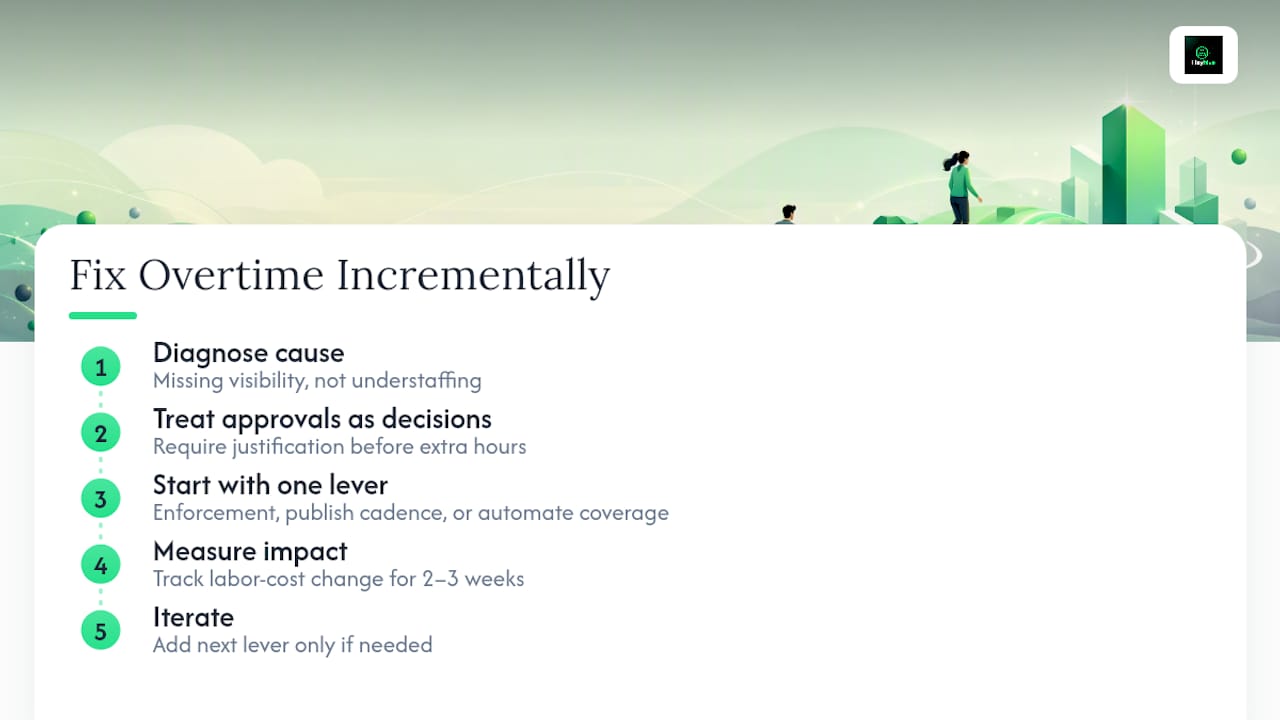
Most operators treat overtime like a symptom of understaffing. It's usually a symptom of missing visibility. When nobody can see hours accumulating in real time, and nobody has to justify approving extra ones, overtime doesn't stay occasional. It becomes structural, baked into how the business runs without anyone deciding it should.
The fix isn't more staff. It's pairing automation with policy discipline: rules that enforce themselves, schedules built from actual demand data, and managers trained to treat an overtime approval as a decision, not a formality. Start with one lever. Turn on enforcement, or fix your publish cadence, or automate open-shift coverage. Measure the labor-cost change for two or three weeks before adding the next one. Overtime reduction that sticks is built incrementally, not fixed in a single policy memo.
— Heyhive
Try Heyhive's AI Scheduling Before Overtime Becomes a Habit
If your team is still building schedules in a spreadsheet and catching overtime after payroll runs, you're solving the problem at the wrong end. Certain AI scheduling platforms build the levers described here directly into the schedule: AI-generated shifts that respect availability and certification limits, automated compliance gates that flag overtime before publishing, and open-shift workflows that route coverage to eligible staff quickly.
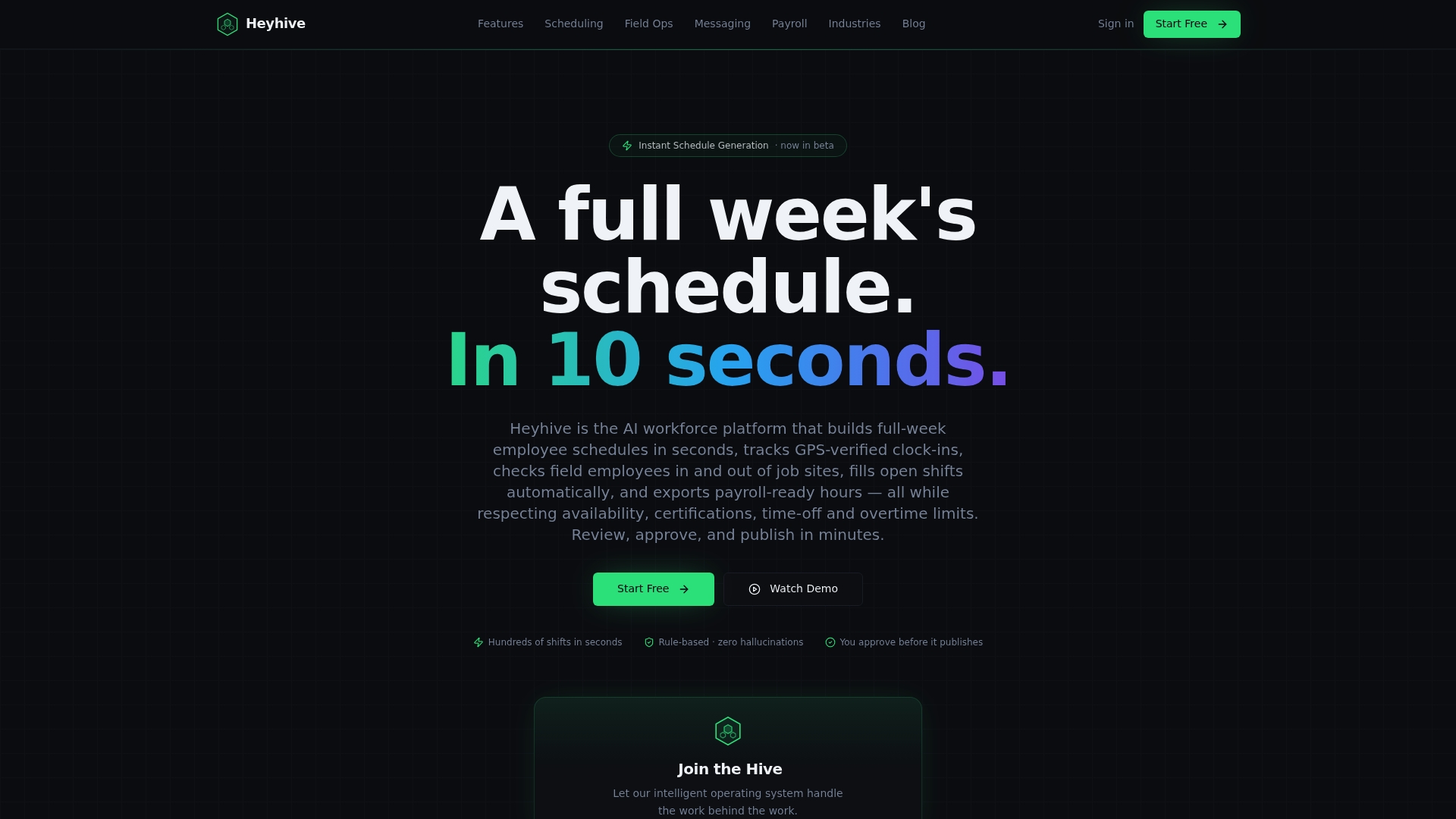
Managers typically approve every shift before it goes live, providing automation without losing control of the final call. GPS-verified clock-ins and payroll-ready exports close the loop on the other end, helping to reduce timecard disputes that can increase unplanned overtime pay. For a related deep dive on filling gaps without defaulting to extra hours, see how to fill open shifts faster.
The easiest way to see the impact is to run a 30-day pilot on a single location. Track your overtime dollars before and after, then decide. You can start that pilot today at Useheyhive.
Sources
- How to Manage Overtime in the Workplace | 2026 Playbook
- Workforce Scheduling Compliance: A Practical Checklist for SMBs (2026)