
A schedule change policy is the written rulebook that governs how employees request, approve, and document shift swaps, cancellations, and last-minute coverage changes. The one rule you can't bend: under the FLSA, overtime pay is mandatory once a nonexempt employee crosses 40 hours in a workweek, no matter what your policy says. Get eligibility, notice windows, and approval authority locked down first, then let tools like Heyhive handle enforcement.
TL;DR:
- Automated systems can prevent overtime violations by calculating weekly hours and blocking swaps that would push employees over 40 hours in a workweek.
- Managers should verify the substitute's certifications and ensure approval occurs within a set timeframe before schedule changes go live.
- Clear documentation of all swap requests and decisions must be retained for at least three years to support dispute resolution.
- Policies should specify eligibility, notice periods, approval authority, and limits on the number of swaps to reduce favoritism and payroll errors.
- Operational enforcement of overtime rules is essential, as written policies alone cannot prevent employees from working more than 40 hours in a week.
Table of Contents
- What should a schedule change policy include?
- How does the FLSA affect schedule changes?
- Processing requests: a step-by-step workflow for requests, swaps, and last-minute changes
- Which tools actually enforce a schedule change policy?
- Sample policy language and short templates to copy
- Implementation checklist and communication plan
- Manager perspective: what actually goes wrong with these policies
- Put your schedule change policy on autopilot
- Sources
What should a schedule change policy include?
A written policy only works if it answers the questions employees and managers actually ask before a swap happens. Vague verbal rules invite disputes, and a documented process for eligibility, approval, and notice periods cuts down on both scheduling conflicts and the sense that certain employees get special treatment.
Build your policy around these components:
- Eligibility: Spell out who can request a change. Many employers restrict swap privileges during a 30 to 90 day probationary period.
- Notice and response timelines: Require requests in advance for routine changes, with a separate, faster track for emergencies.
- Trading partner rules: Swaps only count if the substitute holds the same certifications, licenses, or skill level as the original employee.
- Approval authority: Name who signs off (usually a direct supervisor) and where an appeal goes if that manager is unavailable.
- Consequences and limits: Cap the number of swaps per month and define what happens after repeated late requests or no-shows.
- Documentation and retention: Log every request, approval, and denial, and keep those records for at least the period your state's labor law requires.
Skip any one of these and you're left improvising decisions on the fly, which is exactly how favoritism claims and payroll errors start.
How does the FLSA affect schedule changes?
Overtime math doesn't care about intentions. The FLSA requires nonexempt employees be paid time and a half for every hour worked past 40 in a single workweek, and that obligation cannot be waived by an internal policy, a signed acknowledgment form, or a manager's verbal promise.
A workweek is a fixed, recurring 168-hour block, and hours can't be averaged across two weeks to dodge overtime. Approve a swap that pushes someone from 38 hours to 44 in that single defined week, and you owe overtime for those four extra hours, even if the same employee worked only 30 hours the following week.
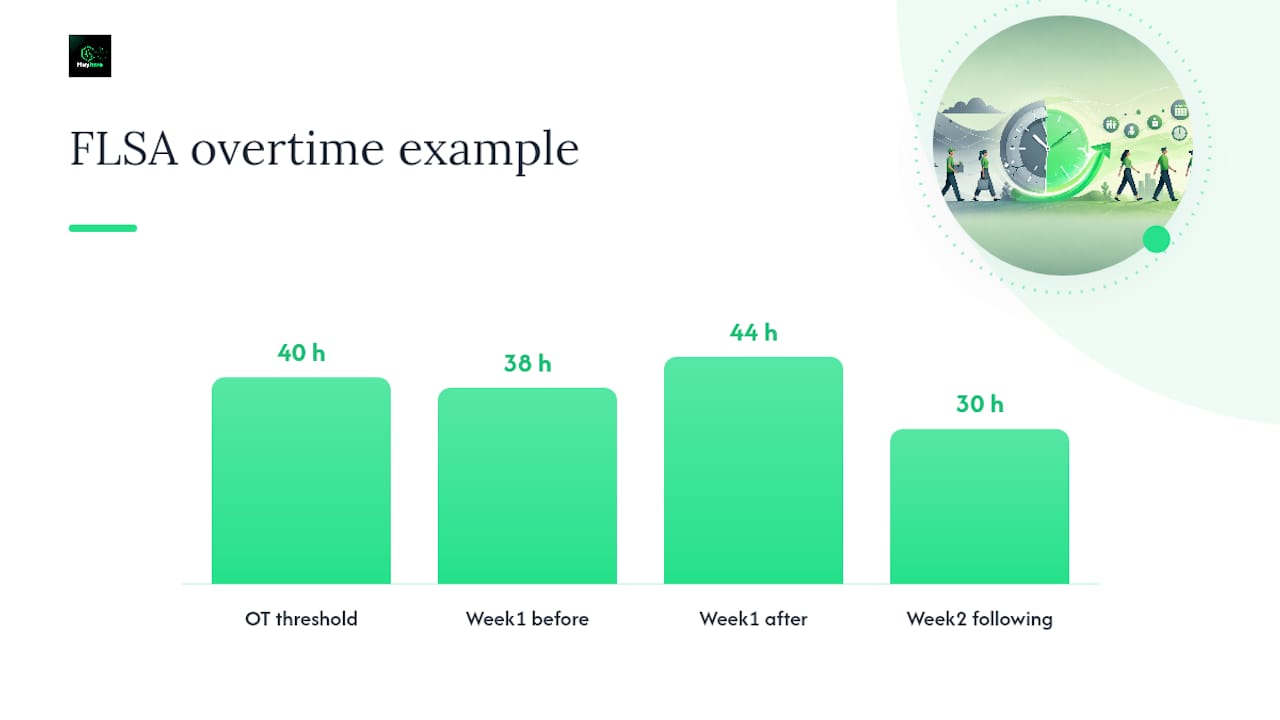
Writing "overtime is not permitted" into your handbook does nothing to stop it from accruing once the hours are worked. Real prevention is operational: check projected weekly totals before approving any swap, not after the pay period closes.
Processing requests: a step-by-step workflow for requests, swaps, and last-minute changes
Consistency is what makes a policy defensible. A repeatable process for how you handle every swap request also builds the audit trail you'll want if a dispute ever lands on your desk.
- Require a standardized request: shift date, time, reason, and confirmed substitute name.
- Verify the substitute's certifications match what the role requires before anything moves forward.
- Run an overtime check against the substitute's current weekly hours, plus a rest-interval check if your state mandates one.
- Route for manager approval within a set SLA, commonly same-day or within 24 hours for standard requests.
- Update the published schedule and notify both employees involved.
- Archive the request, approval, and any denial reason in a searchable log.
- Flag emergencies for expedited review, with a shorter approval window and a note explaining why normal notice didn't apply.
Miss step three and you've got a compliant-looking process that quietly generates unpaid overtime liability.
Which tools actually enforce a schedule change policy?
Written rules only hold up if something stops a bad swap before it's published, not after. This is where scheduling technology earns its keep.
- Approvals-before-publication: No swap goes live until a manager signs off, and the system can auto-block a trade that would push someone into overtime territory.
- Automated overtime and rest-interval checks: The platform calculates weekly totals in real time, flagging conflicts before they become payroll problems.
- GPS-verified clock-ins: Location-tagged time stamps create an audit trail that reconciles what was scheduled against what was actually worked.
- Manager alerts and reporting: Dashboards surface overtime trends and repeat swap requests so you catch patterns before they become habits.
Heyhive builds these checks directly into its scheduling workflow, which means the overtime math happens automatically instead of living in a manager's head.
Pro Tip: Run a test swap that deliberately creates an overtime conflict before you launch any new policy. If your system doesn't catch it and alert a manager, you'll find out the hard way during an actual payroll cycle.
Sample policy language and short templates to copy
You don't need a lawyer to draft the basics, though a quick legal review before publishing never hurts. Start with language your team can actually read.
- Swap request template: "I, [employee name], request to swap my shift on [date] with [substitute name], who holds [certification/skill level]. Reason: [brief explanation]. Submitted: [timestamp]."
- Manager approval language: "Requests submitted more than 24 hours in advance will receive a decision within one business day. Requests submitted with less notice will be reviewed on a case-by-case basis."
- Emergency exception clause: "Emergency swap requests (illness, family crisis) may bypass the standard notice window but must be logged with a reason and approved verbally, followed by written confirmation within 24 hours."
- Repeated-violation clause: "Employees with three or more late or unapproved swap requests in a rolling 90-day period will meet with their manager to review scheduling expectations."
- Recordkeeping statement: "All swap requests, approvals, and denials will be retained for a minimum of three years in accordance with federal recordkeeping standards."
Paste, adjust to your state's specific notice requirements, and you have a working draft.
Implementation checklist and communication plan
A policy that lands without warning breeds resentment, even a fair one. Roll it out in stages instead of dropping it in an email nobody reads.
- Pre-launch review: Have legal or HR confirm the policy matches state-specific notice laws, run a system test simulating common swap scenarios, and train managers on approval authority.
- Launch communication: Announce the policy in a team meeting, distribute written copies, and hold a Q&A session so employees can ask questions before enforcement begins.
- Feedback window: Collect input at 30, 60, and 90 days to catch friction points early.
- Ongoing audits: Review overtime reports monthly and spot-check approval logs for consistency across managers and shifts.
Manager perspective: what actually goes wrong with these policies
The biggest mistake we see isn't a missing policy. It's a policy that bans overtime in writing while doing nothing to stop it operationally. A sentence in a handbook doesn't check anyone's weekly hours before a swap gets approved. The second most common failure is inconsistent approvals, where one manager waves through a same-day request and another denies it, which reads as favoritism even when it isn't. Fix both with automated overtime checks, a documented reason for every decision, and a monthly audit that catches drift before it becomes a pattern.
— Heyhive
Put your schedule change policy on autopilot
Heyhive turns your written rules into automatic enforcement instead of a document nobody rereads. Manager approval stays required before any swap publishes, the platform auto-checks projected hours so an overtime-triggering trade gets flagged instead of quietly approved, and GPS-verified clock-ins create the audit trail you need if a dispute ever comes up.
You still make the final call on every shift. Heyhive just makes sure the math is done before you click approve, not after payroll closes. If you're tired of chasing down swap requests over text messages and hoping nobody quietly crossed 40 hours, start a free trial with Heyhive and watch your next week of schedules build itself in seconds, with your approval built into every step.
Sources
- Fact Sheet #23: Overtime Pay Requirements of the FLSA | U.S. Department of Labor
- Non-Desk Employee Shift Change Best Practices | Yourco