
Employee schedule visibility means employees and managers can see, in real time, who's working, when, and where, based on rules the manager controls. Get this right, and you fill open shifts faster, cut unplanned overtime, and stop employees from guessing about their own hours. This guide walks through:
- Why schedule visibility matters for coverage, fairness, and retention
- The exact settings that control who sees what (publish status, visibility periods, role settings)
- Manager policies to set around visibility windows and privacy
- A step-by-step rollout plan, from audit to pilot to scale
- The metrics that prove visibility improvements are working
- How Heyhive automates these controls without giving up manager approval
You already know scheduling chaos when you see it: last-minute call-outs, three group texts asking "who's covering Saturday," a spreadsheet nobody updated since Tuesday. Visibility is the fix, and it starts with understanding exactly which levers you control.
Key Takeaways
Employee schedule visibility depends on publish status, visibility periods, and role settings, and improving it directly reduces overtime, no-shows, and manager admin time.
| Point | Details |
|---|---|
| Publish status is the master switch | No employee sees a shift until a manager publishes it, making publish actions your top visibility control point. |
| Set a fixed visibility window | A two to three week visibility period gives employees planning time without locking in shifts too early. |
| Audit assignments before rolling out | Location and department mismatches cause invisible shifts more often than any software bug. |
| Expect more requests, not fewer | Better visibility raises shift-swap and change-request volume; plan your approval workflow accordingly. |
| Heyhive automates the workflow | Heyhive drafts AI-generated schedules respecting availability and overtime limits, then requires manager approval before anything publishes. |
Table of Contents
- Why Employee Schedule Visibility Matters for Managers
- What Settings Control Who Sees a Schedule?
- Manager Controls and Policy Decisions That Shape Visibility
- How Do You Roll Out Better Schedule Visibility?
- Which Metrics Prove Schedule Visibility Is Working?
- How Heyhive Automates These Visibility Controls
- Where Vendor Advice Gets Visibility Wrong
- See How Heyhive Puts These Controls to Work
- Vendor Documentation and Practical Resources
- Sources
Why Employee Schedule Visibility Matters for Managers
Poor visibility isn't a minor inconvenience. It's the reason you're scrambling to cover a shift two hours before it starts, and the reason your best employee is quietly job-hunting because they feel like the schedule plays favorites.
Start with coverage. When schedules stay hidden in drafts, buried in unpublished tabs, or scattered across texts and paper printouts, gaps don't surface until someone doesn't show up. Managers then patch holes with reactive overtime, which is expensive and unsustainable. Dayforce's scheduling documentation points out that integrated scheduling with real-time labor analytics helps managers match staffing to demand before gaps happen, not after.
Fairness is the second piece, and it's the one managers underestimate most. When everyone can see the full schedule, including who requested time off, who's been picking up extra shifts, and who hasn't worked a weekend in a month, favoritism gets a lot harder to hide. Employees notice patterns. Transparent scheduling removes the ambiguity that breeds resentment.
Then there's speed. Chasing down availability by phone or text for every open shift eats hours out of a manager's week. Real-time visibility flips that: employees see open shifts and claim them themselves, often within minutes of publication.
Visibility drives three measurable outcomes:
- Fewer staffing gaps. Open shifts get noticed and claimed before they become emergencies.
- Lower unplanned overtime. Managers catch coverage issues in advance instead of paying premium rates to plug last-minute holes.
- Faster shift fill. Employees with mobile access to schedules claim open shifts without a manager making calls.
Pro Tip: Track how long it takes an open shift to get filled before and after you improve visibility. That single number tells you more about your scheduling health than almost any other metric.
None of this requires a bigger team or a new hiring push; adopting an always on recruitment mindset can help managers maintain visibility alongside their staffing pipeline and open-shift sourcing. It requires making the schedule visible to the people who need to act on it, and that comes down to a handful of specific settings most managers never fully explore.
What Settings Control Who Sees a Schedule?
Every scheduling platform, from spreadsheet workarounds to enterprise suites, relies on a small set of controls that determine who sees what. Understand these four, and you understand nearly every visibility problem you'll ever troubleshoot.
Publish status is the master switch. A schedule in draft mode is invisible to employees no matter how complete it looks to you. 7shifts explains that visibility depends heavily on published status, alongside location, department assignment, and individual profile settings. Nothing goes live until a manager publishes it, which means publish actions function as your primary visibility control point, not a formality at the end of the process.
Visibility periods define the date range employees can actually view and act on. Kronos documents the visibility period as the specific window during which employees can see upcoming shifts and submit change requests. Set that window too short, and employees can't plan their lives around next month's shifts. Set it too far out, and you're locking in schedules before you have accurate demand forecasts.
Location and department assignments gate visibility by default. An employee assigned to the downtown location typically won't see shifts at the warehouse across town unless a manager explicitly grants cross-location access. This matters more as businesses add locations or cross-train staff for float coverage.
Role and profile toggles, like the "appear on schedule" setting 7shifts documents, let managers hide specific employees from the visible roster, often for legitimate reasons like a temporary leave or a privacy request, without deleting their account or shift history.
- Publish status: draft vs. live, the single biggest visibility lever
- Visibility period: the date window employees can view and act on
- Location/department assignment: who sees which shifts by default
- Role toggles: hiding or showing individual profiles on the visible roster
Mobile access ties all four together. Microsoft Teams' scheduling documentation emphasizes real-time schedule views and push notifications as the channel employees actually use to check shifts and request changes. A published schedule sitting in a desktop-only system might as well still be a draft for a retail or field employee checking their phone between tasks.
Manager Controls and Policy Decisions That Shape Visibility
Settings only work as well as the policies you build around them. Most visibility failures aren't technical, they're the result of nobody deciding who's responsible for what, or when.
- Set a default visibility window and stick to it. Two to three weeks out is a common baseline: long enough for employees to plan around, short enough that you're not locking in shifts before demand forecasts settle. Retail and food service often lean toward two weeks; field service teams with longer project cycles may need three or four.
- Assign one publish owner per location or shift. Schedule chaos often traces back to two managers editing the same draft, each assuming the other will publish it. Name a single person accountable for hitting the publish button on schedule, every cycle.
- Decide when to hide, not just when to show. There are legitimate reasons to toggle an employee off the visible roster, ongoing medical leave, a safety accommodation, an active HR matter, but hiding someone by default because a manager forgot to update their status isn't a policy, it's an oversight. Document the specific situations that warrant hiding a profile.
- Set a response-time standard for shift swaps and open-shift claims. If an employee requests a swap, how long should they wait for approval? Twenty-four hours is a reasonable default for non-urgent requests; same-day for anything within 48 hours of the shift.
Pro Tip: Write your visibility policy down in one page and share it with every manager on your team. Verbal agreements about "who publishes what" evaporate the first time someone takes a week off.
Privacy deserves its own line item here. Employee scheduling data, availability, medical accommodations, home addresses tied to field routes, carries real sensitivity. The same instinct that drives consumer privacy disclosures, like the transparency patterns behind California privacy choice pages, should shape how you think about who inside your own organization can see sensitive scheduling data. Role-based access isn't just an operational nicety; it's a baseline expectation employees increasingly hold their employers to.

How Do You Roll Out Better Schedule Visibility?
A visibility overhaul doesn't need a company-wide mandate on day one. The managers who succeed treat it as a staged rollout, not a single switch flip.
Step 1: Audit what's actually happening today. Pull up your current schedule and check three things: are shifts published on time, or sitting in draft past your intended cadence? Are employees assigned to the correct location and department, or are there mismatches causing invisible shifts? Are any active employees hidden from the visible roster without a documented reason?
Step 2: Knock out the quick wins. These take days, not months.
- Set and communicate a fixed publish cadence (same day, same time, every week)
- Fix assignment mismatches so nobody's missing shifts they should see
- Turn on mobile push notifications for schedule publishes and changes
Step 3: Pilot with one location or team. Pick a single location, ideally one with a cooperative manager and typical staffing challenges, and run the new visibility policy there for two to four weeks. Collect baseline numbers before you start: current shift fill time, overtime hours, and no-show rate.
Step 4: Train managers first, then staff. Managers need to understand the publish workflow and their response-time obligations before employees start relying on the new system. A short walkthrough, similar in format to the kind of structured video training Microsoft provides for Teams scheduling features, works better than a one-line email announcement.
Step 5: Compare pilot data against baseline, then scale. If shift fill time dropped and overtime eased off, extend the policy to remaining locations using the same training approach.
Which Metrics Prove Schedule Visibility Is Working?
Numbers settle arguments that opinions can't. Before you roll out any visibility changes, capture a baseline on the metrics that actually move when visibility improves.
Track these five:
- Shift fill time: how long an open shift stays unclaimed from posting to acceptance
- Open-shift fill rate: the percentage of posted open shifts that get claimed without manager intervention
- Unplanned overtime hours: overtime triggered by last-minute coverage gaps rather than planned scheduling
- No-show rate: shifts where the scheduled employee never arrived
- Schedule change request volume: how many swap or availability-change requests come in per week
Most integrated scheduling and time-keeping systems expose these numbers automatically once schedules and time clocks are connected. Dayforce's approach to integrated scheduling and analytics is a useful reference point: pairing labor cost data with real-time availability turns scheduling from a guessing game into a measurable process.
One trade-off worth planning for: better visibility tends to increase the volume of change requests, at least initially, because employees who couldn't easily see or act on their schedule before suddenly can. That's not a failure of the rollout. It's evidence the system is working. Build your approval workflow to handle the higher volume, whether that means faster manager response times or clearer self-service swap rules, before you scale visibility across the whole organization.
How Heyhive Automates These Visibility Controls
Everything covered so far, publish workflows, role-based visibility, mobile access, response policies, is exactly what Heyhive builds into the platform itself, with manager oversight kept firmly in place at every step.
Heyhive generates a full week of shifts in seconds, automatically respecting employee availability, certifications, and overtime limits. But it doesn't publish anything without a human checking it first.
- AI-generated draft schedules built from real availability, certification, and overtime data
- Manager approval before publication, so you review and adjust before anyone sees the shift
- Role-based visibility settings that control exactly who sees which shifts and locations
- GPS-verified clock-ins for field and multi-site teams, cutting down on time-fraud disputes
- Payroll-ready hours export, which eliminates the reconciliation work that eats up a manager's Monday morning
Automation should speed up the parts of scheduling that are mechanical, availability matching, overtime math, shift drafting, while leaving judgment calls, who's ready for more responsibility, who needs a lighter week, in a manager's hands. That balance is the whole point of pairing AI drafting with human approval.
If you want a deeper look at how the AI drafting engine actually builds a week of shifts, Heyhive's scheduling breakdown walks through the mechanics.
Where Vendor Advice Gets Visibility Wrong
Most scheduling guidance treats visibility as a features checklist: turn on mobile access, publish schedules, done. That misses the harder problem, which is that visibility without policy creates its own chaos. Give everyone full transparency with no publish cadence, no response-time standard, and no rule about who's accountable for hitting "publish," and you've traded one kind of confusion for another.
The conventional advice also underweights the trade-off nobody likes to mention: more visibility means more requests. Managers who roll out transparency expecting a quiet, self-managing team are often surprised when swap requests spike in week one. That's not a sign the rollout failed. It's the predictable result of employees finally being able to act on information they couldn't see before.
Prioritize the publish cadence and the assignment audit before anything else. A platform with every visibility feature imaginable still fails if a manager sits on the publish button for three days. Fix the human workflow first, then let automation carry the mechanical load.
— Heyhive
See How Heyhive Puts These Controls to Work
If you've read this far, you already know that fixing schedule visibility takes more than flipping one setting. It takes a publish cadence, correct assignments, mobile access, and a platform that respects availability and overtime rules automatically, so managers aren't rebuilding the schedule from scratch every week.
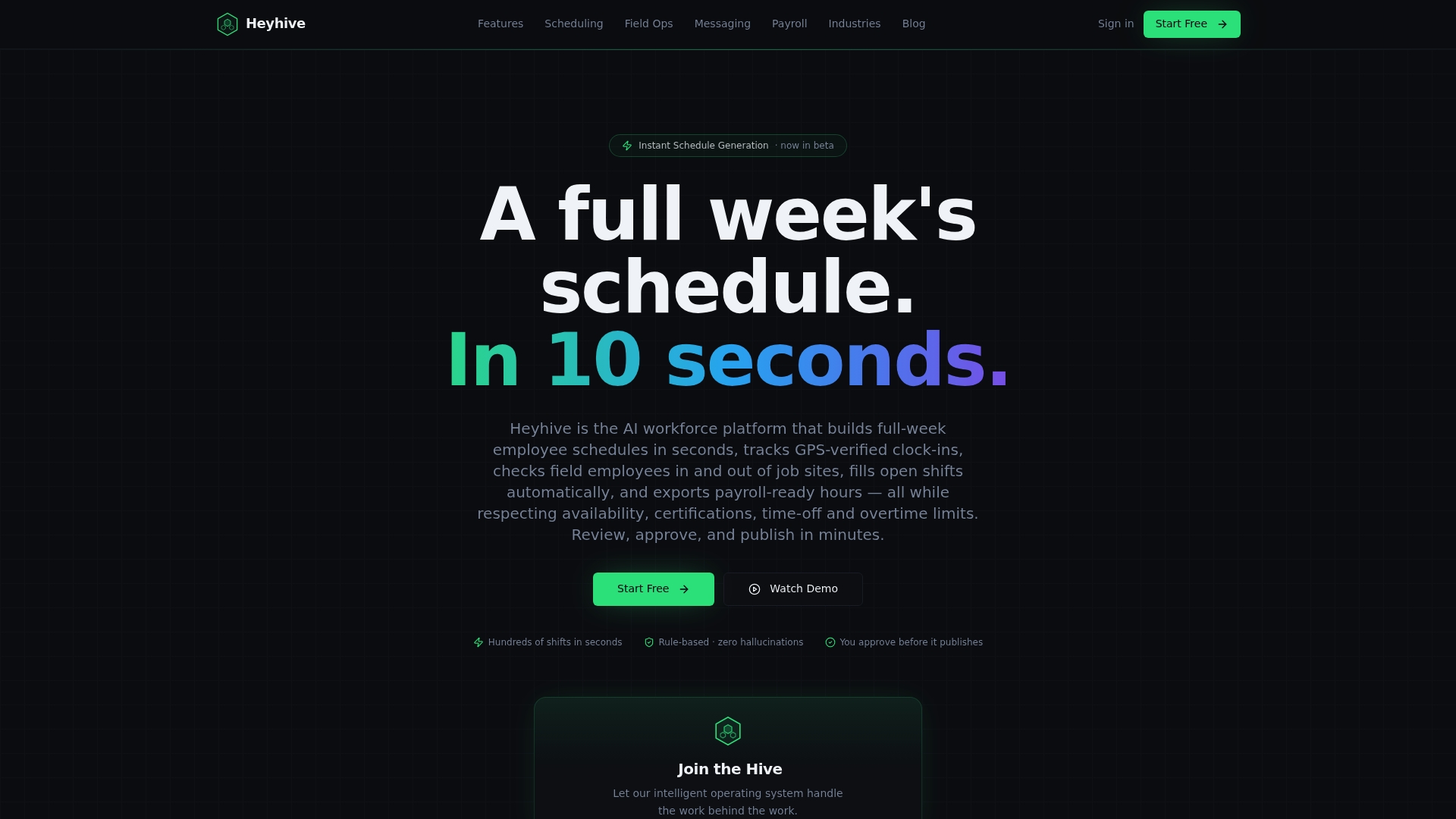
That's the gap Heyhive was built to close. Instead of manually drafting shifts, checking availability by hand, and hoping nobody's certification lapsed, Heyhive generates a full week of AI-drafted shifts in seconds, respects availability and overtime limits automatically, and still puts every schedule in front of a manager for approval before it publishes. Add GPS-verified clock-ins for field teams and payroll-ready hour exports, and the administrative work that usually eats a manager's week shrinks to a review-and-approve step. For teams managing absence alongside scheduling, pairing this with a tool like the absence management options Heyhive has reviewed rounds out the full picture.
If your team is still chasing availability by text or hunting for who's covering Saturday, start a free trial with Heyhive and generate your first automated schedule this week.
Vendor Documentation and Practical Resources
- How schedule visibility works in 7shifts — assignment and publish-status rules
- Shift management and staff scheduling | Microsoft Teams — mobile access and collaboration overview
- Employee Attendance Tracking guide — practical KPI tracking for hourly teams
Sources
- How schedule visibility works in 7shifts
- Shift management and staff scheduling | Microsoft Teams
- Employee Scheduling Software | Dayforce