
Time rounding is permitted under federal law, but only under specific conditions. Under 29 C.F.R. §785.48, employers may round employee start and stop times to the nearest 5 minutes, one-tenth of an hour, or quarter-hour, provided the practice does not result, over time, in undercompensating employees for hours actually worked. That neutrality requirement is the non-negotiable core of every compliant time clock rounding policy.
Two federal regulations control this area. 29 C.F.R. §785.48 governs formal rounding systems. 29 C.F.R. §785.47 covers the separate de minimis doctrine, which applies only to infrequent, incidental minutes that cannot practically be recorded. California and a growing number of states impose stricter standards that can override federal permissiveness.
The practical takeaway for most employers is straightforward:
- If your system captures exact minutes, pay exact minutes. Modern timekeeping software eliminates the administrative rationale for rounding, and exact-minute pay removes the neutrality monitoring burden entirely.
- If you round, use only the three accepted increments (nearest 5 minutes, nearest one-tenth of an hour, or nearest quarter-hour) and apply the midpoint rule symmetrically.
- Document everything. A written rounding policy, original punch data, and periodic neutrality audits are your primary defenses in a DOL investigation or wage claim.
Key Takeaways
Federal law permits time rounding only when it is neutral over time, uses an accepted increment, and is documented in a written policy that employees can see.
| Point | Details |
|---|---|
| Neutrality is non-negotiable | Rounding must average out across employees; employer-favoring drift violates the FLSA regardless of intent. |
| Three accepted increments | Federal law allows rounding to the nearest 5 minutes, one-tenth of an hour, or quarter-hour only. |
| State law can be stricter | California and other states may require exact-minute pay where systems capture precise timestamps. |
| Retain raw timestamps always | Original punch data is your primary defense in a DOL audit or private wage claim. |
| Heyhive captures exact minutes | GPS-verified clock-ins and raw timestamp exports give you a compliant, auditable record for every punch. |
Table of Contents
- What federal law actually says about time rounding rules
- How the 7-minute rule and other rounding systems work in practice
- Where federal acceptance doesn't protect you: state-law conflicts
- Building a defensible rounding policy: employer checklist
- Configuring your timekeeping systems to reduce rounding risk
- How rounding interacts with overtime: payroll examples
- If you face a DOL audit or wage claim: what to do first
- Why exact-minute pay builds more trust than any rounding policy ever will
- Heyhive gives you exact-minute pay and a clean audit trail
- Sources
What federal law actually says about time rounding rules
The FLSA does not require employers to use time clocks, but when you do, the DOL's elaws FLSA Hours Worked Advisor confirms that minor differences between clock records and actual hours are expected. The key is that rounding practices must be neutral across the workforce over time.
29 C.F.R. §785.48 sets three accepted rounding increments:
- Nearest 5 minutes: midpoint at 2.5 minutes past the interval
- Nearest one-tenth of an hour (6 minutes): midpoint at 3 minutes past the interval
- Nearest quarter-hour (15 minutes): midpoint at 7.5 minutes, producing the widely used 7/8-minute rule
The neutrality requirement means that rounding must average out across employees and pay periods. Rounding that consistently favors the employer, even if applied mechanically, violates the FLSA.
29 C.F.R. §785.48 states: "Rounding practices will be accepted by the [DOL] for enforcement purposes only if they are used in such a manner that they will not result, over a period of time, in failure to compensate the employees properly for all the time they have actually worked."
The de minimis doctrine under 29 C.F.R. §785.47 is a separate and narrower concept. It covers genuinely incidental, unpredictable minutes of work that cannot practically be recorded. Employers sometimes misapply it as a catch-all excuse for regularly occurring unpaid minutes. That is a compliance error. If work time is predictable and recordable, de minimis does not apply, and a formal rounding policy is the correct mechanism.
Key distinctions between the two doctrines:
- De minimis (§785.47): infrequent, incidental, practically unrecordable time. Think: an employee who occasionally spends 90 seconds logging out of a system after clocking out.
- Formal rounding (§785.48): a planned, systematic adjustment to recorded punch times using an accepted increment and a neutral midpoint rule.
DOL Fact Sheet #53 provides the clearest published example of how the quarter-hour rule works in practice, and it explicitly warns that rounding that systematically favors the employer may violate the FLSA.
How the 7-minute rule and other rounding systems work in practice
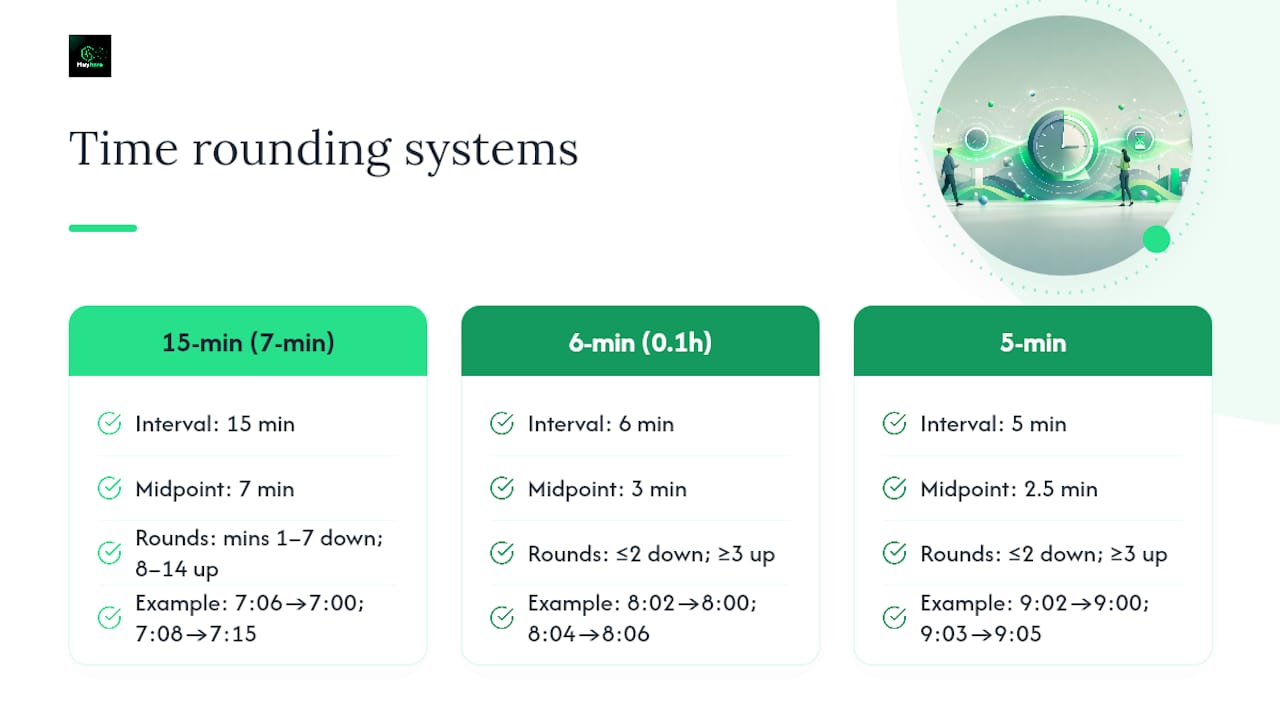
The three accepted rounding systems operate on the same midpoint logic, just at different intervals. Here is how each one works.
Quarter-hour rounding and the 7-minute rule
For 15-minute rounding, each quarter-hour interval runs from :00 to :14, :15 to :29, :30 to :44, and :45 to :59. Punches in minutes 1–7 past the quarter-hour round down; punches in minutes 8–14 round up to the next quarter-hour. Per DOL Fact Sheet #53, an employee clocking in at 7:08 AM is rounded to 7:15 AM (rounded up, losing 7 minutes), while one clocking in at 7:06 AM is rounded to 7:00 AM (rounded down, gaining 6 minutes). Over a full week, these gains and losses should roughly cancel out.
One-tenth-of-an-hour rounding (6-minute intervals)
Each 6-minute block represents 0.1 hours. The midpoint falls at 3 minutes. A punch at 8:02 rounds to 8:00 (0.0 hours); a punch at 8:04 rounds to 8:06 (0.1 hours). This system is common in professional services and salaried-exempt tracking but appears in hourly payroll as well.
5-minute rounding
The midpoint is 2.5 minutes. A punch at 9:02 rounds to 9:00; a punch at 9:03 rounds to 9:05. This is the tightest interval and produces the smallest per-punch variance.
Sample week: neutrality check
In this example, rounded hours exceed actual hours by 12 minutes for the week. The rounding is slightly employee-favorable, which is acceptable. An employer-favoring drift in the opposite direction would trigger a compliance review.
Pro Tip: Run a neutrality audit quarterly. Export raw punch data, calculate actual minutes worked, and compare to rounded totals across all employees. If rounded totals are consistently below actual totals by more than a rounding interval, your policy is drifting out of compliance.
Where federal acceptance doesn't protect you: state-law conflicts
Federal permissiveness on rounding does not mean you are safe in every state. Several jurisdictions have moved toward stricter standards, and California is the clearest example.
California appellate courts have rejected rounding in meal-period contexts, and the state's Division of Labor Standards Enforcement has signaled that where an employer's timekeeping system captures exact minutes, paying to the exact minute is expected. The NC DOL's guidance on recording time illustrates the more common state posture: rounding is permitted when applied consistently up and down, but accuracy and symmetry are required.
States trending toward exact-minute pay include California (most restrictive), and practitioners increasingly recommend the exact-minute default in any state where your software captures precise timestamps.
Action items for multi-state employers:
- Map your workforce by state. Identify every jurisdiction where you have hourly employees and flag states with known rounding restrictions.
- Consult local counsel for California and any state with pending wage-hour legislation. Federal compliance is a floor, not a ceiling.
- Set a conservative default. If your timekeeping system captures exact minutes, pay exact minutes across all states unless you have a specific, documented reason to round in a given jurisdiction.
- Create jurisdiction-specific policy addenda. Your master rounding policy can allow rounding where legally safe, with state-specific addenda that override to exact-minute pay where required.
- Review annually. State wage-hour law is moving faster than federal law right now. A policy that was compliant in 2024 may not be in 2026.
Pro Tip: For field teams operating across state lines, GPS-verified clock-ins with exact timestamps give you the raw data to pay each employee under their state's rules without reconfiguring your entire system.
Building a defensible rounding policy: employer checklist
A written, consistently applied policy is your first line of defense in any DOL audit or private wage claim. Here is what it must contain and how to maintain it.
Essential policy components:
- Rounding algorithm: state the exact increment (e.g., nearest quarter-hour) and the midpoint rule (1–7 minutes round down, 8–14 round up).
- Scope: specify which employees and locations the policy covers.
- Worked examples: include at least two clock-in and two clock-out scenarios showing the math.
- Exception handling: name who approves manual time corrections and under what circumstances.
- Effective date and version control: date every revision and retain prior versions.
Recordkeeping standards:
- Preserve original, unaltered punch timestamps for at least three years (the FLSA minimum; some states require longer).
- Maintain audit logs showing any manual edits, who made them, and when.
- Keep signed copies of employee acknowledgment forms for the rounding policy.
- Retain payroll calculation records that show how rounded hours translated to wages.
Operational best practices:
- Provide written notice of the rounding policy at hire and post it where employees clock in.
- Train supervisors on what constitutes a permissible manual edit versus an impermissible one.
- Run neutrality audits at least quarterly (see the formula in the previous section).
- Establish a correction procedure: if an audit reveals employer-favoring drift, calculate back pay owed and issue it promptly.
- Document every audit, its findings, and any corrective action taken.
Sample policy language HR can adapt:
- "The Company rounds employee clock-in and clock-out times to the nearest quarter-hour. Times from 1 to 7 minutes past a quarter-hour are rounded to the prior quarter-hour. Times from 8 to 14 minutes past are rounded to the next quarter-hour. This policy applies symmetrically to all hourly employees at all locations."
The e-CFR Part 785 guidance reinforces that employers who can capture exact minutes should consider paying exact minutes, since the administrative rationale for rounding weakens when precise timestamps are available.
Pro Tip: Attach your neutrality audit results to the policy file annually. If you are ever audited, a documented history of self-monitoring is strong evidence of good-faith compliance.
Configuring your timekeeping systems to reduce rounding risk
Technology choices drive compliance risk more than most employers realize. The gap between a system that rounds at the point of capture and one that stores raw timestamps and rounds only for payroll display is significant.
Exact-minute capture vs. rounding-enabled clocks
Clocks that round at the point of capture discard the raw timestamp permanently. If your rounding policy is later challenged, you have no original data to audit. Systems that store raw timestamps and apply rounding only during payroll processing give you the ability to re-run neutrality audits, correct errors, and demonstrate compliance with original records intact.
Payroll configuration checklist:
- Select the rounding increment in your payroll software and confirm it matches your written policy exactly.
- Verify that rounding applies symmetrically to both clock-in and clock-out times, not just one direction.
- Enable raw timestamp retention so original punches are never overwritten.
- Schedule automated audit reports that compare actual minutes to rounded totals by pay period.
- Restrict manual time edits to authorized supervisors and require a documented reason for each change.
Operational workflows:
- Employees clock in and out via a GPS-verified or on-site time clock.
- Raw timestamps are stored immediately and remain unaltered.
- Payroll software applies the approved rounding algorithm to generate rounded totals.
- Managers review and approve timesheets before payroll runs, flagging anomalies.
- Payroll exports rounded hours alongside raw timestamps for audit purposes.
What to look for in timekeeping software:
- Raw timestamp export in a standard format (CSV or similar)
- Audit trail showing every edit, approval, and system change
- Manager approval workflow before payroll submission
- GPS verification for field and mobile employees
- Configurable rounding rules with symmetrical application settings
Heyhive's GPS-verified clock-ins capture exact arrival and departure timestamps for field teams, and its GPS time clock features store raw punch data that managers can review and approve before payroll export. For multi-site operations, geofencing time tracking adds location verification to every punch, giving you a defensible record for each clock event.
Pro Tip: For high-risk states or large hourly workforces, run neutrality audits monthly rather than quarterly, and configure your software to flag any pay period where rounded totals fall more than one rounding interval below actual totals.
How rounding interacts with overtime: payroll examples
Rounding cannot be used to avoid overtime. The FLSA requires overtime pay for all hours actually worked beyond 40 in a workweek, and DOL Fact Sheet #53 confirms that rounding which produces undercounted weekly hours can create overtime obligations the employer failed to pay.
Step-by-step example: rounding that crosses the overtime threshold
An employee works the following actual hours Monday through Friday: 8.9, 8.1, 8.2, 8.0, and 8.3 hours. Actual total: 41.5 hours. After quarter-hour rounding, recorded hours come to 8.75, 8.0, 8.25, 8.0, and 8.25 hours. Rounded total: 41.25 hours.
Both totals exceed 40 hours, so overtime is owed either way. The employer must pay 1.25 hours of overtime on the rounded total (41.25 minus 40). Rounding did not eliminate the overtime obligation; it only slightly reduced the overtime hours owed, which is acceptable as long as the overall rounding remains neutral.
Example where rounding creates underpaid overtime:
| Day | Actual hours | Rounded hours |
|---|---|---|
| Monday | 8.9h | 8.75h |
| Tuesday | 8.5h | 8.50h |
| Wednesday | 8.4h | 8.25h |
| Thursday | 8.1h | 8.00h |
| Friday | 6.25h | 6.25h |
| Total | 40.0h | 39.75h |
Actual hours exceed 40, triggering 0.2 hours of overtime. Rounded hours show 39.75, which appears to be straight time. The employer pays no overtime. This is a violation. The rounding systematically shaved enough time to push the employee below the overtime threshold, which is precisely the scenario FindLaw's 7-minute rule analysis warns creates wage-and-hour claims and class action exposure.
Warning: Any rounding pattern that consistently moves employees below 40 recorded hours when actual hours exceed 40 is a compliance failure, not a rounding policy. Correct it immediately and calculate back pay.
If you face a DOL audit or wage claim: what to do first
Speed and organization matter when a DOL investigator contacts you or a wage claim is filed. Here is the priority sequence.
Immediate steps:
- Preserve all records. Issue a litigation hold immediately. Do not delete, overwrite, or alter any punch data, payroll records, or policy documents.
- Suspend the suspect rounding practice if there is any indication it has been employer-favoring. Continuing a potentially non-compliant practice during an investigation worsens exposure.
- Run a neutrality audit covering the full period under review. Calculate actual minutes versus rounded totals for every affected employee.
- Notify employment counsel before responding to the DOL or opposing counsel. Do not provide records or statements without legal guidance.
- Contact your payroll vendor to confirm what raw data is available and in what format.
Evidence to collect:
- Raw punch timestamps for the full statute of limitations period (two years for non-willful FLSA violations; three years for willful)
- Written rounding policy, all versions, with effective dates
- Employee acknowledgment forms showing the policy was communicated
- Training records for supervisors on rounding and manual edits
- Prior neutrality audit results and any corrective action documentation
- Payroll calculation records showing how rounded hours translated to wages paid
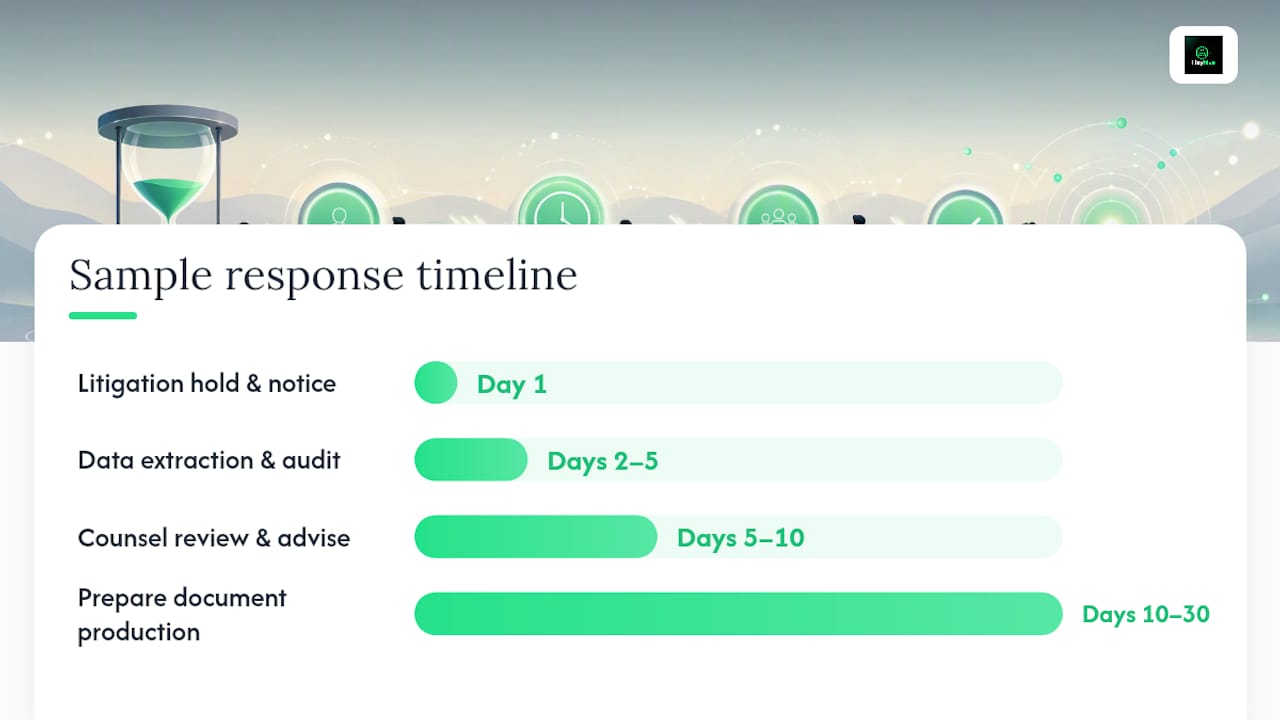
Sample response timeline:
- Day 1: litigation hold, counsel notification, payroll vendor contact
- Days 2–5: raw data extraction and neutrality audit
- Days 5–10: counsel reviews audit results and advises on voluntary correction vs. defense posture
- Days 10–30: prepare document production in response to DOL information request
Pro Tip: The DOL's Wage and Hour Division looks favorably on employers who self-identify a problem, calculate back pay accurately, and pay it promptly. A documented history of neutrality audits and corrections is your strongest evidence of good faith.
Why exact-minute pay builds more trust than any rounding policy ever will
There is a version of this conversation that gets skipped in most compliance guides: the human cost of rounding. Employees notice when their paychecks are consistently a few minutes short. They talk about it. And those small, repeated losses, even when technically legal, create a level of distrust that no written policy fully repairs.
The administrative argument for rounding made sense when time clocks were mechanical and payroll was calculated by hand. Modern systems capture exact timestamps automatically. The rationale for rounding has largely disappeared, but the litigation risk has not.
Transparent, minute-accurate pay sends a clear signal: you trust your employees' time records, and you pay for every minute they work. That posture reduces disputes, supports retention, and removes the neutrality monitoring burden from your payroll team. When employees can see their exact clock-in and clock-out times on their pay detail, there is nothing to argue about.
The employers who face the most expensive rounding litigation are not usually the ones with malicious intent. They are the ones who set up a rounding policy years ago, never audited it, and let employer-favoring drift accumulate unnoticed. The fix is simple: audit regularly, pay exact minutes where your system allows it, and document everything else.
Heyhive gives you exact-minute pay and a clean audit trail
Compliance with time rounding rules starts with the data you capture. Heyhive records exact clock-in and clock-out timestamps for every employee, including GPS-verified arrivals and departures for field teams, so you always have the raw record, regardless of how you choose to handle rounding downstream.

Here is how Heyhive fits into a compliant timekeeping workflow:
- Capture: GPS-verified clock-ins record exact timestamps at the moment of punch, stored unaltered.
- Store: Raw punch data is retained and exportable, giving you the original record for any audit or wage claim.
- Approve: Managers review and approve timesheets before payroll runs, with a full audit trail of every edit.
- Export: Payroll-ready hours export gives your payroll team clean, approved data, whether you pay to the exact minute or apply a documented neutral rounding policy.
For field teams and multi-site operations, Heyhive's employee attendance tracking features give you location-verified records that hold up under scrutiny. Start a free trial at Heyhive and see how exact-minute capture and manager-approved timesheets reduce your rounding compliance burden from day one.
Sources
These are the sources your payroll and HR teams should consult first when drafting, auditing, or defending a rounding policy.
- Fact Sheet #53 – The Health Care Industry and Hours Worked | U.S. Department of Labor
- Law
- elaws - FLSA Hours Worked Advisor
- C. Time Clock "Rounding" (Texas Workforce Commission / EFTE summary)
- Recording Time and Rounding of Hours Worked | NC DOL
For state-specific questions, particularly in California or any state with pending wage-hour legislation, consult local employment counsel before finalizing your policy. Federal compliance is the floor; state law sets the ceiling.
Key principle: When your timekeeping system captures exact minutes, the safest and simplest posture is to pay exact minutes. Reserve formal rounding for situations where exact capture is genuinely not possible, document the policy thoroughly, and audit neutrality at least quarterly.
This article is general information, not a substitute for advice from a qualified lawyer. Consult a qualified legal professional about your own circumstances before acting on anything here.