
California meal break laws require employers to provide a 30-minute unpaid, duty-free meal break for any shift exceeding five hours, plus a paid rest break for every four hours worked or major fraction thereof. Miss either, and you owe the employee one additional hour of pay at their regular rate for that workday. These are not optional courtesies. They are enforceable wage obligations under California Labor Code § 512 and the Industrial Welfare Commission (IWC) Wage Orders.
Here is the essential framework at a glance:
- Meal breaks: Unpaid, minimum 30 minutes, must begin before the end of the fifth hour of work
- Rest breaks: Paid, minimum 10 consecutive net minutes, required for every four hours worked or major fraction thereof
- Meal break waivers: Allowed by mutual consent when the total shift is six hours or less or for the second meal break when total hours do not exceed 12 (and the first break was not waived)
- On-duty meal periods: Only permitted when the nature of the work objectively prevents relief from all duties, require a written agreement, and must be paid
- Penalties: One hour of pay per missed meal or rest break violation per workday, classified as a wage under Murphy v. Cole
- Statute of limitations: Three years for missed break penalty claims
Both employees and employers need to understand these rules precisely. The cost of getting them wrong adds up fast.
Table of Contents
- What California meal break laws actually require from employers
- How California rest break requirements work
- What happens when employers violate break laws
- Which employees are covered and how exemption status changes everything
- How technology helps you stay compliant with California break rules
- Key Takeaways
- Why proactive compliance is the only smart strategy here
What California meal break laws actually require from employers
California Labor Code § 512 is the governing statute. It sets the floor, and the IWC Wage Orders fill in the operational details. Together, they create one of the most employee-protective break regimes in the country.

Meal break length and timing
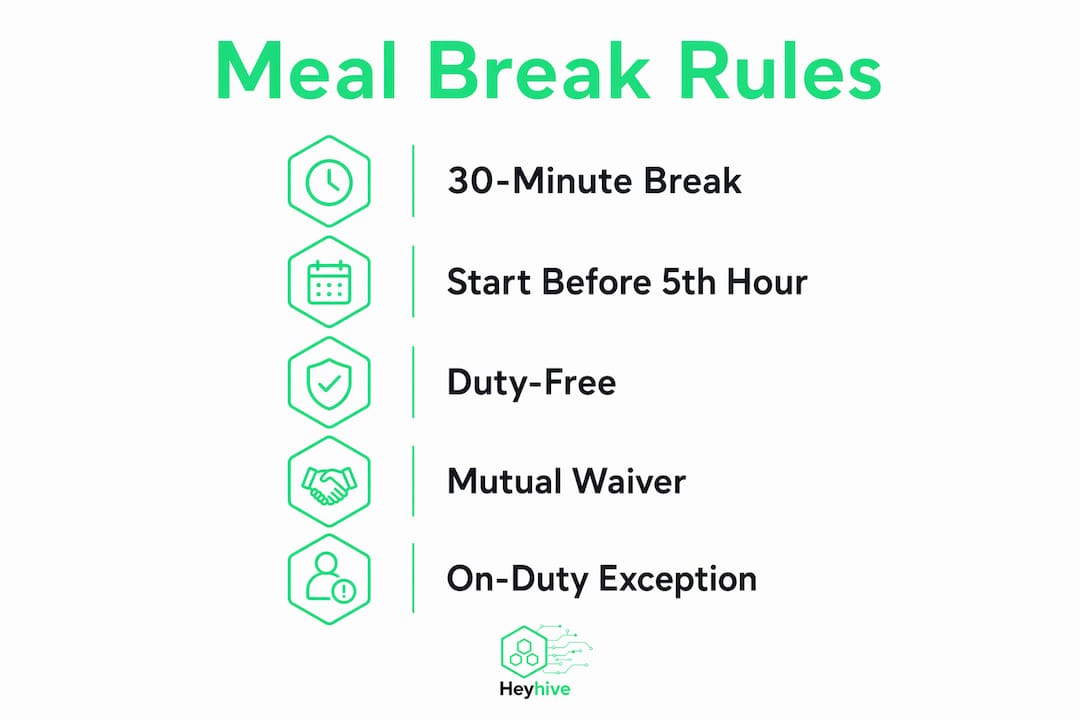
A meal period must be at least 30 minutes and must be duty-free. That means the employee is completely relieved of all work responsibilities and free to leave the premises. If any work-related task interrupts the break, even briefly, the duty-free requirement is violated and the break does not count. The employer owes a penalty hour of pay for that day.

Timing matters too. The first meal break must begin no later than the end of the employee's fifth hour of work. For longer shifts, a second meal break is required before the end of the tenth hour.
When meal breaks can be waived
Mutual consent waivers are permitted under two specific conditions:
- The total work period is six hours or less — either party can agree to waive the single meal break.
- The total work period is 12 hours or less — the second meal break can be waived by mutual consent, but only if the first meal break was not waived.
Waivers must be genuine mutual agreements, not employer pressure. A blanket policy requiring employees to skip breaks does not qualify.
On-duty meal periods: the narrow exception
Some jobs genuinely cannot accommodate a duty-free break. California law allows an on-duty meal period only when the nature of the work objectively prevents relief, there is a written agreement, and the meal period is paid.
Classic examples include a lone security guard at a remote site or a single employee managing a small operation where no relief is available. This exception is narrow and courts interpret it strictly. If the employer could arrange coverage but chose not to, the exception does not apply.
| Meal Break Type | Duration | Paid? | Duty-Free? | Waivable? |
|---|---|---|---|---|
| Standard (shift > 5 hrs) | 30 min minimum | No | Yes | Yes, by mutual consent (≤6 hr shift) |
| Second break (shift > 10 hrs) | 30 min minimum | No | Yes | Yes, by mutual consent (≤12 hr shift, first not waived) |
| On-duty meal period | 30 min minimum | Yes | No | Not applicable |
Facilities and environment
Employers cannot simply tell employees to eat at their workstation and call it a meal break. The employee must be free to use the time as they choose, including leaving the premises. Requiring an employee to remain on-site during an unpaid meal break converts it into a compensable, on-duty meal period.
Pro Tip: Document every meal break in writing. A signed daily break log or a digital timestamp from a scheduling system is your best defense if a wage claim is ever filed.
How California rest break requirements work
Rest breaks operate under a different set of rules than meal breaks, and the distinctions matter for both scheduling and compliance.
The basic entitlement
Paid 10-minute rest breaks are required for every four hours worked, or major fraction thereof. The Division of Labor Standards Enforcement (DLSE) defines "major fraction" as anything more than two hours. So if an employee works more than two hours in a given four-hour segment, they have earned a rest break for that segment.
Because rest breaks are counted as hours worked, they must be paid. You cannot dock an employee's pay for the time spent on a rest break.
Break scheduling by shift length
| Total Hours Worked | Rest Breaks Required |
|---|---|
| Six to 12 hours | 1 |
| 12+ hours | 2 |
Scheduling guidance recommends placing rest breaks as close to the midpoint of each four-hour work segment as practicable. That said, operational realities sometimes make exact midpoint scheduling impossible. The key obligation is that the break happens within the work period, not that it falls at the precise halfway mark.
What counts as a rest break (and what does not)
The 10 minutes is a net figure. The clock starts when the employee reaches an appropriate rest area, not when they leave their workstation. Employers must provide suitable resting facilities that are separate from toilet rooms and available during working hours.
This is a point many employers get wrong. Allowing employees to use the restroom during the workday does not satisfy the rest break obligation. The IWC is explicit: toilet breaks and rest breaks are separate. An employer who counts bathroom trips as rest periods is in violation.
Key rest break rules to keep in mind:
- Rest breaks cannot be waived, even by mutual consent (unlike meal breaks)
- Employees cannot be required to remain at their workstations during rest breaks
- Rest break time cannot be rounded down or combined with other breaks
- Scheduling rest breaks in the middle of each work period is the standard, but flexibility is allowed when circumstances require it
- Rest break time is compensable and must be included in overtime calculations
Industry-specific exceptions
A handful of IWC Wage Orders carve out modified rules for specific sectors:
- 24-hour residential care facilities: Certain employees may have rest periods limited under specific circumstances per IWC Order 5-2001, Section 12(C).
- Performers in strenuous physical activities: Swimmers, dancers, skaters, and similar performers engaged in rehearsal or shooting receive additional interim rest periods per IWC Order 12-2001, Section 12(C).
- Commercial passenger fishing boats: Crew members on overnight trips receive no less than eight hours of off-duty time per 24-hour period, in addition to standard meal and rest breaks, per IWC Order 10-2001.
- Wholesale baking industry: Employees covered by qualifying collective bargaining agreements with a 35-hour workweek structure may operate under modified rest period rules under Labor Code § 512(c).
What happens when employers violate break laws
The financial exposure from missed breaks is real and compounds quickly. California's enforcement framework is designed to make noncompliance more expensive than compliance.
The penalty structure
That ruling has significant practical consequences. Because the penalty is classified as a wage rather than a penalty in the traditional sense, it carries the full weight of California wage law, including the three-year lookback period. An employer who has been skipping breaks for two years is not facing a minor fine. They are facing two years of accumulated hourly penalties for every affected employee, every workday.
The specific rules on how penalties stack:
- Missed meal break: One additional hour of pay at the employee's regular rate, per workday the violation occurs
- Missed rest break: One additional hour of pay at the employee's regular rate, per workday the rest period is not provided (regardless of how many rest breaks were missed on that day)
- Both violations on the same day: The employee can collect up to two additional hours of pay for that workday, one for the meal break and one for the rest break
How penalties affect overtime calculations
Penalty wages are added to the employee's total compensation for the pay period. Because they are classified as wages, they can affect the regular rate of pay used to calculate overtime. Employers who routinely miss breaks and then calculate overtime without accounting for penalty wages may be compounding their liability.
Filing a claim and enforcement
Employees have several options when their break rights are violated:
- File a wage claim with the California Labor Commissioner's Office (also called the Division of Labor Standards Enforcement)
- Report a violation to the DLSE Bureau of Field Enforcement (BOFE), which can conduct inspections and issue civil citations
- File a civil lawsuit under California's Private Attorneys General Act (PAGA), which allows employees to sue on behalf of themselves and other affected workers
For lactation accommodation violations specifically, BOFE may issue a civil citation for each day an employee is denied reasonable break time or adequate space to express milk.
Recordkeeping obligations
Employers must maintain documentation of meal and rest breaks to demonstrate compliance. This includes records showing when breaks were taken, their duration, and that they were duty-free. Inadequate records create a presumption of noncompliance in wage claim proceedings, which shifts the burden of proof to the employer.
Which employees are covered and how exemption status changes everything
Not every employee in California has the same break rights. The distinction between exempt and non-exempt status is the most important dividing line.
Non-exempt employees: full protections apply
Non-exempt employees are those who do not meet the salary and duties tests for exemption under California law. This covers the majority of hourly workers, including retail associates, food service workers, warehouse staff, healthcare support workers, and most field employees. All of the meal and rest break rules described above apply in full to non-exempt employees.
Exempt employees: a different standard
Exempt employees, typically executive, administrative, or professional employees who meet California's salary threshold and duties tests, are generally not entitled to mandatory meal and rest breaks under the IWC Wage Orders. However, this does not mean employers can require exempt employees to work through every meal indefinitely. California law still protects exempt employees from certain abusive practices, and many employers voluntarily provide breaks as a matter of workplace policy.
Key distinctions for exempt vs. non-exempt employees:
- Non-exempt employees are entitled to all meal and rest break protections under Labor Code § 512 and IWC Wage Orders
- Exempt employees are not covered by the mandatory break provisions, but may still have contractual or policy-based break rights
- Misclassifying a non-exempt employee as exempt to avoid break obligations is a serious legal risk and a common source of wage claims
- Some employees classified as exempt under federal law may still qualify as non-exempt under California's stricter standards
On-call and split-shift workers
On-call and split-shift arrangements add complexity. Special rules apply to these situations, and the analysis depends on the specific facts of each arrangement.
For on-call workers, the key question is whether the employee is truly free during the break period. If an employee must remain available to respond to calls or cannot leave the premises, the break is not duty-free and must be compensated. This is especially relevant for healthcare workers, security personnel, and field technicians.
For split-shift workers, each segment of the shift is analyzed separately for break entitlements. A worker who works a four-hour morning segment and a four-hour evening segment may be entitled to rest breaks in each segment, depending on the total hours and the gap between segments.
Employers managing on-call or split-shift schedules should document break policies clearly and apply them consistently. Inconsistent application is one of the fastest ways to generate wage claims.
Collective bargaining agreements
Certain industries can modify break rules through qualifying collective bargaining agreements (CBAs). Labor Code § 512 allows CBAs in the motion picture and broadcasting industries to substitute their own meal period provisions, provided the agreement includes a monetary remedy for missed breaks. Similar provisions exist for other industries under specific IWC Wage Orders. When a valid CBA applies, its terms govern, but the CBA must expressly address meal periods and include enforceable remedies.
How technology helps you stay compliant with California break rules
Manual break tracking is where compliance breaks down. A manager juggling a 20-person team across multiple locations cannot reliably track every break start and end time with a paper log. Errors accumulate, records get lost, and the first sign of a problem is often a wage claim.
The real risk of manual recordkeeping
When break records are incomplete or missing, California law presumes the breaks were not provided. That presumption is difficult to overcome in a wage claim hearing. The employer bears the burden of proving compliance, and a stack of unsigned paper logs rarely meets that standard. For field teams and mobile workers, the problem is even more acute. Without location verification, there is no reliable way to confirm that a break was actually taken away from the work area.
What automated tracking actually solves
GPS-verified time tracking eliminates the guesswork. When employees clock in and out of breaks using a GPS-enabled system, you get a timestamped, location-verified record of every break event. That data is audit-ready from day one.
Heyhive's platform takes this further by combining automated scheduling with real-time attendance tracking. The system can flag when a scheduled break has not been recorded, alerting managers before a violation compounds into a multi-day liability. For field operations, GPS arrival and departure tracking confirms that employees are actually away from the work site during meal breaks, which directly addresses the duty-free requirement.
Benefits of using an automated workforce platform for break compliance:
- Timestamped break records that are automatically stored and retrievable for wage claim defense
- Real-time alerts when breaks are missed or delayed beyond the legal window
- Payroll-ready exports that include penalty hours when violations are flagged, so payroll is accurate from the start
- Shift scheduling that builds breaks in automatically, reducing the chance a break is simply forgotten during a busy shift
- Consistent application across all locations and employee types, removing the variability that creates legal exposure
Pro Tip: Set up automated break reminders in your scheduling system so managers receive a notification 15 minutes before a meal break window closes. Catching a missed break before the shift ends is far cheaper than paying a penalty hour after the fact.
For teams managing employee attendance tracking across multiple sites, the documentation advantage of a digital system is not just about convenience. It is about having defensible records when a claim is filed. Payroll consultation services, such as those offered through payroll compliance specialists, can also help employers review whether their current break pay practices correctly account for penalty wages in overtime calculations.
The bottom line: technology does not replace your legal obligation to provide breaks. It makes it operationally realistic to do so consistently, and it creates the paper trail that proves you did.
Key Takeaways
California meal and rest break laws impose strict, enforceable obligations on employers, and the penalty for each violation is a wage owed directly to the employee.
| Point | Details |
|---|---|
| Meal breaks are unpaid and duty-free | A 30-minute meal break is required for shifts over five hours; any work interruption invalidates it. |
| Rest breaks are paid and non-waivable | Employees earn a 10-minute paid rest break for every four hours worked or major fraction thereof. |
| Penalties are wages, not fines | One additional hour of pay per missed meal or rest break violation per workday, with a three-year lookback period under Murphy v. Cole. |
| Waivers require genuine mutual consent | Meal breaks can be waived only under specific shift-length conditions; rest breaks cannot be waived at all. |
| Technology reduces compliance risk | Automated scheduling and GPS-verified tracking create audit-ready break records and catch violations before they compound. |
Why proactive compliance is the only smart strategy here
California's break laws are not ambiguous. The statute is clear, the case law is settled, and the enforcement mechanisms are well-funded. What surprises many employers is not the rules themselves but how quickly liability accumulates when breaks are handled carelessly.
Consider a 10-person team where meal breaks are routinely delayed by 20 minutes past the fifth-hour mark. Each of those delays is a potential violation. Multiply that by five workdays a week, 50 weeks a year, and the exposure over a three-year lookback period becomes a significant number before a single lawsuit is filed. That math is not hypothetical. It is the calculation plaintiffs' attorneys make when evaluating PAGA claims.
What most compliance guides understate is the operational dimension of this problem. The legal rules are straightforward. The hard part is executing them consistently across a real workforce with variable schedules, call-outs, and last-minute shift changes. A manager who is already managing coverage gaps does not have bandwidth to manually track whether every employee took their break before hour five. That is where the system fails, not the intent.
The employers who handle this well treat break compliance the same way they treat payroll accuracy: as a process that requires a reliable system, not just a policy document. Automated scheduling that builds breaks into the shift structure, digital records that capture break events in real time, and alerts that flag potential violations before the shift ends. These are not luxuries. For any California employer with hourly workers, they are the practical infrastructure of compliance.
Employee well-being and legal adherence are not competing priorities here. They reinforce each other. Workers who consistently get their breaks are less fatigued, make fewer errors, and are less likely to file wage claims. The break laws exist because the California legislature understood that. Employers who internalize the same logic tend to have fewer compliance problems, not because they are more careful about paperwork, but because they have built workplaces where breaks actually happen.
Managing break compliance across a California workforce is exactly the kind of operational challenge Heyhive is built for. The platform's AI-powered scheduling builds meal and rest breaks directly into shift structures, while GPS-verified clock-ins create the timestamped records you need if a wage claim ever lands on your desk. You approve the schedule. Heyhive handles the work behind the work.
Start managing compliant schedules with Heyhive and give your team the breaks they are owed, every shift, every day.