
Private-sector employers are not required to pay shift differentials. But once you pay one, the rules change fast: the differential becomes part of the "regular rate of pay" that federal law uses to calculate overtime for non-exempt employees.
That single fact drives almost every compliance risk on this topic. The U.S. Department of Labor doesn't mandate shift premiums for evening, night, or weekend work in most private workplaces. But when you offer one, 29 CFR § 778.207 requires you to fold it into overtime math. Skip that step and every overtime paycheck for that employee is wrong.
Three things HR and payroll need to confirm this week:
- Your employee handbook clearly states whether differentials are flat-dollar or percentage-based.
- Your payroll system actually blends differential pay into the regular rate before calculating time-and-a-half.
- Someone owns the job of checking state-specific exceptions to federal rules.
Key Takeaways
Shift differentials stay legally optional for most private employers, but paying one triggers a mandatory regular-rate adjustment that changes every overtime calculation for that employee.
| Point | Details |
|---|---|
| Differentials are voluntary | Federal law doesn't require private employers to pay shift differentials; policy and bargaining decide. |
| Regular rate rule is mandatory | Once paid, differentials must be included in the regular rate for overtime under 29 CFR § 778.207. |
| FWS employees follow different rules | Federal Wage System workers get mandatory 7.5% or 10% differentials tied to basic pay. |
| State rules vary | States like Rhode Island have unique premium requirements; verify state labor department rules regularly. |
| Automation reduces blended-rate errors | Enforced scheduling windows and payroll-ready exports catch mistakes manual spreadsheets miss. |
Table of Contents
- Shift Differential Pay Rules Under Federal Law
- How To Calculate Blended Overtime With Shift Differentials
- Federal Wage System Rules for Government Employees
- State Rules That Change the Math
- Building a Compliant Shift Differential Policy
- Common Payroll Errors and How To Audit Them
- Reducing Miscalculation Risk With Scheduling Automation
- Shift Differentials and Employee Benefits Calculations
- Shift Differentials Under Union Contracts
- Industry Differences in Shift Differential Practices
- Shift Differential Pay Rules for Employers: What Actually Matters
- Frequently Asked Questions
- Sources
Shift Differential Pay Rules Under Federal Law
The Fair Labor Standards Act doesn't say a word about paying extra for working nights, weekends, or holidays. For most private employers, shift differentials are a business decision, not a legal obligation, shaped by labor market pressure, union contracts, or a need to fill unpopular shifts.
That voluntary status ends the moment money changes hands. Once a non-exempt employee receives a shift differential, federal regulations require you to include it in their regular rate of pay for that workweek, and overtime gets calculated on that blended number, not the base hourly rate. The DOL has been explicit about this for decades, and 29 CFR § 778.207 is the specific regulatory text payroll teams should keep bookmarked.
Here's what that means in practice:
- Ignoring the differential when calculating overtime understates what employees are owed.
- The error compounds every pay period until someone catches it, usually during an audit or a complaint.
- Both flat-rate and percentage-based differentials trigger the same regular-rate requirement.
Most payroll software handles this correctly out of the box, but plenty of manual spreadsheets and legacy systems don't, and that gap is where liability builds quietly.
How To Calculate Blended Overtime With Shift Differentials
Getting this math right protects you from the most common overtime miscalculation. Here's the process payroll teams should run every time a non-exempt employee mixes base-rate and differential hours in the same workweek.
- Identify the differential type. Flat-dollar differentials add a fixed amount per hour (commonly $1 to $3). Percentage differentials add a set percent of the base rate (commonly 5% to 15%, with healthcare often running higher).
- Calculate total straight-time earnings for the week. Multiply base-rate hours by the base rate, then add differential hours multiplied by the differential rate.
- Divide total earnings by total hours worked. This produces the blended regular rate.
- Calculate overtime premium. Multiply the blended regular rate by 0.5, then multiply that by overtime hours (since straight-time pay for those hours is already counted in step 2).
- Add it all together. Total straight-time pay plus the overtime premium equals gross wages for the week.
Here's a worked example for a 45-hour week where 10 hours fall on a night shift with a $2 differential:
| Component | Value |
|---|---|
| Base rate | $20/hour |
| Night differential | $2 flat-dollar differential |
| Regular hours | $700 |
| Differential hours (10) | $220 |
| Total straight-time pay | $920 |
| Total hours worked | 45 |
| Blended regular rate | $20.44 hourly rate |
| Overtime hours | 5 |
| Overtime premium (0.5 × $20.44 × 5) | $51.11 |
| Total gross pay | $971.11 |
Miss that blended-rate step and you'd calculate overtime on the $20 base rate alone, shortchanging the employee by real money every single week they work a mixed schedule. Payroll tax withholding treats the entire gross figure, including differentials and overtime premium, as ordinary wages subject to standard federal and state withholding. A shift differential calculator built for blended-rate math is worth running against your payroll system's output at least once per quarter to catch configuration drift.
Federal Wage System Rules for Government Employees
Federal Wage System employees operate under a completely different framework than private-sector staff. 5 CFR Part 532 makes night shift differentials mandatory, not optional, and OPM sets the exact percentages.
- Employees whose regularly scheduled hours fall mostly between 3 p.m. and midnight receive a 7.5% differential.
- Employees whose regularly scheduled hours fall mostly between 11 p.m. and 8 a.m. receive a 10% differential.
- Eligibility runs on a majority-of-hours rule, meaning if most of a shift falls in the differential window, the whole shift qualifies, and paid meal breaks up to an hour still count toward that majority.
- FWS differentials count as part of basic pay, which means they affect overtime calculations, retirement contributions, and leave payout computations, unlike most private-sector differentials.
If your organization employs federal wage-grade workers, this framework overrides the private-sector voluntary model entirely.
State Rules That Change the Math
Most states default to the federal baseline described above, but not all of them. Rhode Island has historically imposed unique premium pay requirements for Sunday and holiday work that go beyond anything the FLSA demands, and other states periodically revisit their own rules, so a policy written once in 2020 may not reflect current law today.
- California's daily overtime threshold (over 8 hours in a day, not just 40 in a week) interacts directly with differential pay and requires separate blended-rate testing.
- Any state with its own overtime or premium-pay statute needs its own line item in your compliance checklist, not a generic assumption that federal rules cover everything.
- Assign one person or team to review your state-exceptions table quarterly, since state labor departments do update these rules.
Pro Tip: Build a simple spreadsheet listing every state where you employ workers, then note their overtime threshold, differential requirements, and the date you last verified each one. Five minutes of upkeep beats a surprise audit finding.
Building a Compliant Shift Differential Policy
A written policy protects you as much as it protects employees. Vague handbook language is exactly what turns a simple payroll question into a wage-and-hour dispute.
- Define qualifying time windows precisely (e.g., "night shift differential applies to hours worked between 11 p.m. and 7 a.m.").
- State the rate type clearly: flat-dollar amount or percentage of base rate, with the exact number.
- Address stacking rules: can an employee earn a night differential and a weekend differential simultaneously, or does one override the other?
- Specify eligibility by job classification, department, or location if differentials don't apply company-wide.
- Clarify treatment during paid leave: does a sick day or vacation day include the differential the employee would have earned?
- Note any union contract provisions that override or supplement the general policy.
Operationally, pair that written policy with these payroll controls:
- Time-capture systems configured to flag hours worked inside differential windows automatically.
- Pay codes mapped correctly so differential hours route to the right calculation before overtime runs.
- A quarterly test where you manually recalculate one employee's blended overtime and compare it against system output.
- Documented sample journal entries so anyone auditing your books can trace how differential pay flows through the ledger.
Pro Tip: Keep policy language high-level in the handbook (the "what") and put exact rates and windows in a separate compensation table your payroll team controls (the "how much"). That way a rate change doesn't require a full handbook revision.
Common Payroll Errors and How To Audit Them
The single most frequent mistake is excluding shift differentials from the regular rate before calculating overtime. DOL Fact Sheet #54, written for healthcare employers, walks through this exact scenario and remains one of the clearest federal explanations of blended-rate math available.
- Pull twelve months of timecards and schedule logs for any employee who regularly worked differential hours alongside overtime.
- Recalculate their regular rate manually for a sample of weeks and compare it against what payroll actually paid.
- If you find underpayment, calculate back pay including any interest required under your state's wage laws, then document every step of that recalculation.
- Notify affected employees with a clear explanation and a corrected pay statement, not just a lump sum with no context.
Pro Tip: Involve employment counsel before you communicate a widespread payroll error to employees. How you disclose it can affect whether the issue stays a correction or becomes a claim.
Reducing Miscalculation Risk With Scheduling Automation
Manual spreadsheets are where most blended-rate errors originate, because someone has to remember to apply the differential before overtime runs, every single pay period, for every affected employee.
Automation removes that memory requirement. Enforced shift windows apply differentials the moment a shift is scheduled, not after the fact. Pay codes attach automatically instead of relying on a manager's memory. Heyhive's scheduling platform generates full-week schedules that respect overtime limits and export payroll-ready hours, so differential-inclusive totals arrive at payroll already correctly blended. GPS-verified clock-ins confirm employees actually worked the hours a differential applies to, and manager approval workflows mean nothing publishes without a human check.
Payroll accuracy on differential pay isn't really a math problem. It's a memory and timing problem, and automation solves both by applying the rule the moment the shift is built, not weeks later during a reconciliation.
That kind of audit trail, connecting scheduled hours to approved shifts to exported payroll data, is exactly what regulators want to see if your calculations are ever questioned. If your team also relies on outside payroll processing, payroll management and compliance services can provide an additional layer of verification against your internal exports.
Shift Differentials and Employee Benefits Calculations
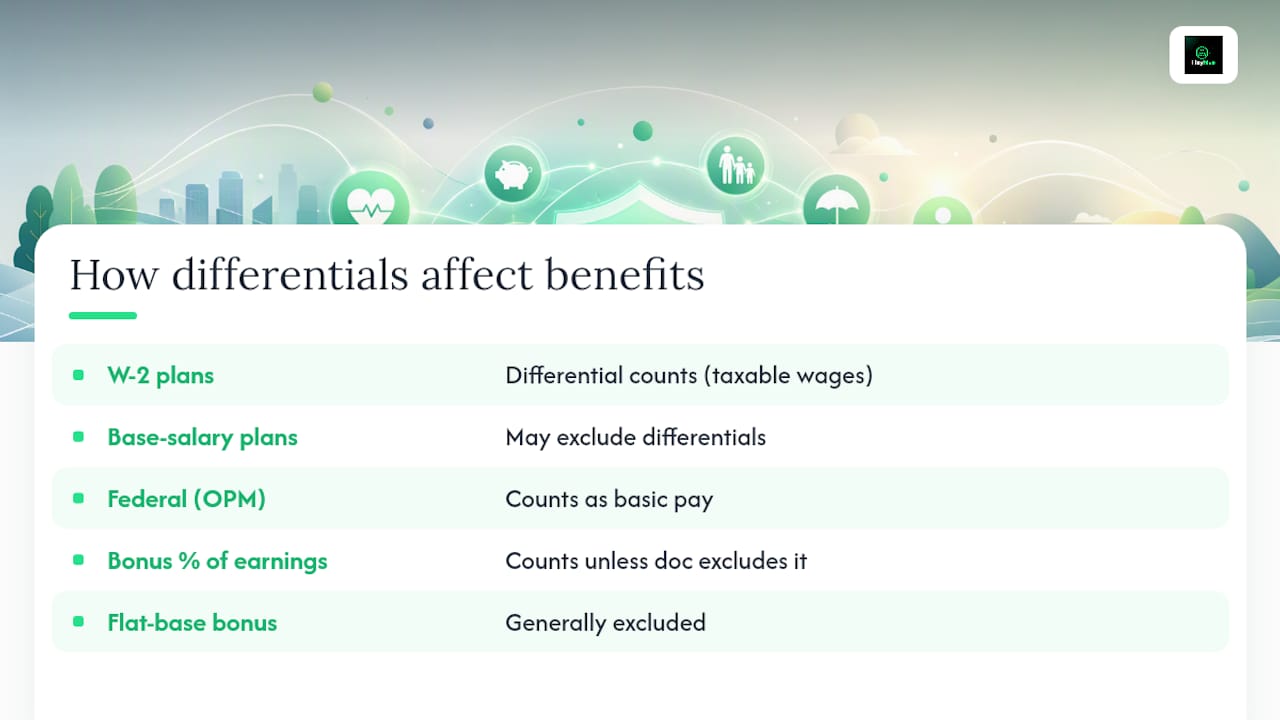
Shift differential pay doesn't disappear once the paycheck clears. It can ripple into benefits calculations depending on how your retirement plan, bonus structure, or leave accrual policy defines "compensation."
Retirement plans that calculate employer matching or profit-sharing contributions based on total W-2 compensation typically capture differential pay automatically, since it's taxable wages. But plans that define contributions around "base salary" or "base rate" specifically may exclude differentials, and that distinction needs to be spelled out in your plan document, not left to interpretation during an audit. For Federal Wage System employees, the rules are more explicit: OPM treats night shift differentials as part of basic pay, which means they factor directly into retirement contribution calculations under federal retirement systems, unlike most private-sector plans.
Bonus calculations raise a similar question. If a bonus is a percentage of annual earnings, differential pay usually counts toward that base unless your bonus plan document says otherwise. Performance bonuses tied to a flat base salary, independent of hours worked, generally don't factor in differentials at all.
The safest approach is auditing every benefit plan document for how it defines "compensation" or "earnings," then confirming whether shift differential pay falls inside or outside that definition. Ambiguous language here is a common source of disputes when an employee's benefit calculation looks different than expected, and it's far cheaper to clarify plan language now than to litigate its meaning later.
Shift Differentials Under Union Contracts
Collective bargaining agreements frequently set shift differential rates directly, and those negotiated terms typically override whatever general policy your handbook describes for non-union staff. If your workforce includes both union and non-union employees, you're often running two separate differential structures simultaneously, and payroll systems need to be configured to apply the correct one based on bargaining unit status.
Union contracts also tend to be more specific about stacking rules than typical company policy. A contract might explicitly state whether an employee working a night shift on a Sunday holiday receives both differentials, one differential, or a single combined premium, language that generic handbooks often leave vague. That specificity is good for compliance since it removes ambiguity, but it also means HR needs to read the actual contract language rather than assuming standard company policy applies.
Renegotiation cycles matter too. When a union contract expires and terms are being renegotiated, differential rates are a common bargaining point, and payroll needs advance notice before new rates take effect so pay codes and blended-rate calculations get updated on time. A gap between a contract's effective date and your payroll system's update date is a direct compliance exposure, since employees are legally owed the new rate from the contract's effective date regardless of when your system catches up.
Industry Differences in Shift Differential Practices
Shift differential practices vary significantly by industry, largely because staffing pressure on unpopular shifts varies too. Healthcare tends to pay some of the highest differentials for night and weekend shifts, reflecting the round-the-clock staffing hospitals and care facilities require and the competition for qualified nursing and clinical staff.

Manufacturing typically uses flat-dollar differentials, often applied consistently across night or swing shifts as a straightforward incentive to keep production lines staffed. Retail and hospitality differentials tend to be smaller and less standardized, often reserved for specific circumstances like holiday coverage or late-night closing shifts rather than a blanket policy.
Logistics and warehousing frequently combine differentials with other incentives, like attendance bonuses, since the operational cost of an unfilled overnight shift can be significant. Call centers and customer service operations sometimes use differentials to cover extended-hours or overseas-time-zone coverage rather than a strict day and night framework.
The common thread across every industry: whatever structure you choose, the same federal regular-rate requirement applies once you're paying non-exempt employees. A hospital and a warehouse follow the same overtime math even though their differential amounts look nothing alike.
Shift Differential Pay Rules for Employers: What Actually Matters
Most compliance content on this topic buries the one fact that matters most: the regular-rate requirement, under a pile of generic advice about "competitive compensation strategy." That's backward. The legal risk isn't whether you offer a differential. It's whether your payroll system correctly blends it into overtime math every single pay period, for every employee, without fail.
The conventional advice to "consult your payroll provider" undersells how much manual review still happens behind the scenes at midsize companies. Plenty of systems handle blended overtime correctly out of the box, but plenty don't, especially when differentials get added as an afterthought to an existing pay structure.
If you take one thing from this, prioritize testing over policy-writing. A beautifully worded handbook section means nothing if the payroll system underneath calculates overtime on the base rate alone. Run the manual math against your system's output before you trust either one. For deeper implementation detail on the overtime side, Heyhive's guide to FLSA overtime rules is worth reading alongside this one.
Frequently Asked Questions
Is shift differential pay required by federal law? No. The FLSA doesn't require private employers to pay shift differentials. They're a matter of company policy or collective bargaining, though once paid to non-exempt employees, they must be included in overtime calculations.
What is a typical shift differential rate? Flat-dollar differentials commonly range from $1 to $3 per hour, while percentage-based differentials often run 5% to 15% of base pay, with healthcare frequently paying higher rates, sometimes 15% to 20% or more.
Do shift differentials count toward overtime pay? Yes, for non-exempt employees. Federal regulations under 29 CFR § 778.207 require differentials to be blended into the regular rate before calculating time-and-a-half overtime.
What's the difference between shift differential and split shift pay? Shift differential compensates for working an undesirable time window, like nights or weekends. Split shift pay compensates for a schedule broken into two or more segments with a significant unpaid gap in between, and some states have separate split shift premium rules beyond federal law.
Are Federal Wage System employees paid differently than private-sector workers? Yes. FWS employees receive mandatory night shift differentials of 7.5% or 10%, depending on their scheduled hours, under OPM rules, and these differentials count as part of basic pay affecting retirement and overtime calculations, unlike most private-sector arrangements.
Sources
- U.S. Department of Labor — Night Work / shift differential guidance
- 29 CFR § 778.207 — Overtime compensation and special situations (regular rate)
- OPM — Night shift differential for Federal Wage System employees