
Every covered, nonexempt employee must receive at least 1.5 times their regular rate of pay for every hour worked beyond 40 in a fixed 168-hour workweek. That is the core rule under the Fair Labor Standards Act, enforced by the U.S. Department of Labor's Wage and Hour Division (WHD). The FLSA covers more than 143 million workers across the country, and the WHD investigates thousands of employers each year for unpaid overtime.
Four actions protect you from back-pay exposure right now:
- Identify coverage. Confirm whether your business meets enterprise coverage ($500,000 annual gross volume) or whether individual employees are covered through interstate commerce activity.
- Document every exemption. For each employee you classify as exempt, record the salary-basis test, salary-level test, and duties test analysis under 29 CFR part 541. Job titles alone prove nothing.
- Use accurate timekeeping. Track all hours worked for nonexempt employees. Employers cannot waive overtime by policy, and Fact Sheet #23 makes clear that records must exist even when employees do not punch a time clock. Employers must maintain accurate and complete timekeeping records for all nonexempt employees.
- Run payroll audits. Review the last two to three years of payroll for misclassified employees, improper deductions, and overtime calculation errors before a WHD investigator does it for you.
The sections below walk through every element of FLSA overtime rules in the order HR teams actually need them: definitions, coverage, exemptions, calculations, recordkeeping, state law, compliance checklists, and enforcement.
Key Takeaways
Federal overtime compliance requires accurate classification, correct regular-rate calculations, and complete time records that can survive a WHD audit for at least two years.
| Point | Details |
|---|---|
| Core overtime rule | Nonexempt employees are owed 1.5× their regular rate for every hour beyond 40 in a fixed 168-hour workweek. |
| Exemption burden | Employers must prove all three EAP tests (salary-basis, salary-level, duties) are met; job titles prove nothing. |
| Current salary threshold | Following the November 2024 vacatur, the operative standard EAP threshold reverts to $684/week under the 2019 rule. |
| Weighted average overtime | Employees working at multiple rates in one workweek require a blended regular rate (total earnings ÷ total hours) before applying the 1.5× multiplier. |
| Heyhive | Heyhive's GPS-verified clock-ins, overtime alerts, and payroll-ready exports reduce recordkeeping errors and unauthorized overtime for hourly and field teams. |
Table of Contents
- What every HR professional must know: core FLSA definitions
- Who the FLSA actually covers: enterprise, individual, and special categories
- How to apply the EAP exemption tests step by step
- Highly Compensated Employees and special exemption categories
- The 2024 final rule, the vacatur, and what salary thresholds apply today
- How to calculate overtime pay correctly: formulas and worked examples
- Records you must keep and timekeeping methods that hold up to WHD review
- When state law gives employees more than the FLSA does
- Your FLSA compliance audit checklist
- What happens when the WHD investigates: penalties and enforcement
- HR and payroll practices that prevent overtime mistakes
- How accurate timekeeping and AI scheduling reduce your FLSA risk
- The FLSA compliance priorities that actually matter most
- Accurate scheduling and GPS time tracking reduce your overtime liability
- Sources
What every HR professional must know: core FLSA definitions
Getting the definitions right is not a formality. Misreading "workweek" or "regular rate" is one of the most common sources of back-pay liability, and both terms have specific legal meanings that differ from how payroll software often labels them.
Workweek
A workweek is a fixed, regularly recurring period of 168 consecutive hours, equal to seven consecutive 24-hour days. You set the start day and time; it does not have to align with the calendar week or your pay period. Once set, it must remain consistent. Averaging hours across two workweeks to avoid overtime is prohibited, a point that trips up multi-site and mobile operations constantly.
Regular rate of pay
The regular rate is the hourly rate actually paid to an employee for the normal, non-overtime hours worked. It is not simply the base wage. Under 29 CFR part 778, the regular rate must include:
- Hourly wages and salaries
- Nondiscretionary bonuses (production bonuses, attendance bonuses, shift differentials)
- Piece-rate earnings
- Most other forms of remuneration for employment
Items excluded from the regular rate include discretionary bonuses, gifts, vacation pay, holiday pay, reimbursements for expenses, and overtime premium payments already paid.
Exempt vs. nonexempt
Nonexempt employees are entitled to overtime. Exempt employees are not, but only when they satisfy all three parts of the EAP (executive, administrative, professional) test under 29 CFR part 541:
- Salary-basis test: The employee must be paid a predetermined, fixed salary that is not subject to reduction based on the quality or quantity of work.
- Salary-level test: The salary must meet or exceed the minimum weekly threshold set by the DOL (see Section 6 for current thresholds).
- Duties test: The employee's primary job duties must meet the regulatory definition for executive, administrative, or professional work.
All three tests must be satisfied simultaneously. Passing two out of three does not create an exemption.
Highly Compensated Employee (HCE) test
The HCE test is a streamlined alternative for very high earners. It requires a lower duties showing but demands a higher total annual compensation threshold. An employee who meets the HCE threshold and customarily performs at least one of the duties of an exempt executive, administrative, or professional employee qualifies. The WHD Fact Sheet #17A makes clear that job titles do not determine exempt status under any of these tests.
Who the FLSA actually covers: enterprise, individual, and special categories
Not every employer or worker is automatically subject to federal overtime rules. Coverage flows through two separate channels, and you need to check both.
Enterprise coverage applies when a business has at least $500,000 in annual gross volume of sales or business done and is engaged in interstate commerce. Certain enterprises are covered regardless of revenue, including:
- Hospitals and institutions primarily engaged in the care of the sick, aged, or mentally ill
- Schools and preschools (public or private)
- Public agencies at the federal, state, or local level
Individual coverage applies when a specific employee is engaged in interstate commerce or in the production of goods for commerce, even if the employer as a whole does not meet the enterprise threshold. A warehouse worker packing goods for shipment across state lines is individually covered even if the employer is a small local business.
A practical decision flow:
- Does the business meet the $500,000 enterprise threshold or fall into a special category? If yes, all nonexempt employees are covered.
- If no, does the individual employee engage in interstate commerce or produce goods for commerce? If yes, that employee is individually covered.
- Apply state overtime laws regardless, since many states cover employees the FLSA does not.
Joint employment can expand coverage. When two businesses share control over an employee's work, both may be jointly liable for FLSA compliance. Staffing agencies, franchises, and subcontractor relationships are common joint-employment scenarios. The DOL's FLSA FAQ provides guidance on how coverage determinations interact with state law.
Pro Tip: If you are unsure whether a worker is individually covered, assume they are and apply overtime protections. The cost of a wrong assumption runs in the direction of back wages and liquidated damages, not a refund.
How to apply the EAP exemption tests step by step
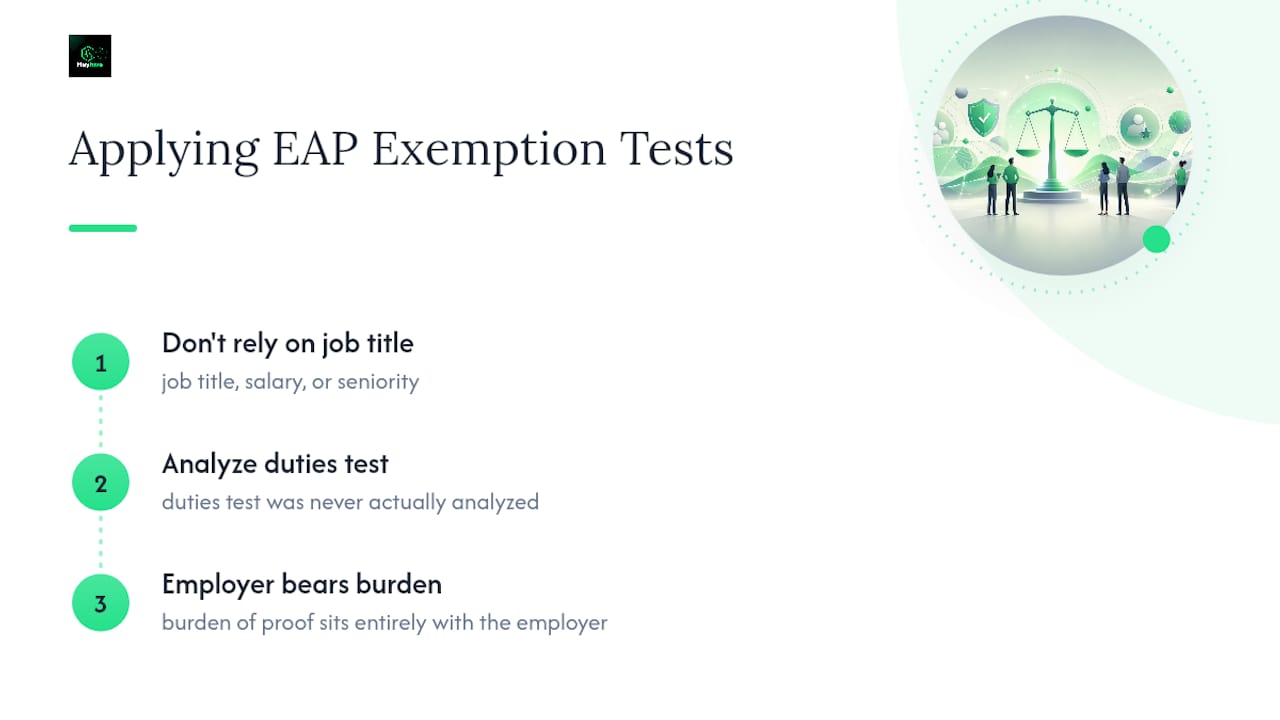
The EAP exemption is where most FLSA liability originates. Employers often classify employees as exempt based on job title, salary, or seniority, then discover during a WHD audit that the duties test was never actually analyzed. The burden of proof sits entirely with the employer.
Step 1: Salary-basis test
Confirm the employee receives a predetermined fixed salary each pay period. The salary cannot be reduced because of variations in the quality or quantity of work. Permitted deductions are narrow:
- Full-day absences for personal reasons (except sickness or disability)
- Full-day absences for sickness or disability when a bona fide sick-leave plan exists
- Penalties imposed in good faith for safety-rule infractions
- Unpaid disciplinary suspensions of one or more full days for workplace conduct violations (under a written policy applied to all employees)
- Partial weeks during the first or last week of employment
Improper deductions, such as docking pay for partial-day absences or for slow business periods, can destroy salary-basis status for the entire class of employees affected, not just the individual.
Step 2: Salary-level test
The employee's weekly salary must meet the current DOL threshold. See Section 6 for the specific figures and their legal status as of 2026.
If a shortfall exists at year-end, the employer may make a "catch-up" payment within one pay period after the end of the 52-week period.
Step 3: Duties test
This is where most misclassifications occur. The duties test requires that the employee's primary duty meets the regulatory definition:
- Executive: Primary duty is management of the enterprise or a recognized department; regularly directs the work of two or more full-time employees; has authority to hire, fire, or make recommendations that carry significant weight.
- Administrative: Primary duty is office or non-manual work directly related to management or general business operations; exercises discretion and independent judgment on significant matters.
- Professional (learned): Primary duty requires advanced knowledge in a field of science or learning, customarily acquired by a prolonged course of specialized intellectual instruction.
- Professional (creative): Primary duty requires invention, imagination, originality, or talent in a recognized field of artistic or creative endeavor.
Pro Tip: Build a duties matrix for each exempt position. List the regulatory factors in one column and the employee's actual documented tasks in the other. Update it annually or when the role changes. A contemporaneous duties statement signed by the employee's manager is your first line of defense in a WHD investigation.
The WHD Fact Sheet #17A states explicitly that job titles do not determine exempt status.
A sample job-duty matrix structure:
Document the analysis, date it, and keep it in the employee's personnel file.
Highly Compensated Employees and special exemption categories
Some positions follow different exemption rules entirely. Knowing which category applies prevents both over-classification (treating someone as exempt who is not) and under-classification (paying overtime to someone who qualifies for a special exemption).
Highly Compensated Employee (HCE) test
The HCE test applies a reduced duties showing in exchange for a higher total compensation requirement. An employee qualifies if they:
- Receive total annual compensation at or above the HCE threshold
- Are paid on a salary or fee basis at a rate at least equal to the standard weekly salary level
- Customarily and regularly perform at least one of the exempt duties of an executive, administrative, or professional employee
The HCE threshold was updated in the 2024 final rule. See Section 6 for the current enforcement posture and applicable figures.
Special exemption categories
Several categories operate under their own rules, separate from the standard EAP test:
- Computer professionals: May be paid on an hourly basis (at a rate of at least $27.63 per hour under the pre-2024 rule) or on a salary basis meeting the standard level. Primary duty must involve systems analysis, programming, software engineering, or similar work requiring theoretical and applied computer knowledge.
- Outside sales employees: No salary requirement. Primary duty must be making sales or obtaining orders away from the employer's place of business. This exemption has no salary-level or salary-basis test.
- Teachers: Exempt if their primary duty is teaching, tutoring, instructing, or lecturing in an educational establishment. No salary test applies.
- Doctors and lawyers: Exempt if they hold a valid license and practice their profession. No salary test applies to these learned professionals.
The following reference points apply to the standard EAP and HCE thresholds under the 2019 rule (currently the operative enforcement level following the 2024 vacatur, as explained in Section 6):
| Category | Weekly Salary Level (2019 rule) | Annual Equivalent |
|---|---|---|
| Standard EAP exemption | $684/week | $35,568/year |
| Highly Compensated Employee | $107,432/year total | $684/week minimum salary component |
These figures reflect the 2019 rule levels the DOL has indicated it is applying following the vacatur of the 2024 rule. Confirm current enforcement posture directly with the WHD before making classification decisions.
The 2024 final rule, the vacatur, and what salary thresholds apply today
This is the section most HR teams need to read carefully, because the regulatory picture changed significantly between 2024 and 2026.
Timeline of the 2024 rulemaking
The DOL published a 2024 final rule updating the EAP salary thresholds with a two-step implementation:
- July 1, 2024: Standard salary level increased to $844 per week ($43,888 annually); HCE threshold increased to $132,964 annually.
- January 1, 2025: Standard salary level was scheduled to increase to $1,128 per week ($58,656 annually); HCE threshold was scheduled to reach $151,164 annually.
- Automatic updates: The rule included a mechanism to update thresholds every three years based on current earnings data.
The November 2024 vacatur
On November 15, 2024, a federal district court in Texas vacated the 2024 final rule in its entirety, including the July 1, 2024 increases that had already taken effect. The court's decision applied nationwide. As a result:
- The salary thresholds reverted to the 2019 rule levels: $684 per week ($35,568 annually) for the standard EAP exemption and $107,432 annually for the HCE threshold.
- The January 1, 2025 increases never went into effect.
- The automatic update mechanism was also vacated.
Current enforcement posture
The DOL has indicated it is enforcing the 2019 rule thresholds following the vacatur. Employers should:
- Verify current DOL notices before making any classification or reclassification decisions, as the regulatory environment remains active.
- Maintain conservative payroll audits that document which threshold was applied and when.
- Monitor the Federal Register for any new rulemaking the DOL may initiate in response to the court's decision.
Pro Tip: If you raised salaries to meet the July 2024 threshold and have not reduced them, those employees remain exempt at the higher salary. Reducing salaries below the level employees were promised can create separate legal exposure. Document your reasoning for any salary changes.
How to calculate overtime pay correctly: formulas and worked examples
Overtime calculation errors are the second most common source of WHD back-pay findings, after misclassification. The math is straightforward once you know the regular rate, but several scenarios add complexity.
The basic formula
Overtime pay = (Regular rate × 1.5) × Overtime hours
The regular rate must be computed correctly before applying the multiplier. Under 29 CFR part 778, it includes all remuneration for employment except the specific exclusions listed in FLSA Section 7(e).
Four worked examples
Example 1: Hourly employee
An employee earns $18.00/hour and works 46 hours in a workweek.
- Regular rate = $18.00
- Overtime hours = 6
- Overtime pay = $18.00 × 1.5 × 6 = $162.00
- Total pay = ($18.00 × 40) + $162.00 = $720.00 + $162.00 = $882.00
Example 2: Salaried nonexempt employee (fixed salary)
An employee earns a fixed salary of $800/week and works 48 hours.
- Regular rate = $800 ÷ 40 = $20.00/hour
- Overtime hours = 8
- Overtime premium = $20.00 × 0.5 × 8 = $80.00 (the salary already covers straight time for all hours)
- Total pay = $800.00 + $80.00 = $880.00
Example 3: Piece-rate employee
An employee earns $0.50 per unit, produces 900 units in 48 hours.
- Total piece-rate earnings = 900 × $0.50 = $450.00
- Regular rate = $450.00 ÷ 48 hours = $9.375/hour
- Overtime premium = $9.375 × 0.5 × 8 = $37.50
- Total pay = $450.00 + $37.50 = $487.50
Example 4: Multiple rates (weighted average overtime)
An employee works two jobs for the same employer in one workweek: 30 hours at $16.00/hour (Job A) and 15 hours at $20.00/hour (Job B), totaling 45 hours.
The OPM guidance on FLSA overtime confirms that when an employee works at two or more rates in a single workweek, the regular rate is the weighted average of those rates.
- Total straight-time earnings = (30 × $16.00) + (15 × $20.00) = $480.00 + $300.00 = $780.00
- Total hours = 45
- Weighted average regular rate = $780.00 ÷ 45 = $17.33/hour
- Overtime hours = 5
- Overtime premium = $17.33 × 0.5 × 5 = $43.33
- Total pay = $780.00 + $43.33 = $823.33
This blended overtime calculation applies whenever an employee works at different rates within the same workweek, whether across departments, job codes, or locations.
Summary of calculation methods
Leave time and holidays: Hours not actually worked, such as paid vacation, sick leave, or holidays, do not count toward the 40-hour overtime threshold. An employee who takes two days of paid vacation and works three days does not trigger overtime even if the vacation pay brings their total compensation above a 40-hour equivalent.
Records you must keep and timekeeping methods that hold up to WHD review
The FLSA does not mandate a specific timekeeping system. What it does require is accuracy. Under 29 CFR part 516, employers must maintain records for each nonexempt employee that include:
- Full name and Social Security number
- Address, including zip code
- Date of birth (if under 19)
- Sex and occupation
- Time and day the workweek begins
- Regular hourly rate of pay
- Hours worked each workday and each workweek
- Total straight-time earnings for each workweek
- Total overtime earnings for each workweek
- All additions to or deductions from wages
- Total wages paid each pay period
- Date of payment and the pay period covered
Payroll records must be retained for at least three years. Time records, work schedules, and records of additions or deductions must be kept for at least two years.
Acceptable timekeeping methods include manual time sheets, punch clocks, electronic badge systems, mobile apps, and supervisor-recorded hours. The DOL permits flexibility in method so long as the records are accurate and complete. What it does not permit is rounding practices that consistently favor the employer or exception-only reporting that omits actual hours worked.
Pro Tip: Run a quarterly timekeeping audit. Pull a random sample of 10 to 15 nonexempt employees and compare their time records to their payroll records. Discrepancies, unexplained gaps, or consistent rounding in one direction are red flags that surface in WHD investigations.
Employers cannot waive overtime obligations by policy. If a nonexempt employee works overtime without prior authorization, the overtime is still owed. The correct response is to pay it and then address the policy violation through discipline, not to withhold pay. Fact Sheet #23 is explicit on this point.
For employee attendance tracking, automated systems that capture clock-in and clock-out times with immutable logs reduce both recordkeeping errors and disputes over hours worked.
Pre-audit recordkeeping checklist
- All nonexempt employees have complete time records for the current and prior two years
- Workweek start day and time is documented and consistent per employee group
- Regular rate calculations are documented for employees receiving bonuses or multiple pay rates
- Payroll records match time records with no unexplained gaps
- Exempt employee files contain current duties analyses and salary documentation
- Any salary deductions are documented with the reason and date
When state law gives employees more than the FLSA does
The FLSA sets a federal floor. When a state or local law provides a greater benefit to the employee, that law applies. This is the "higher standard wins" principle, and it governs every multi-state employer's compliance strategy.
Common state variations you will encounter:
- Daily overtime: California requires overtime pay for hours worked beyond 8 in a single day, regardless of weekly totals. Alaska has similar daily overtime rules.
- Higher salary thresholds: Several states, including California, New York, and Washington, set their own salary thresholds for exempt status that exceed the federal level. In California, the threshold is tied to the state minimum wage and is substantially higher than the federal $684/week.
- Alternative overtime triggers: Some states impose overtime after a certain number of consecutive days worked, independent of the weekly hour count.
- Broader coverage: Some states cover workers the FLSA excludes, such as certain agricultural workers or small-business employees below the enterprise threshold.
Three steps for multi-state employers
-
Build a state law matrix. For each state where you have employees, document the overtime trigger (daily, weekly, or both), the applicable salary threshold for exemptions, and any industry-specific rules. Update it whenever you hire in a new state or when state law changes.
-
Centralize payroll rule changes. When a state updates its overtime threshold or minimum wage, the change must flow through to your payroll system before the effective date. A centralized change-control process with a designated owner prevents the gap between legal change and payroll implementation.
-
Localize employee notices. Several states require written notice of pay rates and overtime policies. Confirm your onboarding documents and pay-stub formats meet state requirements for each location.
The DOL's FLSA FAQ confirms the higher-standard principle: when both federal and state law apply, the employer must follow whichever standard gives the employee the greater benefit.
Your FLSA compliance audit checklist
Run this audit at least annually, and immediately after any reclassification, acquisition, or significant change in job duties.
Priority 1: Coverage and classification
- Confirm the business meets enterprise coverage or identify individually covered employees
- Review every exempt classification against the current salary-level threshold
- Pull the duties analysis for each exempt position and verify it reflects actual current duties
- Confirm no exempt employee has received improper salary deductions in the past three years
Priority 2: Timekeeping and payroll accuracy
- Verify all nonexempt employees have complete, accurate time records
- Confirm the regular rate calculation includes all required remuneration (nondiscretionary bonuses, shift differentials)
- Check that overtime hours are calculated per workweek, not per pay period or averaged across weeks
- Review any piece-rate or multiple-rate employees for correct weighted average overtime calculation
Priority 3: Documentation
- Each exempt employee file contains a current duties statement signed by their manager
- Salary documentation confirms the employee meets the salary-basis and salary-level tests
- Any reclassifications in the past three years are documented with the rationale and effective date
- Back-pay calculations for any corrected errors are retained with the payroll records
Red flags that require immediate follow-up
- An exempt employee's actual duties have changed significantly since the last duties analysis
- Payroll records show deductions from an exempt employee's salary for partial-day absences
- Time records for nonexempt employees show consistent 40-hour weeks with no variation (a sign of rounding or record manipulation)
- An employee classified as exempt earns below the applicable salary threshold
- A nonexempt employee regularly works more than 40 hours but overtime appears only sporadically on payroll
Corrective pay calculation
When you identify a back-pay error, calculate the amount owed using the correct regular rate for each affected workweek. Document the calculation method, the pay period covered, and the reason for the correction. Pay the corrected amount promptly. Voluntary correction before a WHD investigation significantly reduces penalty exposure.
What happens when the WHD investigates: penalties and enforcement
A WHD investigation can be triggered by an employee complaint, a random audit, or a referral from another agency. The process typically begins with a notice to the employer, followed by a records review and employee interviews.
Typical remedies
- Back wages: The employer must pay the full amount of unpaid overtime for the applicable period.
- Liquidated damages: In most cases, the employer owes an equal amount in liquidated damages, effectively doubling the back-pay liability. An employer can avoid liquidated damages only by proving the violation was in good faith and based on a reasonable belief that the conduct was lawful.
- Civil money penalties: For willful or repeated violations, the WHD can assess civil money penalties of up to $1,000 per violation under the FLSA.
- Injunctions: Courts can order employers to stop future violations.
Statute of limitations
The standard statute of limitations for FLSA wage claims is two years from the date of the violation. For willful violations, the period extends to three years. Willfulness means the employer knew or showed reckless disregard for whether its conduct violated the FLSA. Misclassifying employees based on job title alone, without any duties analysis, is the kind of conduct courts have found to support a willfulness finding.
Cooperating with investigators
Provide requested records promptly and accurately. Designate a single point of contact, typically HR or legal counsel, to manage communications. Do not alter or destroy records after receiving notice of an investigation. Voluntary cooperation and early correction of identified violations are factors the WHD considers when determining penalties.
HR and payroll practices that prevent overtime mistakes
Prevention is less expensive than remediation. The practices below address the most common sources of FLSA overtime violations before they become WHD findings.
Overtime approval policies
A written overtime approval policy does not eliminate the obligation to pay overtime, but it does give you a mechanism to control costs and identify unauthorized overtime early. An effective policy includes:
- A clear definition of what constitutes overtime (hours beyond 40 in the workweek, not beyond 8 in a day, unless state law requires daily overtime)
- A requirement for manager pre-approval before overtime is worked
- A process for reporting and paying unauthorized overtime even when it was not pre-approved
- Consequences for employees who work unauthorized overtime repeatedly
Manager training
Managers are the first line of FLSA compliance. Train them on:
- What counts as "hours worked" (pre-shift prep, post-shift cleanup, mandatory meetings, on-call time that restricts the employee's freedom)
- Why they cannot tell employees to "work off the clock" or skip recording overtime
- How to recognize when a nonexempt employee is approaching 40 hours and adjust scheduling accordingly
- How to complete a manager attestation form for exempt employees under their supervision
A manager attestation form should capture the employee's name, position, the manager's name, the date, and a brief statement confirming the employee's primary duties match the documented duties analysis.
Scheduling practices that reduce inadvertent overtime
Shift clustering, where multiple employees are scheduled for the same peak hours without staggered start times, is a common cause of inadvertent overtime. Practical controls include:
- Setting a weekly hour cap alert in your scheduling system for nonexempt employees
- Reviewing projected hours before publishing a schedule, not after the week ends
- Using AI-assisted scheduling to flag employees approaching the 40-hour threshold before shifts are confirmed
Pro Tip: When reclassifying an employee from exempt to nonexempt, brief both the employee and their manager before the change takes effect. Explain what will change (timekeeping requirements, overtime approval process) and what will not (job duties, compensation for straight-time hours). Reclassifications handled without communication create confusion and resentment that leads to timekeeping errors.
For additional scheduling and policy guidance, the Heyhive workforce management blog covers practical approaches to shift management, overtime controls, and payroll-ready time tracking.
How accurate timekeeping and AI scheduling reduce your FLSA risk
The DOL permits employers to choose their own timekeeping method, provided it produces accurate records. For field teams, multi-site operations, and businesses with mobile workforces, that flexibility is both an opportunity and a risk. Manual records are easy to dispute; automated, GPS-verified records are not.
Features that materially lower compliance risk
When evaluating timekeeping and scheduling tools, look for:
- GPS-verified clock-ins: Confirm the employee was physically at the work location when they clocked in. Reduces disputed hours and unauthorized off-site work.
- Immutable time logs: Records that cannot be edited without an audit trail. Any change shows who made it, when, and why.
- Exception reporting: Automatic alerts when an employee's hours approach or exceed 40 in the workweek, when a clock-in is missing, or when a shift runs significantly longer than scheduled.
- Geo-fencing: Defines a geographic boundary for clock-in eligibility. Employees outside the boundary cannot clock in, preventing accidental or fraudulent time entries.
- Manager overrides with audit trail: Managers can correct errors, but every correction is logged with a timestamp and the manager's credentials.
- Payroll-ready exports: Time data exports directly to payroll in a format that preserves the workweek structure, regular rate components, and overtime hours separately.
Operational examples
A construction company with crews at five active job sites uses GPS time clock software to capture arrival and departure at each site. When a WHD investigator requests time records for a specific employee over a 12-week period, the employer produces a complete, timestamped log in minutes rather than reconstructing paper records. The geo-fenced clock-in data also resolves a disputed overtime claim by showing the exact hours the employee was on-site.

A restaurant group with locations in three states uses geofencing time tracking to enforce location-specific clock-in rules and generate weekly exception reports. Managers review the exception report every Monday morning and approve or correct any anomalies before payroll runs on Wednesday. The process catches rounding errors and missed punches before they become back-pay liabilities.
Pro Tip: For field operations, configure GPS boundaries slightly inside the actual work perimeter to account for GPS drift. A boundary set exactly at the property line will generate false exceptions when employees are standing at the edge of the site. A 50-foot inset eliminates most GPS-drift disputes.
Automated attendance systems with GPS verification reduce disputed hours and simplify WHD responses by creating auditable logs. This operational benefit complements legal compliance but does not change exemption tests or substitute for a proper duties analysis.
The FLSA compliance priorities that actually matter most
Most FLSA overtime violations are not the result of bad intent. They come from three operational gaps: not knowing which employees are covered, not documenting exemption analyses, and not maintaining accurate time records. Fix those three things and you eliminate the vast majority of your exposure.
For small employers (under 50 employees), the highest-return action is a one-time classification audit. Pull every exempt position, run the three-part EAP test against actual duties, and document the analysis. Most small employers have never done this formally.
For mid-size employers (50 to 500 employees), the priority shifts to timekeeping accuracy and regular rate calculations. As headcount grows, the number of employees receiving nondiscretionary bonuses, shift differentials, or multiple pay rates increases. Each one is a potential regular-rate error.
For large employers and multi-state operations, the state law matrix and payroll rule change-control process are the critical controls. A threshold change in California or New York that does not flow through to payroll on the effective date creates immediate back-pay exposure across a large employee population.
Accurate scheduling and GPS time tracking reduce your overtime liability
Keeping FLSA overtime rules straight across multiple locations, pay rates, and employee classifications is genuinely complex. The legal analysis requires HR expertise. The operational execution requires tools that capture hours accurately, flag exceptions before payroll runs, and produce records that hold up under WHD review.
Heyhive gives you both sides of that equation. The platform generates full schedules in seconds while respecting each employee's overtime limits, flags employees approaching 40 hours before the week ends, and captures GPS-verified clock-ins for field and multi-site teams. Every time entry is logged with an immutable audit trail. Payroll exports preserve workweek structure and separate straight-time from overtime hours, so your payroll team is not reconstructing calculations from raw data.

You approve every schedule before it publishes. You review every exception before payroll runs. Heyhive handles the hour tracking, the overtime alerts, and the payroll-ready exports. You stay in control of the decisions that matter.
If you manage hourly or field employees and want to reduce recordkeeping errors and unauthorized overtime before they become a WHD problem, see what Heyhive can do for your team.
Sources
Every claim in this article traces back to a primary source. These are the ones worth saving:
This article is general information, not a substitute for advice from a qualified lawyer. Consult a qualified legal professional about your own circumstances before acting on anything here.