
What is a no call no show policy?
A no call no show occurs when an employee misses a scheduled shift without notifying the employer through approved channels by a set deadline. Your no call no show policy is the written framework that defines what counts as a violation, what consequences follow, and how managers should respond. Without it, you are enforcing rules that exist only in your head, and that creates inconsistency, legal exposure, and real operational pain.
Every effective policy covers these core elements:
- Definition: A clear statement that a no call no show means failing to report an absence through an approved channel before a specified deadline, typically within a short time before the shift starts.
- Approved notification methods: Phone call to a direct supervisor, a designated HR line, or a workforce management platform. Text messages to personal numbers or informal channels generally do not qualify.
- Deadlines: The exact cutoff time by which an employee must notify the employer. Vague language like "as soon as possible" invites disputes.
- Consequences: A tiered disciplinary structure, from verbal warning through termination, tied to the number of offenses.
- Job abandonment clause: The threshold at which consecutive no call no shows are treated as voluntary resignation, usually a small number of consecutive days.
- Exceptions: Documented accommodations for emergencies, protected leaves under the Family and Medical Leave Act (FMLA), and disabilities covered by the Americans with Disabilities Act (ADA).
A quick example: an employee scheduled at 8:00 AM who neither shows up nor contacts a supervisor by 7:00 AM has committed a no call no show under a one-hour-notice policy. An employee who calls in sick at 6:45 AM has not, even if the call is inconvenient.
Table of Contents
- Why a formal absence policy protects your business
- Key components that make an attendance policy actually work
- How to create and implement a no call no show policy step by step
- How to handle no call no show incidents effectively
- Communication and documentation strategies that hold up under scrutiny
- What the law actually says about no call no show
- Valid and invalid excuses: where the line falls
- Compliance with payment and equipment return after a no call no show
- How to integrate your no call no show policy with your attendance management system
- Balancing firm enforcement with employee morale and retention
- Heyhive gives you real-time control over attendance and coverage
- Key Takeaways
Why a formal absence policy protects your business
Operational disruption is the most immediate cost. One unplanned absence on a lean shift forces you to scramble for coverage, pay overtime, or run short-staffed, all of which affect output, customer service, and team morale. Multiply that across a year, and the financial toll becomes significant. The CDC Foundation has documented that worker illness and injury alone costs U.S. employers $225 billion annually, and unplanned absences are a major driver of that figure.
Beyond the dollars, the cultural cost is real. When some employees see colleagues disappear without consequence, they lose confidence in management's fairness. A written, consistently enforced policy signals that the rules apply equally to everyone.
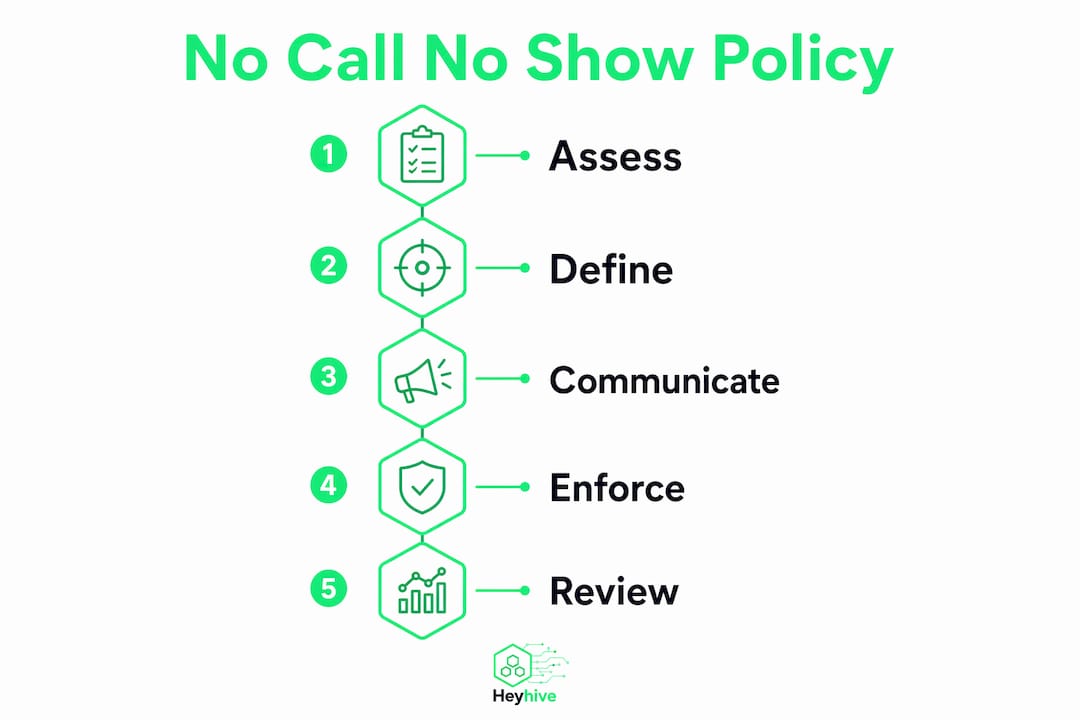
A formal policy also limits your legal exposure. Without documented procedures, a terminated employee can credibly argue the discipline was arbitrary or discriminatory. With them, you have a paper trail that shows consistent application of pre-communicated rules.
Key benefits of having a written employee no show policy in place:
- Reduces operational disruptions by setting clear expectations upfront.
- Creates a consistent, defensible record if a termination is challenged.
- Improves employee accountability and reduces repeat offenses.
- Protects against discrimination claims by applying rules uniformly.
- Gives managers a clear script for handling incidents without guessing.
Key components that make an attendance policy actually work
A policy that is vague or incomplete creates more problems than it solves. Here is what every effective no call no show policy must include:
Clear definitions. Spell out exactly what constitutes a no call no show versus a late call-in versus an excused absence. Ambiguity is where disputes are born.

Notification requirements. Specify the approved communication channels and the deadline. Requiring a direct phone call to a supervisor, rather than a text to a coworker, closes the loopholes employees sometimes use to claim they "notified someone."
Progressive disciplinary framework. Progressive discipline typically starts with a written warning, escalates to a final written warning or suspension, and ends in termination after repeated offenses. Define exactly how many incidents trigger each level and over what time period.
Job abandonment rules. Most employers treat two to three consecutive days without contact as job abandonment and voluntary resignation. State your threshold explicitly in the policy.
Protected leave exceptions. Before any disciplinary action, you must evaluate whether the absence qualifies as protected leave under FMLA, ADA, or applicable state laws. Verifying protected leave status before disciplining is not optional. It is how you avoid wrongful termination claims.
Documentation requirements. Log every contact attempt, every employee explanation, and every disciplinary step taken. Dates, times, and outcomes all belong in the record.
Dispute and appeal process. Employees should know how to contest a no call no show designation if they believe it was incorrectly applied, for example, if they contacted a supervisor who failed to log it.
How to create and implement a no call no show policy step by step
Building the policy from scratch is straightforward when you follow a structured process. Here is how to do it right.
Step 1: Assess your operational needs. Identify which roles and shifts are most vulnerable to coverage gaps. A hospital unit and a retail floor have different risk profiles. Your policy's urgency and consequences should reflect that reality.
Step 2: Define scope and notice requirements. Decide who the policy covers (all hourly employees, salaried staff, or both), what counts as an approved notification method, and what the deadline is. Write these in plain language, not legal boilerplate.
Step 3: Build your disciplinary ladder. Map out the specific consequences at each offense level. A common structure:
- First offense: verbal warning documented in writing.
- Second offense: written warning placed in the employee file.
- Third offense: final written warning or unpaid suspension.
- Fourth offense (or two to three consecutive days): termination or job abandonment designation.
Step 4: Communicate the policy to all employees. Distribute the written policy during onboarding and at each annual policy review. Require a signed acknowledgment. Posting it in a shared digital workspace or employee portal ensures no one can claim they never saw it.
Step 5: Train your managers. Supervisors are the first line of enforcement. They need to know the exact steps to take when an employee does not show up: call the employee, document the attempt, contact emergency contacts if warranted, and notify HR within the timeframe your policy specifies. Inconsistent enforcement by managers is the fastest way to undermine a solid policy.
Step 6: Review and update regularly. State leave laws change. Your workforce changes. Review the policy at least annually and update it when relevant laws or operational needs shift.
Pro Tip: Use HR document automation tools to generate acknowledgment forms, track policy distribution, and maintain a digital record of every employee sign-off. This removes the manual burden and creates an audit-ready trail from day one.
How to handle no call no show incidents effectively
When an employee does not show up and does not call, your response in the first hour matters as much as the policy itself. Here is the sequence that protects you and your team.
Immediate outreach. Call the employee, document the attempt with a timestamp, and if there is no response, try an emergency contact if your policy permits it. Notify HR within the timeframe your policy specifies. Do not skip this step even if you are confident the employee is simply a no-show.
Evaluate before you discipline. Before issuing any disciplinary action, ask whether the absence could be covered by FMLA, ADA, or a state-specific protected leave. An employee who was in a car accident or hospitalized overnight may have a legitimate FMLA claim even if they could not call. Thorough evaluation of potential protected leave before termination is legally critical.
Apply progressive discipline consistently. Once you have confirmed the absence is not protected, follow your disciplinary ladder without deviation. Skipping steps for some employees and not others is exactly the kind of inconsistency that generates discrimination claims.
Document everything. Every action you take belongs in the record.
| Action | What to Document |
|---|---|
| Initial contact attempt | Date, time, method, outcome |
| Emergency contact attempt | Date, time, person reached, what was said |
| Employee explanation (if given) | Date received, content, any supporting documentation |
| Disciplinary action issued | Level of discipline, date, manager signature, employee signature |
| HR notification | Date, time, HR contact name |
Maintain an appeal path. Employees who believe a no call no show was incorrectly recorded should have a clear, written process to contest it. This protects you as much as it protects them.
Communication and documentation strategies that hold up under scrutiny
A policy only works if employees actually know it exists and understand what it requires. Distribution is not enough. You need acknowledgment.
Best practices for communicating your workplace attendance policy:
- Include the policy in your employee handbook and review it during onboarding.
- Require a signed acknowledgment form, digital or paper, and store it in the employee's file.
- Post the policy in your team communication platform or employee portal so it is always accessible.
- Review the policy in team meetings at least once a year, especially after any updates.
Documentation is where most employers fall short. Thorough records, including dates, times, contact attempts, employee explanations, and disciplinary actions, are essential to consistent enforcement and your legal defense if a termination is ever challenged.
Digital attendance and scheduling systems add a layer of transparency that paper logs cannot match. When shift assignments, clock-in records, and absence logs all live in one platform, there is no ambiguity about what was scheduled and what actually happened. That visibility also helps managers spot patterns, like an employee who consistently misses Monday shifts, before a situation escalates.
Pro Tip: Train managers to open follow-up conversations with concern rather than accusation. "We noticed you weren't in and wanted to make sure you're okay" lands very differently than "Why weren't you here?" The first approach de-escalates, encourages honesty, and gives you better information before you decide on next steps.
What the law actually says about no call no show
No specific federal law defines or regulates no call no show policies. The Fair Labor Standards Act governs wages and hours but does not dictate how employers must handle unplanned absences. That means you have broad discretion to set your own notice requirements and disciplinary rules, as long as you apply them consistently and do not run afoul of other statutes.
The laws that do constrain your policy are the ones governing protected leave and disability accommodation. FMLA allows eligible employees up to 12 weeks of unpaid, job-protected leave per year for qualifying reasons, and an employee who is incapacitated may not be able to call in advance. ADA requires reasonable accommodation for employees with qualifying disabilities, which can include modified attendance requirements. State laws add another layer: many states have paid sick leave statutes, and some, like Washington State, have specific paid sick leave protections that affect how you can discipline for absences.
The practical takeaway: your policy can be strict, but it must carve out space for legally protected absences. A blanket "three no call no shows and you're terminated" rule, applied without checking for FMLA or ADA applicability, is a wrongful termination claim waiting to happen.
Valid and invalid excuses: where the line falls
Not every reason an employee gives for missing a shift without notice carries the same weight. Here is how to think about it.
Generally valid (may warrant excused absence or protected leave review):
- Medical emergency, hospitalization, or sudden incapacitation.
- Death or serious illness of an immediate family member.
- Domestic violence situation requiring immediate safety response.
- Natural disaster or severe weather making travel impossible.
- Documented FMLA or ADA-qualifying condition.
Generally not valid (subject to normal disciplinary process):
- Oversleeping or forgetting the shift.
- Transportation issues that could have been anticipated.
- Personal conflicts or social plans.
- Dissatisfaction with the schedule.
- Claiming to have texted a coworker instead of following the approved notification process.
The distinction matters because your response should differ. A hospitalized employee deserves a conversation about FMLA paperwork. An employee who overslept deserves a documented verbal warning. Treating both the same way is both unfair and legally risky.
Compliance with payment and equipment return after a no call no show
Two practical issues arise when a no call no show leads to termination: final pay and company property.
Under the Fair Labor Standards Act, you must pay all earned wages for hours worked, regardless of how the employment ended. Most states set specific deadlines for final paychecks after termination, ranging from the next regular payday to 72 hours. Check your state's Department of Labor rules, because missing that deadline creates additional liability.
Company equipment, uniforms, key fobs, and access credentials must be returned. Your policy should state the return process and timeline clearly. You generally cannot withhold a final paycheck because an employee has not returned equipment, though you may be able to pursue the cost through other legal channels depending on your state. Document the equipment return process the same way you document everything else: dates, items, and signatures.
How to integrate your no call no show policy with your attendance management system
A written policy is only as strong as the system behind it. When your attendance tracking lives in spreadsheets or relies on managers remembering to log incidents, enforcement becomes inconsistent and records become unreliable.
Integrating your absence policy with a digital attendance tracking platform gives you several concrete advantages:
- Automated logging of clock-ins and absences removes manual entry errors.
- Real-time alerts notify managers the moment a shift goes uncovered.
- Centralized records make it easy to pull an employee's full absence history when a disciplinary conversation is needed.
- Shift coverage tools let you fill gaps fast, reducing the operational impact of a no call no show.
AI-powered scheduling also reduces a common source of no call no show disputes: schedule confusion. When employees receive clear, confirmed shift assignments through a single platform and can view their schedule at any time, "I didn't know I was working" becomes a much harder argument to make.
Balancing firm enforcement with employee morale and retention
Strict enforcement and a healthy workplace culture are not opposites. The key is consistency, transparency, and a genuine effort to understand what is driving absences before reaching for the disciplinary playbook.
A few practices that keep enforcement firm without damaging morale:
- Apply the policy equally. Nothing erodes trust faster than seeing a manager excuse a favorite employee's no call no show while disciplining others for the same behavior.
- Look for patterns, not just incidents. An employee with three no call no shows in a month may be dealing with a personal crisis, a scheduling conflict, or a health issue. A conversation before the third disciplinary step can surface information that changes the outcome.
- Use the appeal process. Employees who feel they were incorrectly disciplined and have a real path to contest it are less likely to disengage or file complaints.
- Recognize reliable attendance. Positive reinforcement for consistent attendance costs nothing and signals that you notice effort, not just failure.
The goal of a no call no show policy is not to catch employees doing something wrong. It is to set clear expectations so that the vast majority of your team, who show up reliably, know their effort is protected and valued.
Heyhive gives you real-time control over attendance and coverage
Managing no call no show incidents is far less stressful when you can see exactly who is scheduled, who has clocked in, and where coverage gaps are forming, all in one place.
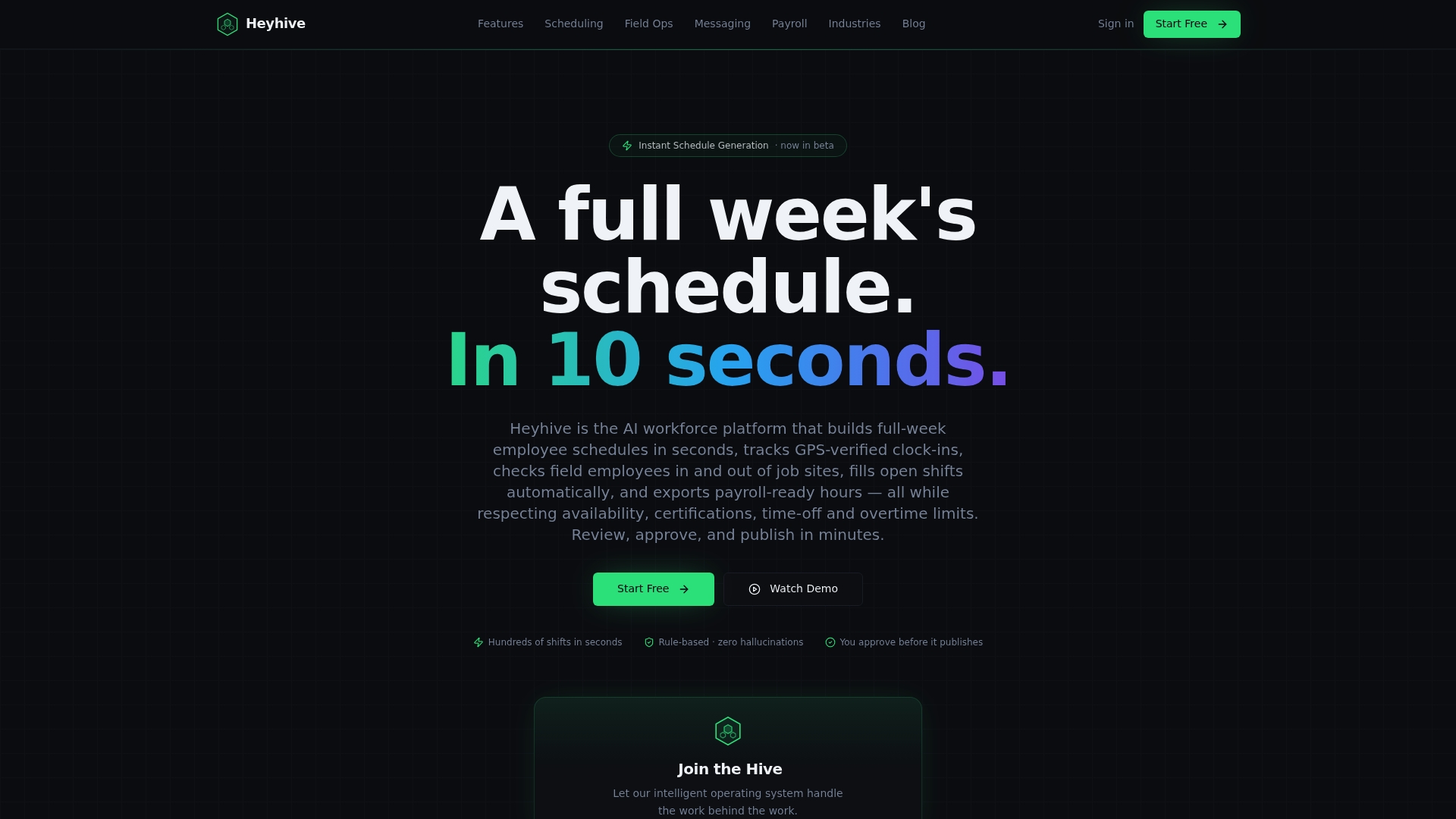
Heyhive's AI-powered workforce platform gives managers that visibility from the moment a shift is published. GPS-verified clock-ins confirm field employees have arrived. Real-time attendance tracking flags uncovered shifts the moment they go unaddressed. And when a no call no show does happen, Heyhive's open shift coverage tools let you fill the gap fast, without a chain of manual phone calls. The scheduling engine respects availability, certifications, and overtime limits automatically, so the replacement you pull in is always a compliant one. You approve every change before it goes live. That is the control your policy needs behind it.
Ready to reduce coverage gaps and enforce your attendance policy with confidence? Start with Heyhive and see how much easier workforce management gets when the data is always current.
Key Takeaways
A no call no show policy works only when it is written, communicated, consistently enforced, and backed by real-time attendance data that managers can act on immediately.
| Point | Details |
|---|---|
| Define it precisely | State the exact notification deadline, approved channels, and what counts as a violation. |
| Protect yourself legally | Always check for FMLA, ADA, or state leave applicability before issuing discipline or terminating. |
| Job abandonment threshold | Two to three consecutive no call no shows are typically treated as voluntary resignation. |
| Document every step | Log contact attempts, employee explanations, and disciplinary actions with dates and signatures. |
| Heyhive closes the gap | Real-time attendance tracking and open shift tools let you respond to no call no shows before they become operational crises. |