
Fair workweek compliance requires five immediate actions: post schedules at least 14 days in advance, provide a written good-faith estimate at hire, document all schedule changes with time-stamped employee consent, pay predictability premiums for employer-initiated changes inside the notice window, and retain every record for at least three years. If your operation touches fast food, retail, or hospitality in New York City, Chicago, Los Angeles, Seattle, Philadelphia, San Francisco, Berkeley, Emeryville, Evanston, or Oregon, you are almost certainly covered by at least one ordinance today.
Your quick-action checklist:
- Post schedules 14 days in advance (72 hours for NYC retail fast food — confirm your local rule)
- Issue a written good-faith estimate at or before the first day of work
- Capture written, time-stamped consent for every employer-initiated change
- Calculate and pay predictability premiums when you change or cancel shifts inside the notice window
- Enforce right-to-rest rules (typically 9–11 hours between closing and opening shifts)
- Offer additional hours to existing staff first before posting open shifts externally
- Post required notices in a visible location and in employees' primary languages
- Retain time-stamped records for at least three years (some jurisdictions require longer)
Your 7/30/90-day compliance timeline at a glance:
- Next 7 days: Identify every covered location, pull local ordinance thresholds, and audit current schedule-posting lead times.
- Next 30 days: Update onboarding forms with a good-faith estimate template, set a 14-day posting standard, and draft a written consent workflow.
- Next 90 days: Configure your scheduling system to auto-timestamp postings, align payroll to flag predictability pay, train all managers, and run your first internal records audit.
For local thresholds, start with the NYC DCWP, Oregon BOLI, and Littler's jurisdiction tracker as your primary references.
Key Takeaways
Fair workweek compliance is won or lost on your records: time-stamped postings, written consents, and payroll entries that match every employer-initiated schedule change.
| Point | Details |
|---|---|
| 14-day advance notice | Post complete schedules at least 14 days out; NYC retail fast food uses a 72-hour rule. |
| Good-faith estimate at hire | Provide a written estimate of hours, days, and on-call expectations before or on the first day of work. |
| Predictability pay | Pay 1 hour at the regular rate for added shifts; half-rate for reduced hours when you change schedules inside the notice window. |
| Records are the compliance control | Time-stamped postings, written consents, and payroll entries are what investigators demand; missing records drive enforcement outcomes. |
| Heyhive for audit-ready scheduling | Heyhive automates time-stamped postings, consent capture, and predictability-pay calculation, producing exportable audit reports on demand. |
Table of Contents
- What does fair workweek compliance actually require?
- Which employers and locations are covered?
- What records do enforcement agencies actually look for?
- How do penalties and enforcement actually work?
- Your 30/60/90-day implementation plan
- What software features actually reduce your compliance risk?
- Why defensible recordkeeping is your single biggest compliance lever
- Heyhive keeps your scheduling audit-ready
- The employer mistakes we see most often
- Sources
What does fair workweek compliance actually require?
Every fair workweek ordinance is built around the same six operational rules. The details vary by city, but the underlying employer obligations are consistent enough that you can build one compliance framework and tune it per jurisdiction.
Advance notice of schedules
The 14-day advance-notice standard is now the modal requirement across modern ordinances. You must post a complete, written schedule covering every employee's shifts at least 14 calendar days before the first day that schedule covers. "Posting" means both a physical notice in a visible workplace location and individual delivery to each employee, typically via a scheduling app or written notice. NYC fast-food employers follow the same 14-day rule, while NYC retail operates on a 72-hour advance-notice window.
What counts as delivery matters. A schedule pinned to a break-room bulletin board without individual notification does not satisfy most ordinances. The employee must receive the schedule, and you must be able to prove it with a time-stamped record.
Good-faith estimate at hire
Before or on an employee's first day, you must provide a written good-faith estimate of their expected schedule. The estimate must include:
- Median hours per week the employee can expect
- Expected days and times of shifts (or a range)
- Whether on-call shifts are expected and how they work
- The location(s) where the employee will work
Chicago's updated rules, effective June 1, 2026, require additional specificity in the estimate's content. When an employee's actual schedule consistently differs from the estimate, you must update the document. Treat the good-faith estimate as a living record, not a one-time onboarding checkbox.
Predictability pay and premium formulas
When you change a posted schedule inside the advance-notice window without the employee's written consent, you owe predictability pay. The common formulas:
- Added or extended shifts: 1 hour of pay at the employee's regular rate
- Reduced hours or canceled shifts: half the regular rate for each hour removed
- On-call shifts the employee is not called in for: typically half the regular rate for each on-call hour
Employee-requested changes are exempt. The premium applies only to employer-initiated changes. Payroll treatment matters here: the DOL's Fact Sheet #56B explains when scheduling penalty payments must be included in the FLSA regular rate for overtime calculations and when they can be excluded under 29 CFR §§778.220–.223. Get your payroll team aligned on this before you go live.
Right-to-rest and clopening rules
Most ordinances prohibit scheduling an employee for an opening shift that starts fewer than 9–11 hours after their previous closing shift, a practice called "clopenings." If the employee consents in writing, some jurisdictions allow it with a premium pay obligation. Without consent, the schedule change is simply prohibited. Train managers to check shift gaps before publishing, not after.

Access-to-hours and offer-of-shifts rules
Before posting an open shift externally or hiring a new employee to fill hours, you must first offer those hours to qualified existing employees. The offer must be in writing, with a defined response window. Keep a log of every offer made, who received it, and whether it was accepted or declined.
Posting and language requirements
Required notices must be posted in a conspicuous location at each worksite. NYC DCWP publishes downloadable posters and software specifications for fast-food and retail employers. Many ordinances require multilingual posting when a significant portion of your workforce speaks a language other than English. Seattle's secure-scheduling resources include employer FAQs and posting templates you can adapt.
Which employers and locations are covered?
Coverage is not automatic. You need to pass three tests: industry, headcount, and location.
The three coverage tests
Industry filter: Most ordinances target retail, fast food, food service, and hospitality. Some extend to healthcare and building services. Oregon's predictive scheduling law covers retail, hotels, motels, and food service employers. Chicago's ordinance covers building services, healthcare, hotels, manufacturing, restaurants, retail, and warehouse services.
Headcount threshold: Coverage typically kicks in at 100–500 employees globally or within a franchise network. Franchise aggregation rules mean a franchisee with 10 locations may be covered based on the franchisor's total employee count, not just their own.
Location-based coverage: The ordinance applies to each covered workplace individually. A company with 20 locations may have 5 covered and 15 not, depending on which cities have enacted rules.
Jurisdiction-by-jurisdiction coverage
Chicago's rules are in active revision. The June 2026 updates expand good-faith estimate requirements and tighten recordkeeping obligations, so confirm current thresholds with Chicago's city guidance directly.
Oregon's law, which raised its advance-notice standard to 14 days effective July 1, 2020, remains the primary state-level model. Every other jurisdiction listed above is a city or county ordinance.
Conservative coverage posture
For multi-location operators, you have two design choices: build per-jurisdiction policy modules or apply the strictest local rule everywhere. Labor experts note that the strictest-everywhere model often reduces legal complexity and back-pay exposure, even though it carries a modest labor-cost overhead. For most employers with 5 or more covered locations, the administrative savings from one unified policy outweigh the cost of applying 14-day notice and full premium formulas everywhere.
Pro Tip: Before finalizing your coverage map, check franchise aggregation rules in each jurisdiction. A single franchise agreement can pull all your locations into coverage even if each individual site is below the headcount threshold.
What records do enforcement agencies actually look for?
Investigators do not start with your schedule. They start with your records. If you cannot produce time-stamped evidence that a schedule was posted, that an employee received it, and that any change was consented to in writing, the presumption shifts against you.
Required records by category
- Schedule postings: Time-stamped log showing when each schedule was published, the week it covers, and the employees it includes
- Employee notifications: Individual delivery receipts or read-confirmations with timestamps
- Good-faith estimates: Signed copies for every employee, with the date issued and any update dates
- Consent records: Written, time-stamped consent for every employer-initiated change inside the notice window, including the employee's name, the change description, and the date/time of consent
- Reasons for changes: Some jurisdictions require you to document why a schedule was changed
- Predictability pay entries: Payroll records showing the premium amount, the triggering event, and the pay period
- Offer-of-hours logs: Written record of every open-shift offer, the employees it was sent to, and their responses with timestamps
- Posting confirmations: Evidence that required notices are displayed at each worksite
Technical specifications agencies expect
NYC DCWP publishes software specifications that describe what a compliant scheduling system should produce. The core technical requirements across jurisdictions converge on:
- Immutable audit trail: Records cannot be edited or deleted after creation; changes create a new version with a timestamp
- Time-stamped schedule posting: The system records the exact date and time a schedule is published and when each employee is notified
- Integration between scheduling and payroll: Predictability pay triggers flow automatically to payroll without manual re-entry
- Readable wage stubs: Pay stubs must show predictability pay as a distinct line item
- Multilingual posting capability: The system can generate notices in employees' primary languages
- Exportable audit reports: HR can pull a complete compliance report for any date range within minutes
Enforcement settlements have repeatedly traced back to missing or insufficient records. Labor and compliance experts report that missing records were central in multiple large enforcement outcomes, including cases where employers believed they were compliant but could not prove it.
Quarterly records audit checklist
Run this check every quarter:
- Pull a random sample of 10 schedules from the past 90 days. Confirm each has a timestamp and employee notification record.
- Pull all schedule changes from the same period. Confirm each has written consent or a predictability-pay entry.
- Pull all new-hire records. Confirm each has a signed good-faith estimate with an issue date.
- Pull all open-shift offers. Confirm each has a written log with employee responses.
- Confirm required posters are displayed at every covered worksite.
- Confirm your retention policy covers at least three years of records.
Pro Tip: Ask your scheduling system vendor for a "compliance export" report before you need it in an investigation. If the vendor cannot produce a clean, time-stamped audit trail on demand, that is a procurement disqualifier.
How do penalties and enforcement actually work?
Agencies do not wait for employee complaints. Many jurisdictions conduct proactive audits, particularly targeting industries with high violation rates.
Penalty ranges and enforcement mechanics
Penalties vary by jurisdiction but follow a common structure:
- Per-violation fines: Typically assessed per affected employee per violation. A single missed predictability-pay event for 20 employees is 20 violations.
- Back pay and premium recovery: Employees are entitled to unpaid predictability premiums plus interest.
- Civil penalties: Some jurisdictions add civil penalties on top of back pay.
- Cure periods: Los Angeles's Fair Work Week Ordinance includes notice-of-correction mechanics that give employers a limited window to cure violations before penalties escalate. Use that window immediately and document every corrective action.
Common audit triggers
Investigators look for patterns, not isolated incidents. The triggers that most frequently open investigations:
- Inconsistent posting timestamps: Schedules that appear to have been backdated or posted after the required window
- Missing good-faith estimates: New hires with no estimate on file, or estimates that are unsigned or undated
- No written consent for changes: Schedule changes inside the notice window with no consent record
- Wage-stub mismatches: Payroll records that do not show predictability pay for periods with documented schedule changes
- Repeat late changes: A pattern of last-minute schedule modifications that suggests the advance-notice rule is being ignored systematically
How to respond to an agency notice
- Preserve all records immediately. Do not delete, modify, or archive anything.
- Identify the time period and employees named in the notice.
- Pull the full records package for that period within 48 hours.
- Engage employment counsel before responding to the agency.
- Document every corrective action you take during the investigation.
Your 30/60/90-day implementation plan
30-day sprint: scope and foundations
Owner: HR Director + Legal
- Map every location against jurisdiction coverage tests (industry, headcount, franchise aggregation).
- Pull the current advance-notice lead time for each covered location. Flag any location posting fewer than 14 days out.
- Draft a good-faith estimate template that meets the most detailed local requirement (Chicago's June 2026 standard is currently the most specific).
- Update onboarding packets to include the signed good-faith estimate as a required document.
- Draft a written consent form for employer-initiated schedule changes.
- Identify which scheduling and payroll systems are in use at each location.
30-day completion criteria: Every covered location is identified, a good-faith estimate template is approved, and a written consent form is ready for use.
60-day sprint: systems and training
Owner: HR + IT + Payroll
- Configure your scheduling system to time-stamp every schedule posting and employee notification.
- Build a consent-capture workflow inside the scheduling system (not a separate email chain).
- Set up payroll codes for predictability pay that flow from the scheduling system automatically.
- Verify that wage stubs will show predictability pay as a distinct line item.
- Enable multilingual posting for locations with non-English-speaking workforces.
- Train all managers on the advance-notice rule, the consent workflow, and the right-to-rest requirements.
- Run a pilot at two or three locations and audit the records output after two weeks.
60-day completion criteria: Scheduling system produces time-stamped audit trails, payroll codes are live, and managers at pilot locations have passed a compliance quiz.
90-day sprint: full rollout and audit
Owner: HR + Store/Site Managers
- Roll out the configured system to all covered locations.
- Run the quarterly records audit checklist (see the recordkeeping section above) for the first time.
- Confirm required posters are displayed at every covered worksite in the required languages.
- Document your retention policy in writing and confirm your system retains records for at least three years.
- Conduct a tabletop exercise: simulate an agency investigation and practice producing the records package within 48 hours.
90-day completion criteria: All covered locations are live, first internal audit is complete and documented, and the records-production drill has been run.
Implementation task matrix
| Task | Owner | Completion Criteria |
|---|---|---|
| Coverage mapping | HR Director | Written list of covered locations with ordinance citations |
| Good-faith estimate template | HR + Legal | Approved template meeting strictest local standard |
| Consent form | HR + Legal | Signed form captures employee name, change description, timestamp |
| System time-stamping | IT + Scheduling vendor | Every posting generates a timestamped log entry |
| Payroll code setup | Payroll | Predictability pay flows automatically from scheduling system |
| Manager training | HR | 100% of covered-location managers trained and documented |
| Poster display | Site managers | Posters confirmed at every covered worksite |
| Records audit | HR | Quarterly audit completed and documented |
What software features actually reduce your compliance risk?
Technology does not replace policy, but the right scheduling system makes defensible compliance far easier to maintain at scale. Here is the feature checklist to use when evaluating any scheduling tool.
Features ranked by legal defensibility
Tier 1: Non-negotiable
- Immutable audit trail: Every schedule version, posting event, and change is logged with a timestamp that cannot be edited. This is the single feature that most directly determines whether you can defend yourself in an investigation.
- Time-stamped employee notifications: The system records when each employee received their schedule, not just when it was posted.
- Written consent capture: Employees can consent to schedule changes inside the app, and the consent record includes a timestamp, the employee's identity, and the specific change.
- Automated predictability-pay calculation: The system identifies changes inside the notice window and generates the correct premium amount without manual calculation.
Tier 2: Required for operational compliance
- Payroll integration: Predictability pay entries flow to payroll automatically. Manual re-entry creates errors and audit gaps.
- Availability and availability-change workflows: Employees submit availability through the system, and managers can see it before building schedules.
- Multilingual posting: Notices and schedules can be generated in employees' primary languages.
- Exportable compliance reports: HR can pull a complete audit report for any date range within minutes.
Tier 3: Operational efficiency
- Manager approval gates: Schedules require manager approval before publication, preventing accidental early or late posting.
- Versioned schedule records: Every draft and published version of a schedule is retained.
- Role-based access: Only authorized users can modify posted schedules, reducing the risk of unauthorized changes.
Procurement minimum acceptance criteria
When issuing an RFP for a scheduling system, require vendors to demonstrate:
- A live audit trail export showing timestamps for postings and notifications
- A consent-capture workflow with a sample record
- A payroll integration that passes predictability-pay codes automatically
- Multilingual support for the languages spoken at your locations
- A compliance report that can be produced within 5 minutes for any 90-day period
Pro Tip: Ask vendors to walk you through what an investigator would see if they requested your records today. A vendor who cannot answer that question confidently is not ready for a covered employer's compliance needs. Heyhive's AI scheduling platform is built with manager approval gates and audit-ready logs as core features, not add-ons.
Why defensible recordkeeping is your single biggest compliance lever
The answer is direct: regulatory actions succeed when employers cannot produce time-stamped evidence. The schedule itself is rarely the problem. The inability to prove what happened, and when, is what turns a manageable compliance gap into a costly enforcement outcome.
Labor-law experts at Littler highlight that the highest single risk factor in enforcement is not the hourly schedule itself but the inability to produce defensible, time-stamped records showing when schedules were posted and when employees were notified or consented. Investigators presume violation when records are missing. That presumption is hard to overcome without documentation.
Audit-readiness metrics to track
Measure these monthly to gauge your actual compliance posture:
- Percent of schedules with a timestamped employee notification: Target 100%. Anything below 95% is an audit risk.
- Percent of employer-initiated changes with written consent captured: Target 100%.
- Percent of new hires with a signed, dated good-faith estimate on file: Target 100%.
- Percent of open-shift offers with a written response log: Target 100%.
- Average schedule-posting lead time: Should consistently exceed 14 days for covered locations.
Creating an unalterable chain of custody
The chain of custody for a schedule posting runs from draft to publication to employee notification to any subsequent change. Each step must produce an immutable record. Practically, this means:
- Use a scheduling system that logs every action with a server-side timestamp (not a client-side timestamp the user can manipulate)
- Store records in a system where deletion requires multi-level authorization and creates its own log entry
- Export and archive compliance reports monthly so you have a backup outside the scheduling system
- Keep the archive for at least three years, or longer if your jurisdiction requires it
Pro Tip: Treat your compliance records the same way you treat payroll records. If your payroll team would not accept a verbal confirmation of hours worked, your HR team should not accept a verbal confirmation of schedule consent.
Agencies increasingly publish recommended software specifications, and NYC DCWP's published guidance is the clearest example of what regulators expect from scheduling technology. If your current system cannot produce the records that guidance describes, that gap is your highest-priority compliance risk.
Heyhive keeps your scheduling audit-ready
Fair workweek compliance is a documentation problem as much as a scheduling problem. You need a system that captures the right records automatically, so your managers are not manually logging timestamps and consent forms after every shift change.
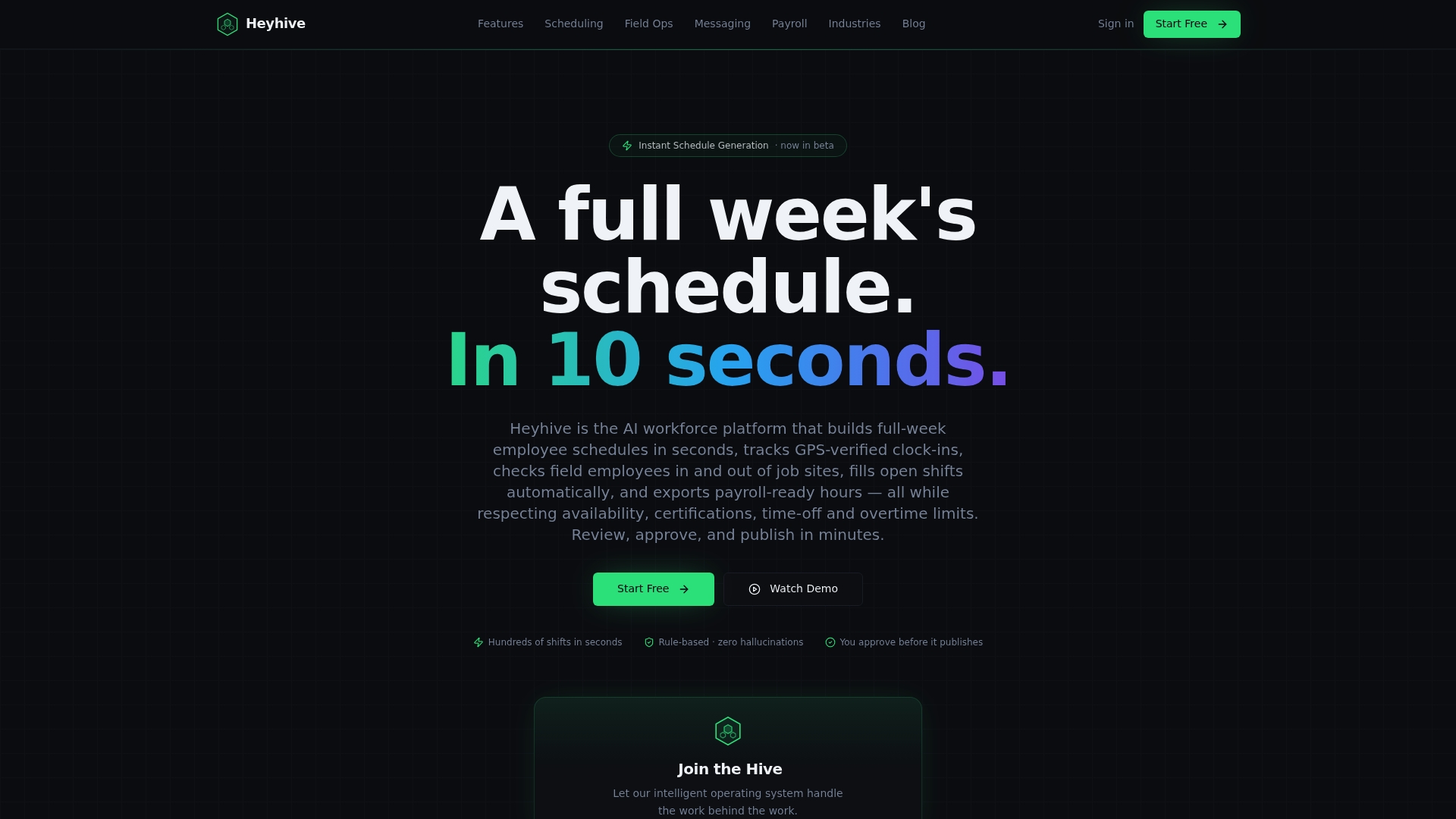
Heyhive maps directly to the compliance controls this playbook describes. Time-stamped schedule postings and individual employee notifications are built into the publishing workflow. Written consent for schedule changes is captured inside the app, with a timestamped record tied to the specific shift. Predictability-pay calculations are automated based on the change type and timing, and the output flows to your payroll export without manual re-entry. When an investigator asks for your records, Heyhive's audit reports give you a clean, exportable compliance log for any date range in minutes.
Your managers approve every schedule before it goes live, so no shift publishes without authorization. Availability rules are enforced at the point of scheduling, not discovered after the fact. For multi-location operators, Heyhive supports the strictest-everywhere posture without requiring separate configurations for each site.
Start your free trial at Heyhive or request a compliance-focused walkthrough to see how the audit trail and consent workflows work in practice.
The employer mistakes we see most often
Most fair workweek violations are not intentional. They are operational habits that predate the ordinances and were never updated. Here are the five most common, and the fix for each.
Relying on verbal consent or text messages. A manager calls an employee and asks them to come in early. The employee says yes. That verbal agreement does not satisfy the written-consent requirement in any jurisdiction. The fix: route all schedule-change consent through your scheduling system, where the record is automatic.
Inconsistent schedule-posting locations. Some managers post in the app, others email a PDF, others pin a paper copy to the break-room wall. Investigators look for a consistent, documented posting method. Pick one system and enforce it across every covered location.
Failing to update good-faith estimates. An employee hired for 20 hours a week is regularly working 35. The original estimate is never updated. That gap is a compliance exposure. Review estimates quarterly for employees whose actual hours consistently differ from the estimate on file.
Conflating employee-requested changes with employer-initiated changes. An employee asks to swap shifts with a coworker. The manager approves it and logs it as an employer-initiated change, triggering an unnecessary predictability-pay entry. The reverse error, treating an employer-initiated change as employee-requested to avoid the premium, is far more common and far more dangerous. Train managers on the distinction with written examples.
Weak payroll tagging of predictability pay. Predictability premiums coded as "miscellaneous pay" or "bonus" do not satisfy the wage-stub requirement and can create secondary FLSA issues when the regular rate is calculated incorrectly. Every predictability-pay entry needs its own payroll code and a clear description on the wage stub.
A typical failure mode: a Chicago employer with solid scheduling practices but no written consent workflow faces a June 2026 audit. The schedules were posted on time. The premiums were paid. But the consent records were verbal, and the good-faith estimates were unsigned. The result was a back-pay settlement covering two years of changes, because the employer could not prove any of the consents were valid. The fix was a two-week system configuration, not a policy overhaul.
Sources
Use these official agency pages and ordinance texts as your primary references. Bookmark them and check for updates at least quarterly, since several jurisdictions are actively revising their rules.
- Untangling the Varying Requirements of State and Local Fair Workweek Laws | Littler
- Updates to Chicago’s Fair Workweek Ordinance Expand Employer Obligations - Jackson Lewis
- Predictive Scheduling — Oregon Bureau of Labor and Industries
- Fact Sheet #56B: Scheduling Penalties & the FLSA regular rate | U.S. Department of Labor
- NYC Fair Workweek — Department of Consumer and Worker Protection