
Schedule optimization algorithms turn raw demand data and staff availability into a compliant, fair, published roster in minutes instead of hours. They automate the matching of people to shifts while respecting hard rules like overtime caps, certifications, and rest requirements, then let a manager review and approve before anything goes live. Heyhive builds on that model by pairing AI-generated schedules with manager approval, GPS-verified clock-ins, and payroll-ready exports.
TL;DR:
- Scheduling algorithms rely on demand forecasts, employee data, and labor policies to generate optimized rosters rapidly, often in minutes.
- Hybrid approaches combining MILP and metaheuristics scale better for mid-to-large teams, while constraint programming handles complex interdependent rules.
- Accurate input data, including demand, certifications, and absence patterns, is essential for reliable scheduling; gaps lead to weaker recommendations.
- Running parallel pilots over four weeks helps evaluate schedule quality, stability, override frequency, and fairness before full deployment.
- Managers should trust automated schedules when KPIs remain stable and explanations are clear, stepping in for safety concerns or special circumstances.
Table of Contents
- How Schedule Optimization Algorithms Work in Real Operations
- Which Scheduling Algorithm Fits Your Operation?
- What Constraints and Data Does the Algorithm Need?
- How Do You Evaluate a Scheduling Solution Before Buying?
- How to Roll Out Schedule Optimization Without Disrupting Operations
- When Should a Manager Trust the Algorithm vs. Step In?
- Heyhive: What It Delivers and How to Start a Pilot
- Sources
- FAQ
How Schedule Optimization Algorithms Work in Real Operations
A scheduling algorithm is only as good as what feeds it. Five components do the heavy lifting: a demand forecast (based on sales history, bookings, or foot traffic), employee master data (availability, skills, certifications), a policy engine that encodes labor rules, an optimization engine that assigns people to shifts, and an approval interface where a manager signs off.
The optimization loop itself runs on repetition. It generates a set of candidate shifts, assigns available staff to fill them, checks every assignment against hard constraints, and scores the result against goals like labor cost, fairness, and stated preferences. It repeats that cycle, refining the roster until it hits a strong score or runs out of time budget.
This is where the "algorithm" label gets misunderstood. It's not one calculation. It's a search process, similar to how a GPS app tests dozens of routes before landing on the fastest one.
Field results back up the payoff. In one McKinsey field-service case study, AI-driven schedule optimization reduced emergency break-ins dramatically, cut job delays significantly, and increased total on-job time substantially.
Every generated roster should carry a decision log: which constraints were active, which shifts were flagged as risky, and why the algorithm chose one assignment over another. That log is what lets a manager override a suggestion without losing the reasoning behind it. The workflow generally includes:
- A forecast layer pulling from POS, booking systems, or historical throughput
- A constraint checker validating certifications, availability, and overtime limits
- A scoring pass that balances cost against fairness and staff preferences
- An approval step where a manager reviews flagged shifts before publishing
Pro Tip: Ask any scheduling tool to show its reasoning for at least one contested shift assignment during a demo. If it can't explain why it picked Employee A over Employee B, you'll have a hard time trusting it during a real staffing crunch.
Which Scheduling Algorithm Fits Your Operation?
Not every business needs the same math under the hood. The right algorithm family depends on your roster size, how many constraints you're juggling, and how fast you need an answer.
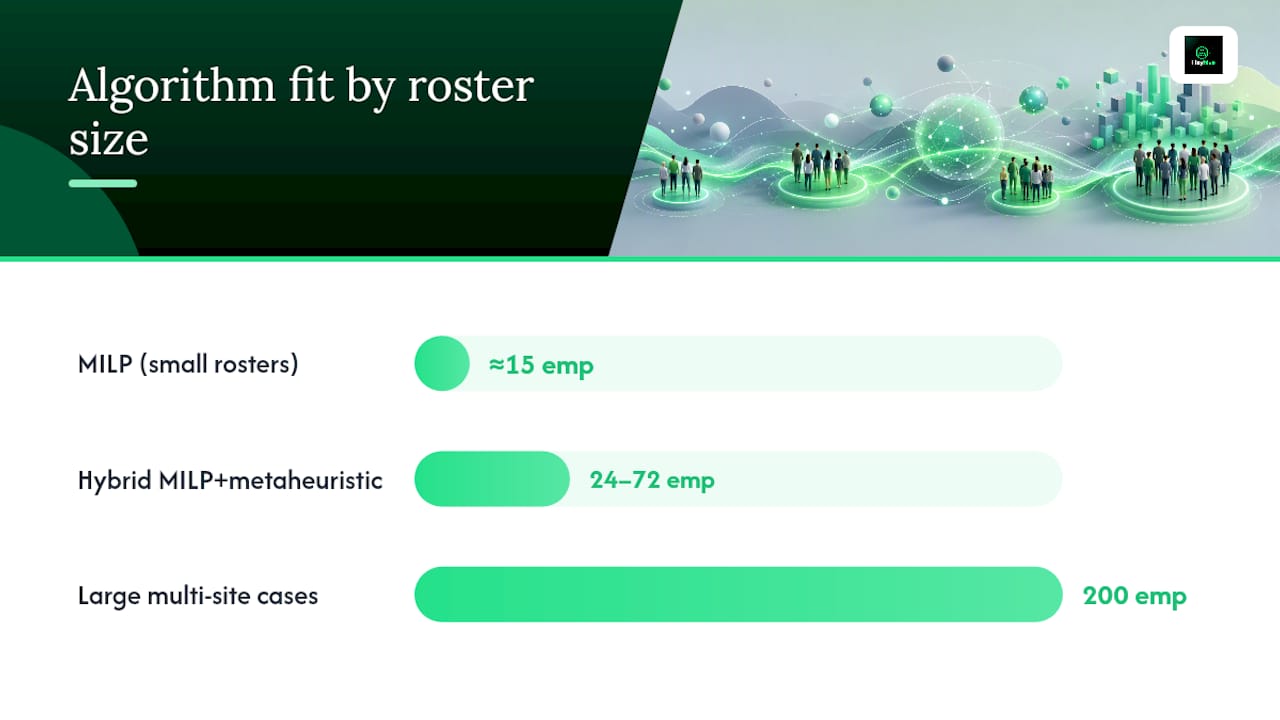
Mixed-integer linear programming (MILP) finds mathematically optimal solutions for small-to-medium rosters, but it gets computationally expensive fast as headcount and constraint count grow. A 15-person coffee shop schedule is trivial for MILP. A 200-person multi-site retail chain with overlapping certifications is not.
That's why most production systems now use a hybrid MILP plus metaheuristic approach. The MILP solver seeds a strong starting solution, and metaheuristic moves (swap shifts, change shift type, add or remove a shift) refine it toward near-optimal quality much faster. Research on employee rostering shows this hybrid MILP plus scatter search method scales notably better than MILP alone for instances in the 24 to 72 employee range, which covers a large share of shift-driven businesses.
Constraint programming (CP) shines when your rules are genuinely complex and interdependent. Google's OR-Tools CP-SAT framework uses patterns like one-shift-per-day limits and even shift distribution, which makes CP a strong fit for operations with dense, overlapping policy requirements.
Greedy and real-time algorithms trade optimality for speed. When a line cook calls in sick 45 minutes before open, you don't need the mathematically perfect replacement. You need a fast, rule-compliant one right now.
- MILP: best for smaller rosters where you want provably optimal results
- Hybrid MILP plus metaheuristic: best for mid-to-large rosters needing near-optimal speed
- Constraint programming: best when rule complexity outweighs headcount
- Greedy/real-time: best for last-minute rebooking and emergency coverage
What Constraints and Data Does the Algorithm Need?
An algorithm can't respect a rule it never sees. Every scheduling engine needs both a full list of hard constraints and a steady feed of accurate operational data.
- Legal and safety rules: maximum weekly hours, mandated rest periods between shifts, minimum age for certain tasks, and any applicable predictive-scheduling premiums.
- Certification and skill requirements: no assigning an uncertified line cook to fryer duty or an unlicensed technician to a job that requires one.
- Overtime and double-shift limits: caps that prevent burnout and unplanned payroll spikes.
- Union or collective bargaining clauses: seniority rules, guaranteed hours, and shift-bidding order where applicable.
The smart approach layers these as a policy engine: federal and state rules sit at the base, company or site policy sits above that, and the strictest applicable rule always wins. Vendor guidance on AI scheduling compliance stresses this layered structure as essential to avoiding costly compliance errors.
On the data side, you need demand forecasts from POS or booking systems, current availability, certification records, payroll rates, and historical no-show patterns. Skip any one of these and the algorithm fills gaps with guesses, not facts.
How Do You Evaluate a Scheduling Solution Before Buying?
Run any candidate system through a short list before committing budget to it. The strongest pilots test six things: schedule quality, run time, constraint fidelity, explainability, override workflow, and how well it integrates with your existing payroll and POS systems.
KPIs matter more than demo polish. Track these during any trial:
- Schedule stability (how often published shifts get changed after the fact)
- Emergency rework rate (last-minute reassignments due to callouts or gaps)
- Premium-pay incidence (how often the schedule triggers overtime or predictive-scheduling penalties)
- Coverage against your service-level target
- Manager time spent building and adjusting schedules
- Staff satisfaction with the published roster
A four-week parallel pilot, where the algorithm builds a schedule alongside your current manual process, gives you a clean side-by-side comparison. Nursing-sector research backs this up: an AI scheduling pilot in nursing found fewer unhealthy scheduling patterns and higher staff satisfaction once the algorithm enforced rest periods and balanced skill levels across shifts.
This evaluation model is used by some AI scheduling solutions that generate the roster with AI, require manager approval before publishing, verify field employee time with GPS, and export hours in a payroll-ready format.
How to Roll Out Schedule Optimization Without Disrupting Operations
Before touching any live schedule, map your data. Build a skills matrix, document your policy packs (legal, union, company), and align with department leads on which KPIs define success.
- Pilot in parallel. Run the algorithm alongside your existing process for two to four weeks. Require manager approval on every output.
- Tune constraint weights. Adjust how heavily the system prioritizes cost versus fairness versus preferences based on what the pilot data shows.
- Go live in stages. Roll out by site or team rather than all at once, and train managers on the override workflow before employees see the new schedule.
- Govern continuously. Review fairness metrics and premium-pay incidents monthly, and feed override patterns back into your constraint tuning.
Pro Tip: Pick your lowest-complexity site for the first stage rollout, not your flagship location. You want to catch configuration mistakes somewhere the stakes are low, not on your busiest weekend.
When Should a Manager Trust the Algorithm vs. Step In?
Trust the schedule when your KPIs stay consistent, coverage holds, and the system attaches a clear explanation to each assignment. Step in for one-off local events, safety concerns, or anything with direct customer impact that historical data wouldn't capture.
Keep a short log of every override. Feeding that back into your constraint weights is how the schedule actually improves over time.
— Heyhive
Heyhive: What It Delivers and How to Start a Pilot
You've seen how the algorithm families differ and what a solid evaluation checklist looks like. Some AI scheduling platforms provide schedule generation that respects availability, certifications, and overtime limits, with manager approval required before publishing.
Every schedule generated by such platforms typically runs through configured rules before manager review, balancing automation speed with human oversight. GPS-verified clock-ins help confirm field attendance, and hours may be exported in payroll-ready formats to streamline processing.
If you're weighing this against building your own solver or sticking with manual scheduling, start with a focused four to six week pilot at one site. Track schedule stability, rework rate, and premium-pay incidents against your current process, and let the approval flow stay in your hands the whole time. Read how Heyhive builds a full week of shifts in seconds for a walkthrough of the workflow, or head to Heyhive's scheduling platform to start a pilot at your own site.
Sources
For teams that want to go deeper on the technical side, a few sources stand out. McKinsey's field research on AI scheduling documents real operational outcomes. Engineering teams evaluating solver approaches should look at Google's Workforce Scheduling API and the GES solver framework from TU Wien for algorithmic detail. For a broader vendor-market view, this HR software comparison offers useful context.
- Smart scheduling: how to solve workforce planning challenges with AI | McKinsey
- AI scheduling for nursing: IH-NASS pilot study (2025)
FAQ
What Are Schedule Optimization Algorithms?
They are computational methods that automatically assign employees to shifts while enforcing rules like availability, certifications, overtime caps, and rest requirements, then score the result against cost and fairness goals.
Which Algorithm Type Is Best for a Small Restaurant?
MILP alone often works well for smaller rosters since exact optimization stays computationally manageable at that scale.
Can These Algorithms Handle Last-Minute Callouts?
Yes. Greedy and real-time algorithms trade some optimality for speed, making them the right tool for emergency reassignments rather than full-roster generation.
Does Automated Scheduling Replace Manager Judgment?
No. Tools like Heyhive generate the roster with AI but require manager approval before publishing, keeping a human decision point in the workflow.
What Data Does an Algorithm Need to Build a Good Schedule?
It needs demand forecasts, employee availability, certifications, payroll rates, and historical absence data. Missing any of these forces the algorithm to fill gaps with assumptions instead of facts.