
Scheduling improvements reduce turnover when they give employees more predictability and more control over their own hours. That is not a theory. Field research from the Shift Project, a controlled retail experiment, and a large-scale flexibility study all point the same direction. Start with a single change: publish schedules further in advance and let employees have real input, then measure what happens to your 90-day turnover.
TL;DR:
- Publishing schedules at least two weeks in advance significantly reduces turnover by providing predictability and stability for employees.
- Giving employees control over their schedules through shift swaps and flexible time windows lowers work-family conflict and increases job satisfaction.
- Implementing a phased pilot with control groups and clear policies ensures successful rollout and measurable improvements in retention metrics.
- Using scheduling tools that automate availability, enforce fairness, and support real-time communication enhances the effectiveness of retention strategies.
- Managers must be trained to consistently enforce policies and avoid last-minute changes, as execution habits can undermine scheduling improvements.
Table of Contents
- How Reducing Turnover With Scheduling Actually Works
- Which Scheduling Models Actually Lower Turnover?
- How Do You Roll Out a Scheduling Change Without Chaos?
- What Scheduling Features Actually Support Retention?
- How Do You Measure Whether Scheduling Reduced Turnover?
- Where Scheduling-for-Retention Efforts Go Wrong
- What Heyhive Sees Across Workforce Operations
- Ready to Pilot a More Predictable Schedule?
- Sources
- FAQ
How Reducing Turnover With Scheduling Actually Works
Unstable schedules push people out the door faster than almost any other single workplace factor short of pay. Employees who get less than a week's notice on their shifts turn over at rates roughly 35% higher than employees who receive two or more weeks' notice, according to Shift Project research on the US service sector. Even a modest gap of one to two weeks' notice carries meaningfully higher turnover than the two-plus-week benchmark.
The turnover math is stark: last-minute shift changes alone raise the odds an employee quits by a notable margin, per that same Shift Project data. Unpredictability doesn't just annoy people. It disrupts childcare, second jobs, transportation, and sleep, and employees respond by leaving for something more stable.
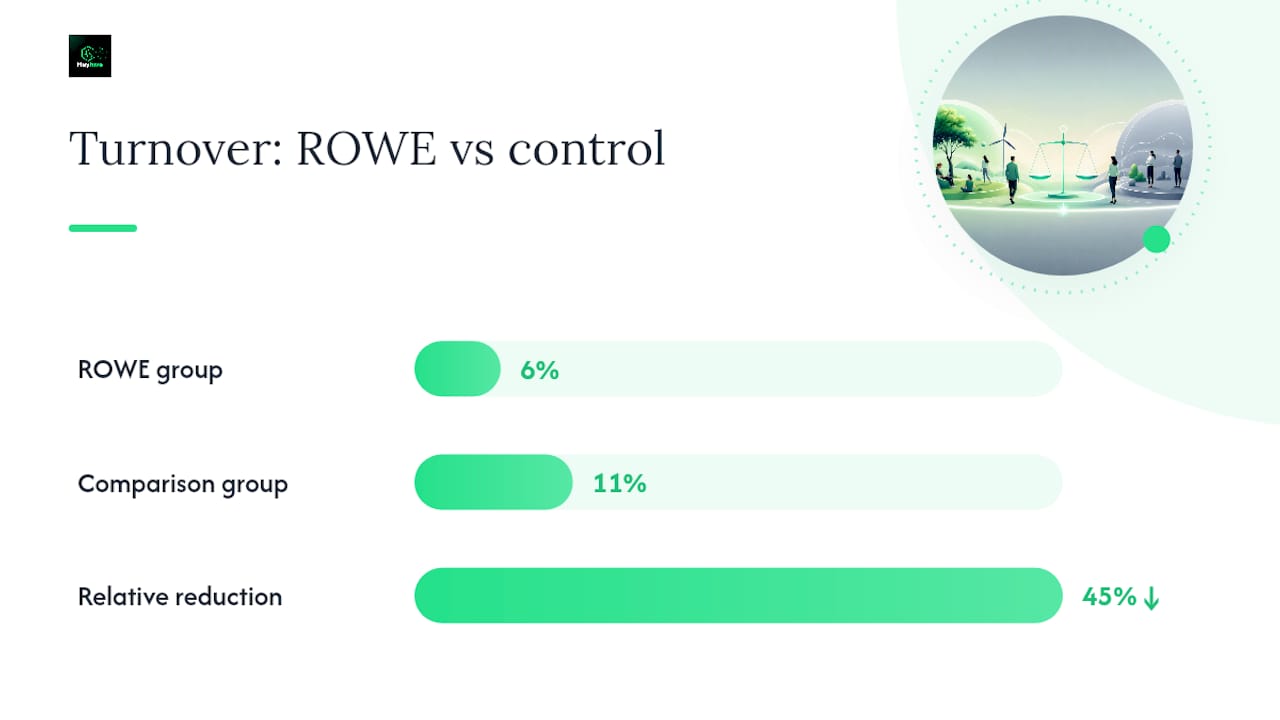
The University of Minnesota's Results-Only Work Environment (ROWE) research backs this up from the opposite angle. When employees got real control over when and how they worked, turnover dropped sharply. Participants in the ROWE group left their jobs at a 6% rate over eight months, compared to 11% in the comparison group, a 45% reduction, according to SHRM's coverage of the study.
A randomized field experiment across 28 Gap stores adds the business case. Stores that adopted more consistent, predictable scheduling experienced a measurable productivity gain, driven by increased sales and decreased labor costs.
The mechanism behind all three findings is consistent:
- Unpredictable schedules increase work-family conflict and financial strain, both strong predictors of quitting.
- Schedule control raises perceived fairness from supervisors, which drives job satisfaction independent of pay.
- Predictability lowers the mental tax of planning around unknown hours, which reduces burnout-driven exits.
- Employees who feel trusted with input into their own schedules report higher engagement scores across multiple industry studies.
Scheduling isn't a perk sitting next to retention strategy. It's one of the mechanisms retention strategy runs through.
Which Scheduling Models Actually Lower Turnover?
Not every scheduling model fits every workforce, but four approaches show up repeatedly in the research and in operational practice. Picking the right one depends on your industry, your staffing volatility, and whether your roles are hourly or salaried.
- Advance-notice scheduling. Publishing shifts two or more weeks out is the single highest-leverage change available, given the 35% turnover gap the Shift Project documented. This works best in retail, food service, and healthcare, where staffing needs are forecastable from historical sales or patient volume data.
- Shift-swap with guardrails. Letting employees trade shifts through a self-service process, subject to manager approval and skill/certification checks, restores a sense of control without sacrificing coverage. The guardrail matters: unrestricted swapping can create fairness complaints if senior staff hoard the best shifts.
- Flexible start and finish windows. Instead of fixed clock-in times, some roles tolerate a 30 to 60 minute window. This suits warehouse, logistics, and light-manufacturing environments where output matters more than exact arrival time.
- Results-only or compressed models. For salaried or knowledge-based roles, a ROWE-style approach or a compressed four-day week removes the clock-watching entirely and lets output define success. This is the model least suited to customer-facing shift work, since coverage still has to happen at specific hours.
The selection logic is straightforward: if a role has fixed customer-facing hours, focus on advance notice and swap flexibility. If a role has output-based deliverables, focus on control over when the work happens rather than when it starts.
How Do You Roll Out a Scheduling Change Without Chaos?
A scheduling overhaul fails when it launches everywhere at once with no baseline to compare against. A phased pilot gives you defensible data and a much easier internal sell.
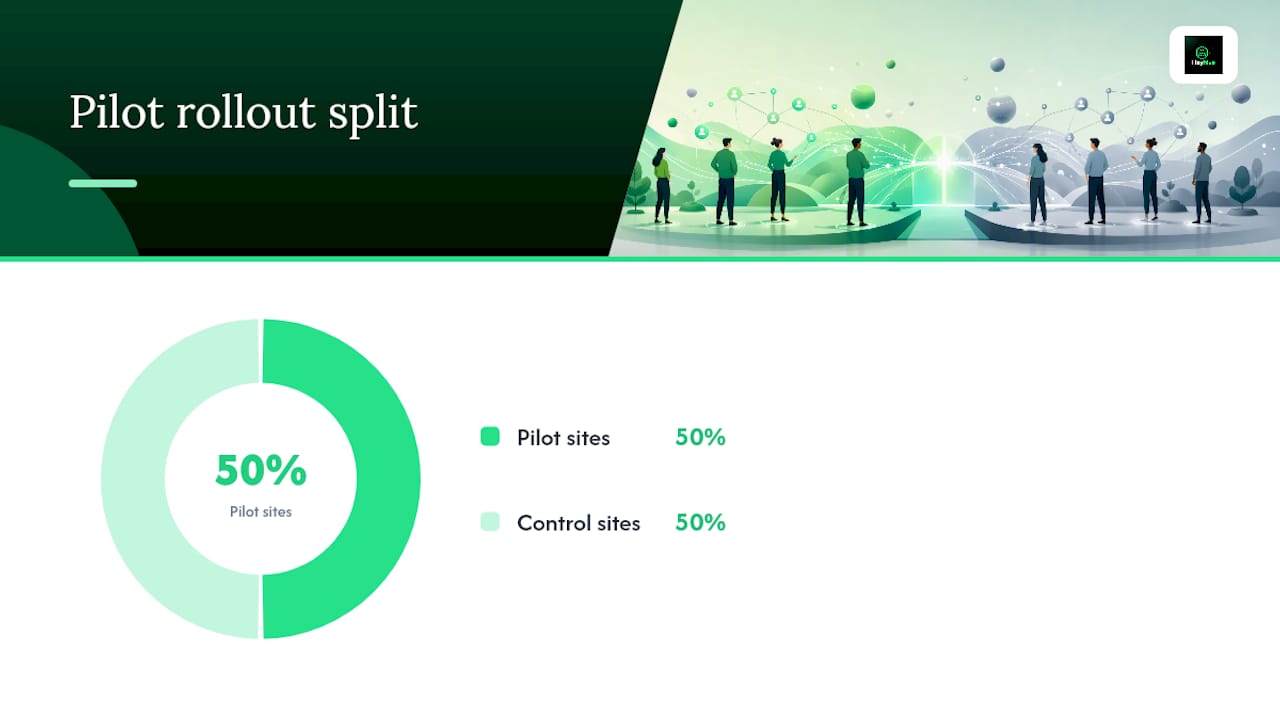
- Design the pilot with a control group. Pick two to four comparable locations or teams. Apply the new scheduling policy (advance notice, swap rules, or flexible windows) to half, and leave the rest on the current process for 60 to 90 days. Matched or randomized comparison groups produce far more credible ROI numbers than a simple before-and-after look, a lesson borrowed directly from the Gap retail experiment's design.
- Formalize the policy before you launch. Write down the advance-notice minimum (a multi-week window is the evidence-backed target), the availability-update window, overtime caps, and who approves swap requests. Vague rules create the fairness disputes that undermine the whole effort.
- Collect employee availability directly. Use a structured availability form rather than verbal requests. A documented process, like the one outlined here, removes ambiguity and gives you a paper trail when disputes come up.
- Train managers before you train employees. Give managers a short checklist: confirm published dates, review swap requests within 24 hours, and flag any pattern of last-minute changes. A one-on-one script works well here: "Here's how the new schedule process works, here's what changes for you, and here's who to ask if a request doesn't fit."
- Set a review cadence. Check pilot metrics at 30, 60, and 90 days, then decide whether to scale, adjust, or kill the pilot based on the data, not on anecdote.
Pro Tip: Send a one-page team brief the same day you announce the pilot. Include the exact notice window, the swap-request process, and a single point of contact. Ambiguity in the rollout message is the fastest way to create the very unpredictability you're trying to fix.
Manager quality still matters more than any single scheduling policy. Automation and clear rules only work if managers actually enforce them instead of quietly reverting to informal, last-minute reassignments.
What Scheduling Features Actually Support Retention?
The right HR software for e-commerce stores scheduling tool doesn't just save admin hours. It enforces the fairness and predictability that make the retention gains real. Look for a platform that captures the following without requiring a manager to chase it down manually:
- Availability capture that lets employees set and update their own preferences, rather than relying on a manager's memory of a verbal request.
- Shift-swap workflows with built-in certification and skill checks, so trades happen without creating coverage gaps.
- Overtime guardrails that flag or block scheduling that would push someone past legal or policy thresholds before the shift gets published.
- Advance publishing that supports a two-week (or longer) notice window as the default, not an afterthought.
- Mobile access and push notifications so shift confirmations and swap approvals happen in real time, not after someone's already shown up to the wrong shift.
- Manager approval queues that keep a human in the loop for every change, preserving accountability without slowing things down.
- Payroll and HRIS export so approved hours flow directly into payroll without manual re-entry.
Industry guidance from AIHR makes a point worth repeating: scheduling tools work best when they're built to hand control back to employees, not just to streamline a manager's workflow. A tool that only makes the manager's life easier while leaving employees guessing about next week's hours will not move your turnover numbers.
How Do You Measure Whether Scheduling Reduced Turnover?
Turnover moves slowly enough that a two-week pilot won't tell you much. Give the change 60 to 90 days minimum before drawing conclusions, and track a consistent set of numbers across that window.
| Metric | What it tells you | Recommended cadence |
|---|---|---|
| Voluntary turnover rate (30/60/90-day cohorts) | Whether new hires and existing staff are leaving faster or slower than baseline | Monthly, compared to pilot start |
| Schedule-predictability index (% of shifts published 2+ weeks out) | Whether the policy is actually being followed | Weekly during pilot |
| Last-minute change rate | Whether managers are reverting to old habits | Weekly during pilot |
| Time-to-fill open shifts | Whether swap and self-service tools are working | Biweekly |
| Overtime hours | Whether guardrails are preventing burnout-driving overtime | Biweekly |
| Employee satisfaction (pulse survey) | Whether the change is felt, not just measured | Monthly |
For the financial case, anchor your ROI estimate to something concrete. The Gap field experiment found a 5.1% productivity gain from responsible scheduling, split between a 3.3% sales increase and a 1.8% labor-cost decrease. Apply that ratio to your own labor cost base as a starting estimate, then refine it against your pilot's actual numbers once you have 90 days of data. A matched control group, not a simple before-and-after comparison, is what makes that estimate defensible to finance leadership.
Where Scheduling-for-Retention Efforts Go Wrong
Most scheduling initiatives don't fail because the model is wrong. They fail because of execution habits that quietly cancel out the benefit.
- Posting schedules late, then changing them again. This recreates the exact instability the policy was meant to fix. Fix it with a hard notice minimum and a "change premium" (extra pay or priority scheduling) for any shift altered inside that window.
- Designing the policy without employee input. A schedule built entirely top-down, even a predictable one, misses real constraints like second jobs or childcare. Fix it with a mandatory availability form before the first schedule under the new policy goes live.
- Skipping manager training. Managers who don't understand the new rules will default to old habits within a few weeks. Fix it with a short onboarding checklist and a 30-day check-in.
- Using scheduling as punishment. Cutting a difficult employee's hours or assigning undesirable shifts as discipline destroys trust in the whole system. Fix it by making every rule visible and applied the same way to everyone.
Pro Tip: If you only fix one thing this quarter, fix the change premium. Employees forgive an imperfect schedule far more easily than they forgive one that keeps changing without warning.
What Heyhive Sees Across Workforce Operations
Everything in this article points to the same operational challenge: predictability and employee control are easy to recommend and hard to sustain by hand. That's the gap Heyhive is built to close. AI-generated schedules respect availability, certifications, and overtime limits automatically, so the two-week notice window and the fairness rules described above don't depend on a manager remembering every constraint.
Managers still approve every schedule before it publishes, which keeps the human judgment in place while removing the hours of manual shift-building that usually eat into coaching time. GPS-verified clock-ins give field and multi-site teams the same accountability without the friction of paper timesheets. When the administrative load drops, managers get the bandwidth back to do the part of retention that scheduling alone can't fix: checking in, coaching, and catching problems before they turn into resignations.
— Heyhive
Ready to Pilot a More Predictable Schedule?
A scheduling pilot doesn't need to be complicated to prove its value. Pick two locations or teams, commit to a two-week advance-notice minimum, turn on self-service shift swaps with manager approval, and track voluntary turnover for 60 to 90 days against a comparable control group. That's the entire test.
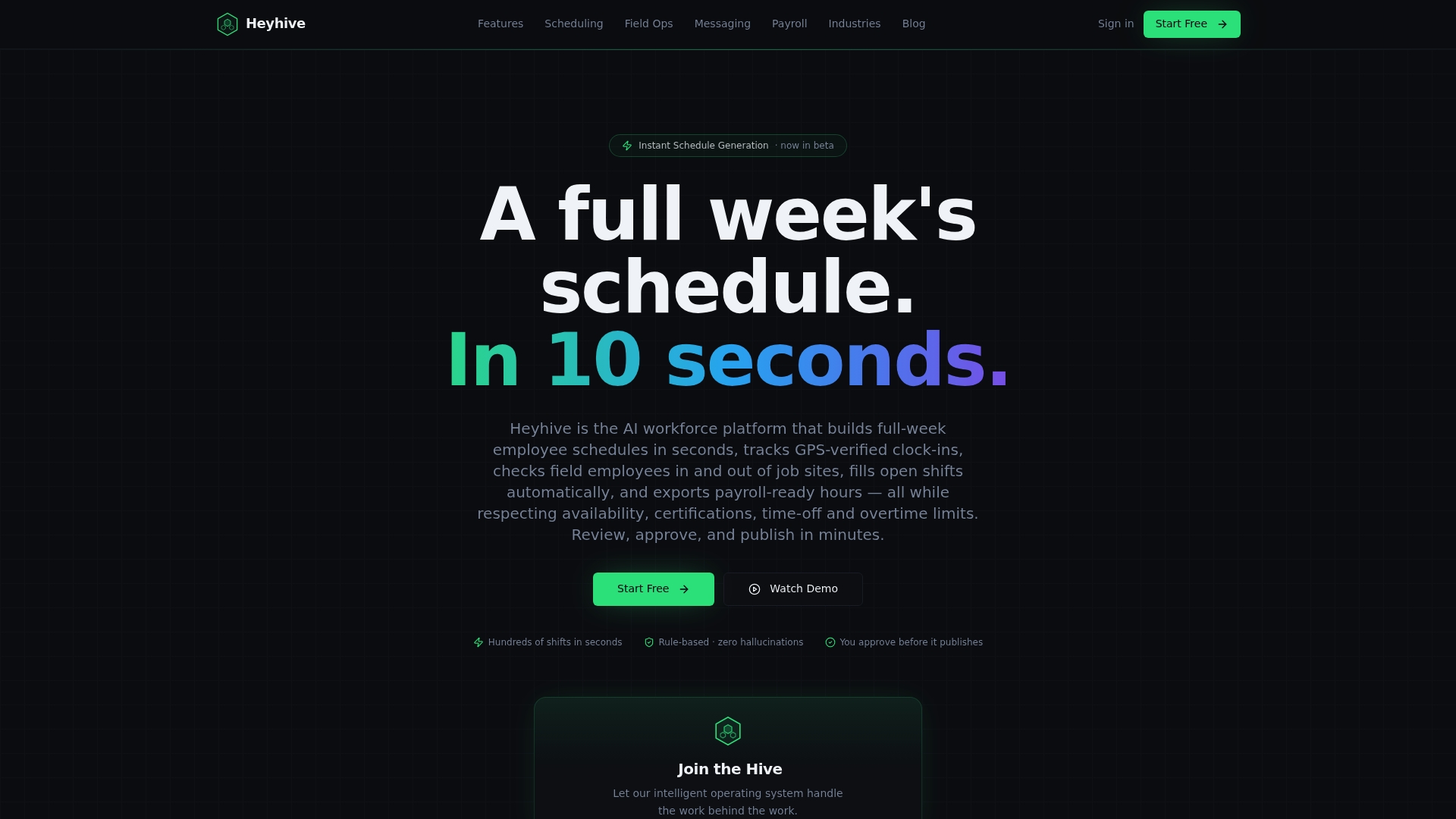
Heyhive is built for exactly this kind of pilot. The AI Scheduling engine builds a full week of shifts in seconds while respecting availability and overtime limits, and every schedule still waits for manager approval before it goes live, so you get speed without losing control. Pair that with GPS-verified time clocks and payroll-ready hour exports, and the operational side of your pilot runs itself while you focus on the retention numbers. Start a free trial on the Heyhive homepage and measure your first 90 days against the KPIs outlined above.
Sources
- Uncertain Time: Precarious Schedules and Job Turnover in the US Service Sector (Shift Project)
- Study: Flexible Schedules Reduce Conflict, Lower Turnover (SHRM summary of ROWE research)
- Doing well by doing good: Improving retail store performance with responsible scheduling practices (Management Science)
- Employee Retention Strategies (AIHR)
FAQ
What Are Seven Strategies to Reduce Employee Turnover?
The strongest levers include publishing schedules two or more weeks in advance, giving employees real input into their availability, training managers to enforce scheduling rules consistently, offering shift-swap flexibility with guardrails, tracking schedule-predictability KPIs, avoiding punitive scheduling, and pairing schedule improvements with fair pay and clear growth paths. Scheduling changes alone produced a 45% turnover reduction in the ROWE study, making it one of the highest-leverage strategies on that list.
What Is a 3/2/2/3 Work Schedule?
A 3/2/2/3 schedule is a rotating shift pattern where employees work several days in a row, then have multiple days off, cycling continuously across a team to maintain 24/7 coverage. It's common in manufacturing, healthcare, and other round-the-clock operations because it balances consistent days off with full coverage.
How Can I Lower My Employee Turnover Rate?
Start by measuring your current voluntary turnover rate in 30, 60, and 90-day cohorts, then target the biggest predictable driver: schedule instability. Moving from under a week's notice to two-plus weeks is associated with a roughly 35% drop in turnover risk, according to Shift Project data, and pairing that with manager training compounds the effect.
What Are the 5 C's of Retention?
Definitions of the "5 C's" vary by source, and no single version is universally standardized in the research reviewed for this article. Most versions center on care, communication, compensation, career growth, and culture, with scheduling improvements acting as a practical lever within both care and communication.
Can Scheduling Software Alone Reduce Turnover?
Scheduling software supports retention but works best paired with manager training and clear policy, since managers who revert to informal, last-minute reassignments can undercut even a well-designed tool. Platforms like Heyhive that combine AI-generated schedules with mandatory manager approval keep automation and human judgment working together rather than one replacing the other.