
A seasonal staffing plan works when it matches labor capacity to forecasted demand without blowing your budget or your quality standards. Start now with three moves: build a demand forecast using last year's data plus this year's known variables, lock a 3 to 6 month planning timeline, and open your sourcing pipeline, rehire pool included, before you need bodies on the floor. The templates and tools below help you execute all three.
TL;DR:
- Building multiple demand scenarios ensures enough staffing for peak times without overcommitting or underestimating seasonal fluctuations.
- Starting recruitment three to six months in advance and maintaining alumni pipelines reduces costs and accelerates onboarding during busy periods.
- Using automated workforce tools with features like GPS clock-ins and instant schedule generation improves scheduling accuracy and manages absenteeism effectively.
- Refining cost budgets by separating wages, overtime, recruitment, and training allows for early detection of overspending and better financial control.
- Implementing contingency plans with pre-screened candidates and flexible staffing agreements mitigates the impact of sudden demand surges or staff shortages.
Table of Contents
- How Do You Forecast Seasonal Staffing Demand?
- What's the Planning Timeline for Seasonal Hiring?
- Building Recruiting Pipelines and Rehiring Strategies
- Fast, Role-Specific Onboarding That Actually Sticks
- Scheduling and Attendance Tools: What to Require
- Retaining Seasonal Staff and Converting Top Performers
- Post-Season Measurement and Ramp-Down Checklist
- Cost Budgeting and Financial Planning for Seasonal Staffing
- Contingency Plans for Unexpected Demand Fluctuations or Absenteeism
- Legal Compliance and Labor Regulations for Seasonal Employees
- Employee Retention Strategies Beyond Rehiring
- Your First 90 Days: A Manager's Checklist
- How Heyhive Helps You Execute the Plan You Just Built
- Sources
How Do You Forecast Seasonal Staffing Demand?
Forecasting starts with your own numbers, not a guess. Pull weekly sales, order volume, or foot traffic from the same period last year, then layer in what's different this time: a new promotion calendar, a shifted carrier pickup schedule, or a store opening down the street. Retailers and logistics operators that build scenario planning into their staff planning consistently outperform teams that hire off a single gut-feel number.
Build three versions of the season: low, medium, and high. Each scenario needs its own staffing count, not just a shared plan with a note to "hire more if needed."
The math behind headcount is simpler than most managers expect. Required hires equal forecasted workload divided by average employee productivity, minus your existing capacity. If you expect 12,000 orders a week, each associate handles 400 orders, and you already have 20 people scheduled, you need 10 more hires, not 30.
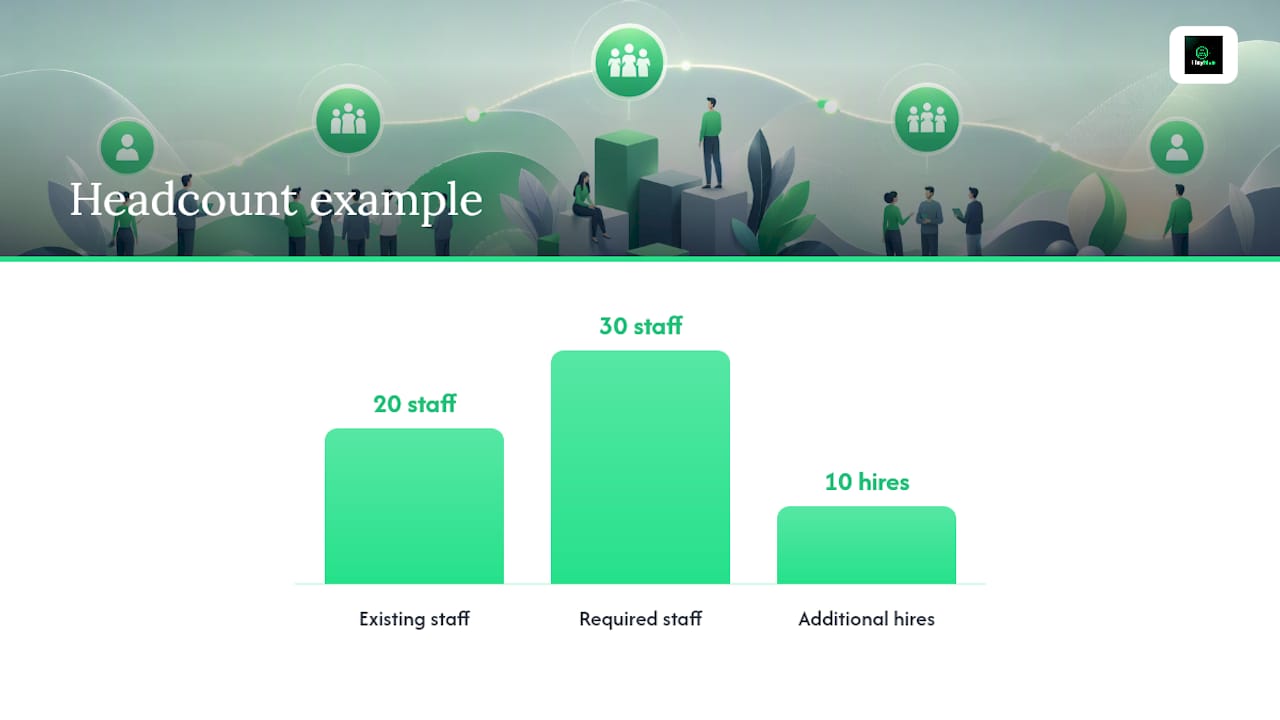
Pro Tip: Run your medium scenario as the default hiring target, but staff your onboarding and training capacity for the high scenario. It's cheaper to have an unused training slot than to scramble for trainers mid-surge.
Before any offer goes out, run eligibility checks through E-Verify so you're not backfilling paperwork during your busiest week. Document your assumptions as you go:
- Average productivity per role, and how it changes by week three versus week one
- Expected attrition rate across the season, not just at the start
- Planned leave, holidays, or known absences among returning staff
- External signals that could shift demand up or down mid season
What's the Planning Timeline for Seasonal Hiring?
Seasonal staffing fails most often because teams start the clock too late. A 3 to 6 month runway gives you room to source quality candidates instead of whoever answers the phone first.
- 3 to 6 months out: Finalize your demand forecast, set the labor budget, and flag critical roles that take longest to fill (supervisors, forklift operators, anyone requiring certification). Start rebuilding your alumni pipeline now.
- 2 to 3 months out: Launch active sourcing and screening. Extend offers to your strongest candidates and verify work eligibility immediately, not after start dates are set.
- 1 month out: Run onboarding cohorts, finalize weekly schedules, and assign supervisors and quality checkpoints to each new hire group.
Set decision triggers ahead of time so you're not debating mid-crunch. If time-to-fill stretches past 10 to 14 days for a critical role, engage a staffing partner immediately. If your forecast jumps above your medium scenario, open additional shifts before the week starts, not after complaints roll in.
Building Recruiting Pipelines and Rehiring Strategies
Your fastest, cheapest hires are the people who already worked for you. Teams that plan rehiring proactively report lower onboarding costs and faster time-to-fill than teams starting from zero every season.
Build the pipeline with a layered approach:
- Keep a live alumni database and reach out before competitors do, not after your posting goes live
- Offer referral bonuses tied to retention over a meaningful period, not just a signing bounty
- Post on job boards that match the role's skill level, not a generic catchall
- Line up a staffing agency in advance. Agencies can often supply qualified temporary workers within 24 to 48 hours when your own pipeline runs dry
Pro Tip: Set a screening floor and don't lower it under volume pressure. A bad hire costs more in supervision time and error correction than an empty shift does.
Track time-to-fill, cost-per-hire, and projected productivity per source. It tells you which channel to fund harder next season.
Fast, Role-Specific Onboarding That Actually Sticks
Skip the week-long orientation. A templated, cohort-based onboarding running 2 to 4 days gets seasonal hires productive faster than a longer, individualized program ever will.
- Day 1: Paperwork, eligibility verification, and orientation to the specific role, not the whole company.
- Day 2 to 3: Hands-on training paired with a buddy, someone who's done the job through at least one prior peak.
- Day 4: Supervised independent work with a manager checking in at set intervals, not hovering the whole shift.
Use recorded microlearning for repeatable tasks so trainers aren't re-explaining the same steps to every cohort. Run quality checks at day 3 and again at the one-week mark. Track first-week error rate and time-to-productivity as your core signals to monitor performance changes associated with headcount increases.
Scheduling and Attendance Tools: What to Require
Manual scheduling breaks down exactly when you need it most, during the week volume spikes and five people call in sick. Digital workforce tools that automate shift generation and track attendance respond to demand changes far faster than a spreadsheet ever will.
Before you commit to a platform, require these features:
- Fast week-generation that builds a full schedule in minutes, not hours
- Automatic enforcement of availability, certifications, and overtime limits
- GPS-verified clock-ins for field or multi-site teams
- Payroll-ready hours export that doesn't need manual reformatting
Automation doesn't mean losing oversight. A platform like Heyhive's AI scheduling tool generates a full week of shifts in seconds while still routing every schedule through manager approval before it publishes. That keeps quality control intact even when you're filling shifts fast.
A practical workflow looks like this: your forecast sets the weekly headcount target, the system builds a draft schedule respecting availability and overtime rules, a manager reviews and approves it, and open shifts get flagged for fast-fill the moment someone calls out. For a broader look at what to evaluate, see this guide to workforce management software.
Retaining Seasonal Staff and Converting Top Performers
That's when you have enough performance data to know who's worth a conversion offer, and enough runway left to make one before they take another job.
- Extend permanent or extended-hours offers to top performers before the season winds down
- Reopen alumni outreach early, many operations start their next-season recruiting conversations as early as May
- Track conversion rate and rehiring rate as core KPIs, not just headcount filled
- Use early-offer incentives and referral bonuses to boost return rates season over season
Conversion is cheaper than cold recruiting. Every seasonal worker you keep is one less person you have to source, screen, and train from scratch next peak.
Post-Season Measurement and Ramp-Down Checklist
Close the season by reviewing labor cost variance against budget, total overtime hours, and service levels during peak weeks. Compare conversion and rehiring rates against last season's numbers.
Update your forecasting template with actual productivity figures, real attrition rates, and any external signals that moved the needle. Send a closing communication to your alumni pool thanking them and flagging next season's timeline, then wrap administrative steps: final pay, equipment returns, and access removal.
Cost Budgeting and Financial Planning for Seasonal Staffing
Seasonal labor costs spiral when everything gets lumped into one number. A workable staffing budget separates hourly wages, overtime, recruitment, and training into distinct line items you can track and adjust independently.
Hourly wages should reflect your medium demand scenario, with a flexible buffer for the high scenario built in as a separate contingency line, not baked into the base number. Overtime deserves its own cap. Once weekly overtime hours cross a set threshold, that's your signal to open another shift or bring in temporary support rather than keep paying premium rates on stretched staff.
Recruitment costs cover job board fees, agency placement fees, and referral bonuses. Training costs cover trainer time, buddy-system hours, and any paid orientation days. Splitting these out lets you see exactly where a season ran over budget instead of guessing.
Build in a review checkpoint at the season's midpoint. If actual costs are tracking 10% or more above budget in any single line, that's early enough to correct course, whether that means tightening overtime approval or pausing a low-performing sourcing channel. Waiting until the season ends to check the math means you've already spent the money.
Contingency Plans for Unexpected Demand Fluctuations or Absenteeism
Even a well-built forecast gets tested by a supply chain hiccup, a viral promotion, or a flu wave that takes out a quarter of your floor staff in one week. Your plan needs a response ready before that happens, not a scramble after.
Build a bench. Keep a short list of pre-screened, pre-verified candidates who can start within 48 hours if a staffing partner isn't fast enough. Cross-train your core team across at least two roles each, so a shortage in one area can pull coverage from another without stopping the line.
Set a clear absenteeism threshold that triggers action. If call-outs on a given shift exceed a set percentage of scheduled staff, a manager should have standing authority to call in bench staff or approve overtime without waiting on a chain of approvals that eats the first two hours of the shift.
For demand spikes, pre-negotiate flexible terms with at least one staffing agency so you're not negotiating rates while you're also short-staffed. Keep a standing agreement in place even during slow stretches. It costs nothing to have and saves days when you need it.
Review your contingency triggers each season. A threshold that worked last year might be too loose or too tight depending on how your core team's skills and headcount have shifted since then.
Legal Compliance and Labor Regulations for Seasonal Employees
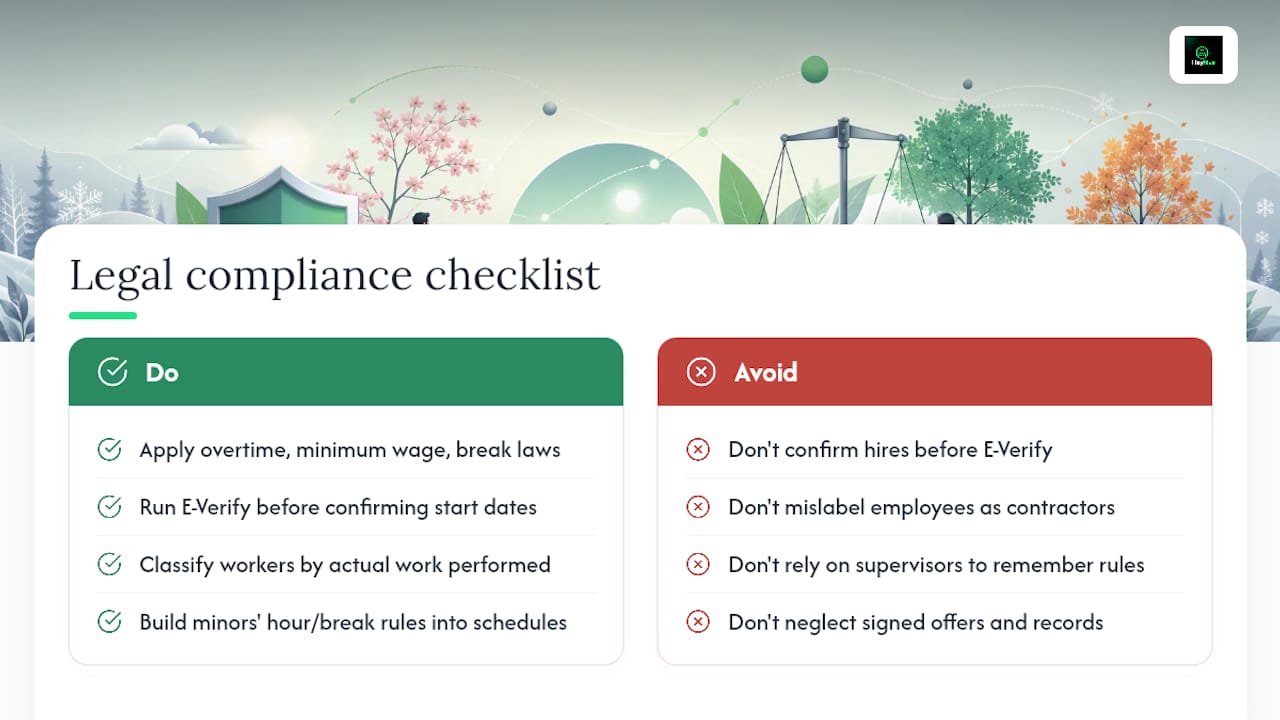
Seasonal doesn't mean exempt from the rules that govern your full-time staff. Overtime thresholds, minimum wage requirements, and break laws generally apply to seasonal and temporary workers the same way they apply to permanent hires, though specifics vary by state and by role classification.
Work eligibility verification is non-negotiable. Every offer should clear through E-Verify before a start date gets confirmed, not after. Waiting on eligibility checks after someone's already on the schedule creates compliance exposure you don't need during your busiest weeks.
Classification matters more than most managers assume. A seasonal worker misclassified as an independent contractor when they're functioning as an employee, set schedule, supervised work, company equipment, creates liability that surfaces long after the season ends. If a role looks and functions like employment, treat it as employment for tax and labor purposes.
Minors working seasonal retail or hospitality roles often face specific hour restrictions and required break periods that don't apply to adult staff. Build those rules into your scheduling process from day one rather than relying on a supervisor to remember them mid-shift.
Keep documentation clean: signed offer letters, verified eligibility, and clear records of hours worked. If a wage dispute or an audit comes up after the season ends, that paperwork is what protects you.
Employee Retention Strategies Beyond Rehiring
Rehiring alumni solves part of the retention puzzle, but it doesn't address why some seasonal workers walk away mid-season in the first place. That's where the real cost sits, not in next year's recruiting budget, but in this year's coverage gaps.
Recognition during the season matters more than most managers budget for. A simple shift-completion bonus at the two-week and four-week marks gives workers a reason to stay through the toughest stretch instead of leaving the moment a better offer appears elsewhere.
Scheduling predictability keeps people around too. Seasonal workers who get their schedules with at least a week's notice report fewer no-shows and voluntary exits than those scheduled two or three days out. If your scheduling process can't guarantee that lead time, that's worth fixing before the next peak, not after.
Give seasonal staff a real voice on the floor. A quick daily or weekly check-in, even five minutes, catches burnout, confusion, or friction with a supervisor before it turns into a walkout. Workers who feel heard during a chaotic season are the ones who come back next year without needing a rehire campaign to convince them.
Pay transparency helps too. Workers who understand exactly how overtime, shift differentials, and bonuses get calculated trust the process more than those left guessing at their own paycheck.
Your First 90 Days: A Manager's Checklist
Start today: pull last year's demand data and reactivate your alumni list. In 30 days: lock your labor budget, reserve staffing-partner capacity, and finalize your forecast scenarios. In 90 days: complete onboarding cohorts and publish finalized schedules.
Loop in finance early on budget sign-off, and get operations and hiring managers aligned on critical roles before sourcing starts. A one-page forecast, shared across all three, keeps everyone working from the same numbers.
How Heyhive Helps You Execute the Plan You Just Built
Every step in this plan, forecasting, timeline, onboarding, retention, runs into the same wall without the right scheduling engine behind it: manual shift building eats hours you don't have during peak weeks.
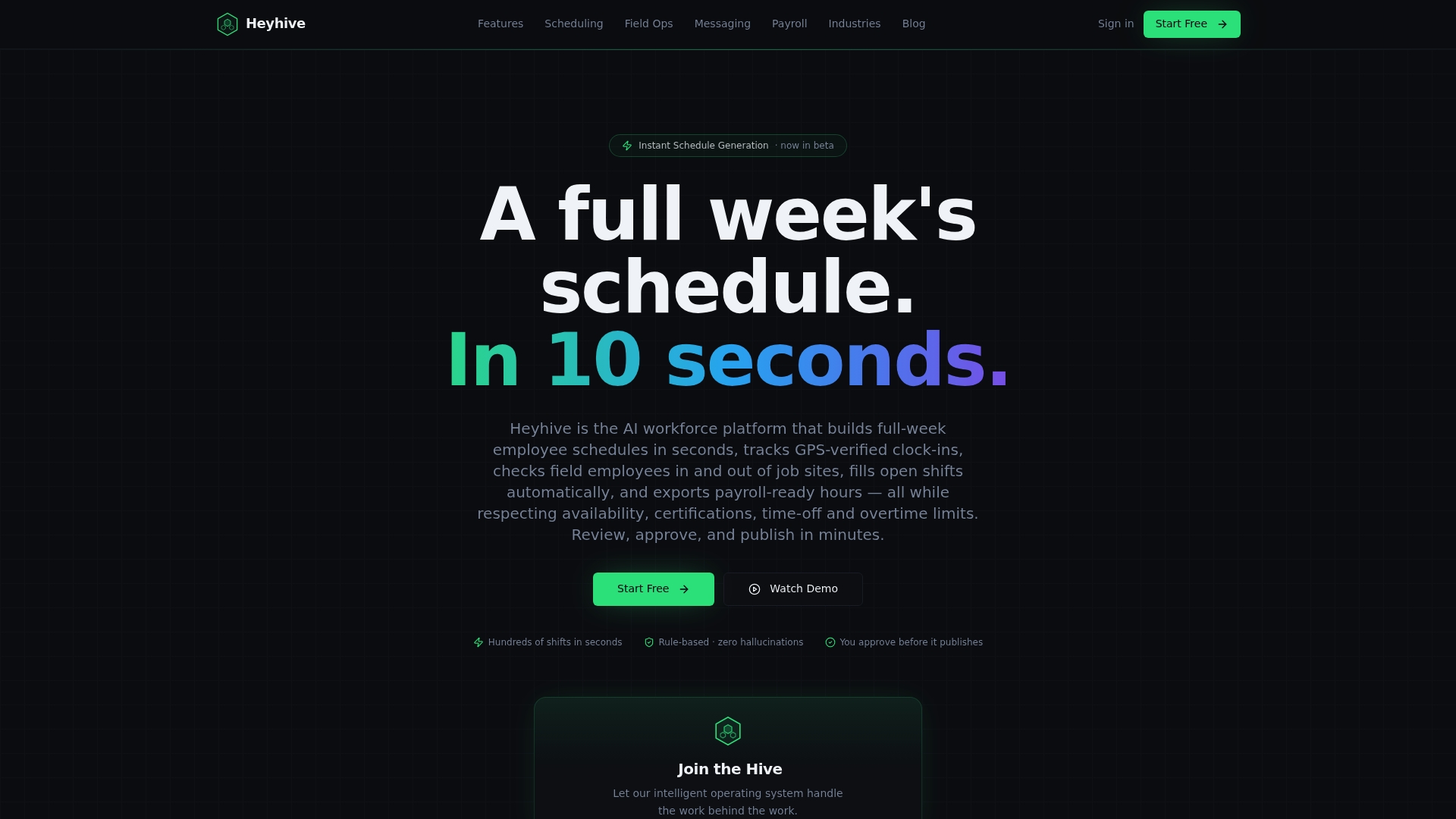
Heyhive generates a full week of shifts in seconds, built around each employee's availability, certifications, and overtime limits, so your seasonal schedule doesn't require a spreadsheet marathon every Sunday night. You still approve every schedule before it publishes, so quality control never leaves your hands. GPS-verified clock-ins keep field and multi-site teams accountable without extra admin work, and payroll-ready hours export means your seasonal cohort doesn't create a payroll bottleneck in week one. For HR teams managing hiring volume alongside scheduling, Heyhive's AI resume screening tools can also help cut through applicant volume faster. If you're building your forecast now, start a free trial at Heyhive and see how fast your next peak-season schedule comes together.
Sources
Verify eligibility through E-Verify. Explore forecasting and hiring guidance on the Heyhive blog.
- E-Verify
- Staff planning: Scaling your workforce for seasonal demand
- Seasonal hiring playbook
- Seasonal hiring plan & temporary staffing budget