
The fastest way to prevent buddy punching is a three-part combination: a written, signed policy that defines the offense clearly; consistent manager oversight of clock-in records; and layered verification technology that creates tamper-resistant proof at the moment of punch. No single lever works alone.
Here is what that looks like in practice:
- Written policy first. Define buddy punching explicitly, list prohibited behaviors, and spell out progressive discipline steps. Get a signed acknowledgment from every employee.
- Manager oversight second. Supervisors review flagged punches before payroll closes, not after. Approval workflows make this systematic rather than ad hoc.
- Layered verification third. Photo-on-punch, GPS geofencing, and device ID together create human-reviewable evidence without requiring biometric templates that trigger state privacy laws.
This approach deters cheating, builds an evidence trail for HR investigations, and keeps you on the right side of wage-and-hour rules. Platforms like Heyhive combine GPS-verified clock-ins with manager approval workflows so you can deploy all three layers without stitching together separate tools.
Key Takeaways
Stopping buddy punching requires a written policy, layered verification technology, and consistent manager oversight working together, not any single control applied in isolation.
| Point | Details |
|---|---|
| Policy comes first | A signed, written policy is the legal foundation; without it, discipline decisions are fragile. |
| Layer your verification | Combine photo-on-punch, GPS geofencing, and device ID for tamper-resistant proof without biometric risk. |
| Managers approve before payroll | Approval workflows that hold flagged punches until a supervisor reviews them prevent fraudulent hours from reaching payroll. |
| Measure and audit regularly | Track edited punch rates and payroll variance monthly; run a full compliance audit annually. |
| Heyhive accelerates deployment | GPS-verified clock-ins, manager approvals, and exportable logs are built into one platform for fast, compliant rollout. |
Table of Contents
- What is buddy punching and what does it cost you?
- Why do employees buddy punch in the first place?
- How do you know if buddy punching is already happening?
- The three-pillar prevention framework
- How to write and enforce an anti-buddy-punching policy
- Which technical controls actually work?
- How to choose and deploy the right technology stack
- How do you measure whether your program is working?
- Your layered proof checklist: operational steps and Heyhive features
- Prevention works best when employees understand why
- Heyhive makes layered proof fast to deploy
- Sources
What is buddy punching and what does it cost you?
Buddy punching is a form of time theft in which one employee clocks in or out on behalf of another, recording hours the second employee did not actually work. It is a specific subtype of payroll fraud, distinct from extended breaks or personal internet use, because it requires active cooperation between at least two people.
The scale is significant. Industry estimates place annual U.S. losses from buddy punching at roughly $373 million, concentrated in shift-driven sectors like restaurants, retail, healthcare, and field services where manual or PIN-based time clocks are still common.
The payroll damage runs deeper than the direct wage overpayment. Consider what else gets distorted:
- Overtime exposure. Inflated hours push employees past 40-hour thresholds, triggering overtime pay for hours nobody worked.
- Labor-cost forecasting. Scheduling models built on inaccurate historical hours produce staffing plans that consistently miss.
- FLSA recordkeeping risk. The Fair Labor Standards Act requires accurate records of hours worked. Systematic inaccuracies, even if caused by employees rather than management, create compliance exposure during audits.
- Morale erosion. Employees who show up on time and follow the rules notice when others do not. Over time, perceived leniency breeds resentment and can normalize the behavior across a team.
A concrete scenario: a restaurant with 30 hourly employees where five regularly buddy punch for 15 minutes per shift, five days a week, accumulates roughly 325 fraudulent hours per year at a $16 average wage. That is more than $5,000 in direct wage loss before overtime multipliers, and it does not count the scheduling distortions that follow.
Why do employees buddy punch in the first place?
Understanding the causes matters because technology alone cannot fix a cultural problem. The most common drivers are:
- Lax or inconsistent oversight. When managers rarely review time records before payroll closes, the perceived risk of getting caught is low.
- Peer pressure and loyalty. Employees cover for coworkers who are running late, viewing it as a favor rather than fraud.
- Manual or PIN-based time clocks. A shared PIN requires zero coordination effort. The barrier to buddy punching is essentially zero.
- Unclear or unacknowledged policy. If employees have never seen a written definition of buddy punching or its consequences, many genuinely do not classify it as a serious offense.
- Inconsistent scheduling. Unpredictable shift changes create situations where employees feel entitled to flexibility they were not formally granted.
- Unpaid break expectations. When employees believe break deductions are unfair or inaccurate, some rationalize buddy punching as a form of self-correction.
Remote and field work change the risk profile considerably. Without a physical clock-in terminal, the only barrier is the honor system, and peer pressure to cover for a slow-starting colleague is stronger when no supervisor is physically present.
Pro Tip: Reward structures can unintentionally encourage buddy punching. If a team's performance bonus depends on full attendance metrics, employees have a financial incentive to cover for each other. Audit your incentive design alongside your timekeeping controls.
How do you know if buddy punching is already happening?
Detection comes before discipline. Before you can act, you need documented evidence, and that evidence lives in your time and attendance data.
Data red flags to look for:
- Repeated identical timestamps across two or more employees clocking in within seconds of each other, consistently
- GPS coordinates that place an employee at a location they could not physically reach given their prior clock-out location
- Multiple clock-ins originating from the same device ID for different employee accounts
- Frequent manual edits to time records with vague or missing reasons
- Sudden spikes in overtime for specific employees that do not align with scheduled hours
Operational signals:
- A consistent pattern of late arrivals always covered by the same coworker's punch
- Manager reports of schedule gaps that do not match payroll records
- Mismatches between badge-access or CCTV logs and time-clock entries
Once you spot a pattern, follow a structured investigation workflow before taking any action:
| Step | Action | Purpose |
|---|---|---|
| 1. Preserve records | Export and lock the relevant time logs immediately | Prevent accidental or intentional alteration |
| 2. Gather supporting data | Pull GPS logs, photo captures, device IDs, and badge records | Build a multi-source evidence file |
| 3. Interview involved staff | Speak separately with the employee and the suspected proxy | Identify honest mistakes vs. deliberate fraud |
| 4. Document findings | Write a factual summary before any discipline decision | Protect the company in any subsequent dispute |
FirstHR's guidance on time theft makes an important distinction here: correctly classifying the behavior, honest mistake versus deliberate falsification, determines the appropriate HR response. Treating a genuine scheduling error as fraud creates legal and morale risk of its own.
The three-pillar prevention framework
Stopping buddy punching for good requires three pillars working together. Each one is necessary; none is sufficient alone.
Pillar 1: Policy. A written, signed policy sets the legal and behavioral foundation. It defines what buddy punching is, what the consequences are, and what recordkeeping method employees are required to use. Without it, discipline decisions are legally fragile.
Pillar 2: Supervision. Manager oversight enforces the policy and models the expectation that time records are taken seriously. Approval workflows that require a manager to review flagged punches before payroll closes turn oversight from an intention into a process.
Pillar 3: Technology. Tamper-resistant verification creates evidence that neither the employee nor the manager can easily alter. Practitioner guides consistently recommend combining GPS, photo capture, and device ID because no single control is foolproof on its own.
The pillars interact in a specific sequence. Policy defines what technology enforces. Technology produces the evidence that managers review. Managers apply the policy to what the evidence shows. Skip any pillar and the system has a gap.
First steps in sequence:
- Draft and distribute an updated written policy with signed acknowledgment
- Train managers on the approval workflow and what flagged punches look like
- Pilot the verification technology with one team or location before full rollout
How to write and enforce an anti-buddy-punching policy
A policy that employees have never read and signed is not a policy. It is a document. The difference matters the moment you need to discipline someone.
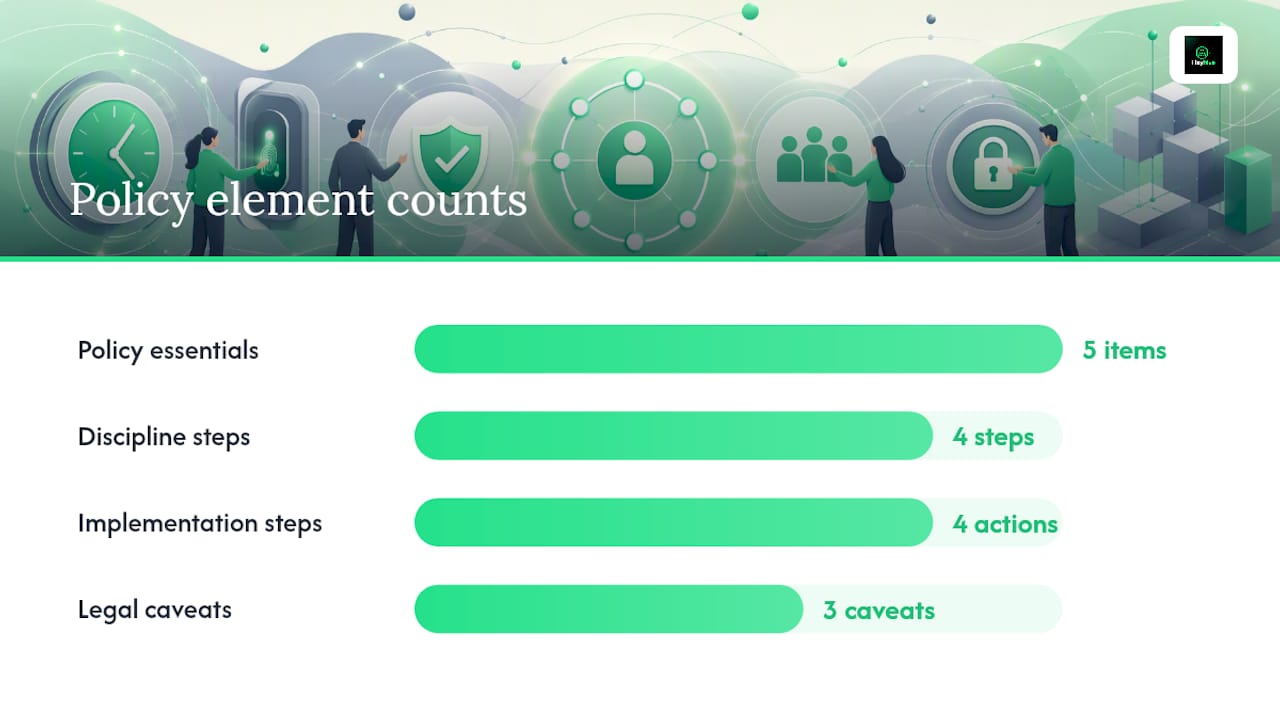
Policy essentials to include:
- A clear, plain-language definition of buddy punching with two or three concrete examples
- A statement of the required timekeeping method (app, terminal, or platform) and that no other method is authorized
- Progressive discipline steps: verbal warning, written warning, final written warning, and termination for repeated or egregious violations
- A statement that both the employee who punches and the employee who benefits are subject to discipline
- A signed acknowledgment line, with the date, that becomes part of the personnel file
Implementation steps:
- Introduce the policy at onboarding and have new hires sign before their first shift
- Re-distribute to all current employees with a deadline for signed acknowledgment
- Store signed copies in personnel records, not just a shared drive
- Schedule an annual reminder, either a brief training or a policy re-acknowledgment, so the expectation stays current
Legal caveats worth knowing:
Under the Fair Labor Standards Act, employers generally cannot withhold earned wages to recover suspected time theft. The legally sound response is a documented investigation, progressive discipline, and, where termination occurs, paying all wages owed before pursuing any separate recovery. Some states, including California, impose waiting-time penalties for delayed final pay. If your workforce operates in Illinois or another state with a biometric privacy statute, any technology that captures and stores biometric templates requires a separate notice-and-consent process. This is operational guidance, not legal advice; consult employment counsel for your specific situation.
For attendance-related misconduct more broadly, a no-call no-show policy paired with your buddy-punching policy gives managers a complete framework for handling attendance issues consistently.
Which technical controls actually work?
The right technology stack depends on your work environment, your budget, and your tolerance for legal complexity. Here is a practical breakdown.
Biometric time clocks (fingerprint or facial recognition)
How it works: Employees authenticate with a physical trait that cannot be shared. Effectiveness: Very high. No proxy can replicate a fingerprint. Limits: Hardware cost, maintenance, hygiene concerns, and significant legal risk in states with biometric privacy laws. Illinois's Biometric Information Privacy Act (BIPA) requires written consent, a retention policy, and prohibits selling biometric data. Similar laws exist in Texas and Washington. Best for: High-volume, fixed-location workplaces with legal counsel already engaged on BIPA compliance.
Photo-on-punch
How it works: The clock-in app captures a timestamped photo that a manager reviews. Effectiveness: High. Creates human-reviewable evidence without biometric template processing. Limits: Requires manager time to review; photo quality depends on lighting and device camera. Legal risk: Lower than biometric systems. Clockspot's guidance notes that the capture step is legally distinct from biometric template processing, so photo storage typically does not trigger BIPA when no facial-recognition algorithm processes the image. Best for: Most businesses as a baseline control.
GPS geofencing
How it works: Clock-ins are only accepted when the employee's device is within a defined geographic boundary around the worksite. Effectiveness: High for field and multi-site teams. Eliminates remote proxy punching entirely. Limits: Requires smartphone with location services enabled; geofence calibration matters (too tight and legitimate punches get rejected). Best for: Field crews, construction, delivery, and any multi-site operation. See the geofencing time tracking guide for setup specifics.
Device ID locking
How it works: Each employee's account is tied to a registered device. Clock-ins from unregistered devices are flagged or blocked. Effectiveness: Moderate to high. Stops most casual proxy punching. Limits: Employees sharing devices for legitimate reasons (shared tablets at a kiosk) require exception handling. Best for: Any mobile-first workforce as a complement to GPS.
IP address restrictions
How it works: Clock-ins are only accepted from approved IP addresses (office network). Effectiveness: Moderate for fixed-location work; near-zero for field teams. Limits: VPNs and mobile data bypass IP restrictions easily. Best for: Office environments as a supplementary control, not a primary one.
The layered proof advantage: A multi-factor non-biometric approach combining photo-on-punch, GPS geofencing, and device ID gives strong detection signals at lower legal risk and cost than company-wide biometric programs. Each layer compensates for the others' blind spots.
How to choose and deploy the right technology stack
Selecting the right tools is a procurement decision. Deploying them without disrupting operations is an implementation one. Both require a checklist.
Selection criteria:
- Match the use-case: on-site teams need terminal or kiosk options; field teams need GPS-first mobile apps; remote workers need device ID plus IP restrictions.
- Require layered proof: any platform you evaluate should support at least two of photo capture, GPS, and device ID simultaneously.
- Prioritize manager approval workflows: the system should route flagged punches to a manager before payroll export, not just log them for later review.
- Confirm exportable audit logs: payroll integration requires clean, timestamped records that can be pulled for audits without manual reformatting.
- Check data retention controls: set retention periods that match your state's recordkeeping requirements and your legal team's guidance.
Deployment tasks:
- Test geofences at each site before go-live; walk the boundary and confirm the radius captures all legitimate clock-in locations
- Calibrate photo capture timing so it fires at the moment of punch, not after a delay that allows substitution
- Connect the approval workflow to your payroll export so no unapproved punch reaches payroll automatically
- Set access controls so only authorized managers can edit time records, and log every edit with a reason
Pilot and rollout plan:
- Select one team or location for a two-week pilot
- Train managers on the approval interface and what a flagged punch looks like
- Communicate the change to employees before go-live (what data is captured, how to view their own records, how to dispute an error)
- Collect feedback on false positives, device failures, and geofence edge cases
- Adjust settings, then roll out to remaining teams with the refined configuration
For field-specific deployment, the construction time tracking guide covers GPS-first exception handling in detail.
How do you measure whether your program is working?
Prevention programs that are never measured tend to drift. Set KPIs before rollout so you have a baseline to compare against.
| Metric | What it measures | Target direction |
|---|---|---|
| Edited punch rate | Percentage of punches manually adjusted after submission | Decreasing over time |
| Suspicious-pattern flags per 1,000 punches | System-detected anomalies (duplicate device, out-of-geofence) | Decreasing after policy rollout |
| Payroll variance vs. scheduled hours | Difference between scheduled and paid hours by team | Narrowing toward zero |
| Manager confirmation rate on flagged punches | Percentage of flags reviewed and resolved before payroll close | Very high |
Audit cadence:
- Weekly during rollout: review all flagged punches, confirm manager resolution rates, and catch configuration issues early.
- Monthly after stabilization: run a pattern review across teams, compare payroll variance to the pre-rollout baseline, and spot emerging anomalies.
- Annually: conduct a full compliance audit, confirm log retention is intact, and re-train managers on the approval workflow.
Demonstrating ROI:
Use your pre-rollout payroll variance as the baseline. After 90 days, calculate the reduction in unexplained variance and multiply by your average hourly wage. That figure is the direct labor savings attributable to the program. For a more rigorous test, run a phased rollout across matched teams and compare variance trends between the pilot group and the control group.
Your layered proof checklist: operational steps and Heyhive features
This checklist is designed to be followed in sequence. Complete each step before moving to the next.
Enable and configure the core controls:
- Enable photo-on-punch for all clock-in events and set the photo to be stored with the timestamp and employee ID
- Configure a GPS geofence for each worksite; set the radius to cover all legitimate clock-in locations with a small buffer
- Register each employee's device and block clock-ins from unregistered devices
- Enable manager approval for all manual edits to time records
- Set log retention to at least three years to cover FLSA recordkeeping requirements
Workflow: from flagged punch to payroll resolution:
- Employee attempts a clock-in outside the geofence or from an unregistered device
- System flags the punch and holds it from payroll export
- Manager receives a notification and reviews the photo, GPS coordinates, and device ID
- Manager contacts the employee for an explanation if the evidence is ambiguous
- Manager approves (legitimate exception) or rejects (fraudulent or policy-violating punch) with a documented reason
- Approved punches flow to payroll export; rejected punches are logged with the manager's notes for the HR file
How Heyhive maps to each step:
Heyhive's GPS-verified clock-ins enforce geofence boundaries at the moment of punch. Manager approval workflows hold flagged punches out of payroll until a supervisor reviews and resolves them. Exportable audit logs give HR a clean, timestamped record for any investigation. The timesheet approval workflow ties the entire sequence together so nothing reaches payroll without a human sign-off.
SHRM's guidance reinforces that making records visible to employees, so they can view and dispute their own time data, reduces dishonesty without requiring heavy surveillance. Heyhive's employee-facing schedule and time views support exactly that transparency.
Prevention works best when employees understand why
The most common mistake managers make when rolling out anti-buddy-punching controls is treating it as a covert operation. Announcing the change, explaining what data is captured, and showing employees how to view and correct their own records produces faster behavior change than any surveillance-first approach.
SHRM's expert guidance is clear: systemic prevention paired with transparency protects honest employees while making unfair advantage harder to obtain. Covert monitoring, by contrast, tends to surface only after trust is already damaged, and the legal exposure from undisclosed monitoring is real in many states.
When you announce the rollout, say three things plainly: what the system captures (photo, GPS location, device ID), how managers use that data (review before payroll, not continuous monitoring), and how employees can view their own records and flag errors. That framing turns a surveillance announcement into a fairness announcement.
Treat honest mistakes differently from intentional fraud. An employee who occasionally forgets to clock in and asks a coworker to cover deserves a conversation and a policy reminder, not a termination letter. An employee with a documented pattern of coordinated proxy punching, confirmed by photo and GPS evidence, is a different situation entirely. Progressive discipline informed by documented evidence keeps both responses proportionate and legally defensible.
Heyhive makes layered proof fast to deploy
Cutting payroll losses from buddy punching does not require a six-month implementation project. Heyhive gives managers GPS-verified clock-ins, photo capture, device registration, and manager approval workflows in a single platform, connected directly to payroll-ready exports.
A practical two-step pilot: enable GPS geofencing and photo-on-punch for one team in week one. In week two, activate manager approval so every flagged punch requires a supervisor sign-off before it reaches payroll. By the end of the pilot, you have a documented baseline, a trained manager, and a clear picture of where your time theft exposure actually sits.
Heyhive's attendance tracking and scheduling tools mean the same platform that prevents buddy punching also handles shift coverage, overtime limits, and payroll export, so you are not adding a point solution on top of an already complex stack.
Ready to see it in action? Start a free trial at Heyhive and have layered proof running for your first team within a day.
Sources
The sources below are the primary references used in this guide. Government sources carry the highest authority for legal and compliance questions; practitioner sources provide operational context.
- U.S. Department of Labor — Fair Labor Standards Act (FLSA)
- SHRM (Society for Human Resource Management)
- HCI/HRDailyAdvisor — Buddy punching costs U.S. employers $373 million annually
- FirstHR — Time Theft at Work: What It Is and How to Prevent It
- Employee Monitoring (eMonitor) — Time theft prevention guide
This article is general information, not a substitute for advice from a qualified lawyer. Consult a qualified legal professional about your own circumstances before acting on anything here.