
Most predictive-scheduling rules require employers to post or transmit written work schedules at least one to two weeks before the work period, listing shift start and end times, on-call status, and location. If you manage hourly staff, the compliance action is simple to state and harder to skip: publish on time, log the publication, and keep a timestamped record of every change. When a schedule shifts after the deadline, be ready to pay whatever predictability premium your local ordinance demands.
TL;DR:
- Employers must provide at least 14 days' written advance notice of work schedules, including shift times, on-call status, and locations, in most jurisdictions.
- Compliance requires timestamped records of schedule postings and any changes, along with proof of employee notification, to pass audit trails.
- Different cities and states, like Chicago, Oregon, and Seattle, have varying rules on notice content, delivery methods, and exceptions, complicating multi-location compliance.
- Significant last-minute schedule changes require prompt employee communication and timely payroll reconciliation of any predictability premiums paid.
- Using scheduling software with approval workflows, automatic notifications, and detailed change logs simplifies compliance and supports legal proof of adherence.
Table of Contents
- Where Advance Notice Schedules Rules Actually Come From
- Building an HR Policy That Actually Holds Up
- How Scheduling Technology Makes Compliance Practical
- What to Do When a Schedule Changes Late
- A Quick Checklist and Copy-Ready Templates
- Notice Alone Doesn't Fix Scheduling. Certainty Does.
- Making Advance Notice Schedules Easier to Manage
- Sources
- FAQ
Where Advance Notice Schedules Rules Actually Come From
There's no federal law that sets a national standard for advance notice schedules. What exists instead is a patchwork of state and municipal ordinances, each with its own definitions, deadlines, and enforcement mechanics. If you operate in more than one city, you're not following one rulebook. You're following several, and they don't always agree.
That said, most of these ordinances share a common skeleton. Once you know what to look for, reading a new one gets a lot faster:
- Minimum notice period. Usually about two weeks, though some rules allow shorter windows, including as little as one day, for specific situations like employee-requested swaps or emergencies.
- Delivery method. Written posting in a conspicuous, accessible location, electronic transmission, or both.
- Required content. Shift start and end times, on-call status, and often work location.
- Language and accessibility rules. Some jurisdictions require postings in English and the employee's primary language.
- Exceptions. Weather emergencies, employee-initiated changes, and operational disruptions typically carry different rules than employer-initiated changes.
- Penalties. Predictability pay, civil fines, or both, depending on the jurisdiction.
Three examples show how this plays out in practice.
Chicago requires covered employers to give new hires a good-faith estimate of their schedule at the time of hire, then post or transmit actual work schedules at least 14 days before the work period begins. The Chicago municipal code spells out that posted schedules must include shifts and on-call status, and it sets compensation triggers for changes made after that 14-day line.
Oregon runs one of the more detailed state-level frameworks. Employers must provide a written work schedule at least 14 calendar days before the first day of that schedule, and the rule requires posting in a location employees can actually see and access, plus timely notice of any change, according to Oregon's Bureau of Labor and Industries. The state's administrative code goes further, requiring bilingual posting where applicable and clarifying exactly when a modified schedule counts as a "change" for premium-pay purposes, per OAR 839-026-0030. That last detail matters more than it sounds: not every adjustment triggers pay, and knowing the difference protects you from over-paying and under-paying alike.
Seattle's Office of Labor Standards publishes a template that many employers use as a starting point. It calls for the same 14-day advance notice, requires on-call shifts to be included, and specifies that schedules go out in English and the employee's primary language, according to Seattle's official advance notice template.
When you read any local ordinance for the first time, check three things before anything else: the effective date (many laws phased in over multiple years), the definition of "covered employee" (headcount thresholds and industry carve-outs vary widely), and the exceptions list (it usually tells you more about how enforcement actually works than the headline notice period does).
Building an HR Policy That Actually Holds Up
Legal text tells you what's required. It doesn't tell you how to run a shift-based business without missing a deadline every other week. That's a policy problem, and it's one you solve with a handful of concrete decisions.
- Pick a fixed publish deadline and stick to it. Don't leave "written" ambiguous. Decide whether your company means a physical posting, an email, or a notification through a scheduling app, and write that definition into your policy so managers aren't guessing.
- Write a schedule-change policy with teeth. Spell out when changes are allowed, who has to be notified and how, and when premium pay kicks in. Vague change policies are where most predictability-pay disputes start.
- Keep records that would survive an audit. Timestamped posts, notification receipts, and employee acknowledgments are the artifacts regulators actually ask for. Some ordinances also require visibility into whole workgroup schedules, not just an individual's shifts, so build that into your recordkeeping from the start.
- Measure your own change rate before locking in a notice window. A systematic review of advance-notice research found limited evidence that longer notice periods alone reduce fatigue or improve outcomes. The more useful approach is pairing notice length with certainty: pull your roster-change history and pick a notice window that keeps last-minute changes low without locking your operation into a schedule it can't actually hold.
- Give managers a script for last-minute coverage gaps. Who gets contacted first, in what order, and how offers and declines get documented. Improvised coverage scrambles are exactly when compliance slips.
Pro Tip: *Run a quick audit of your last three months of published schedules.
How Scheduling Technology Makes Compliance Practical
A paper posting on a breakroom wall satisfies "conspicuous" in the narrowest sense, but it doesn't leave much of a trail when a regulator asks who saw what, and when. A workable system needs a few non-negotiable features:
- A publish/approve workflow that separates schedule generation from the moment it becomes official.
- An immutable change log with timestamps, so every edit after publication is traceable.
- Automatic employee notification receipts confirming the schedule actually reached the people on it.
- Multilingual posting support and on-call flags, matching what jurisdictions like Oregon and Seattle require.
- Payroll export that flags which hours triggered a premium-pay event.
The workflow itself is straightforward once the system supports it: generate the draft schedule, route it to a manager for approval, publish it, trigger automatic notifications to affected employees, and log every step. When something changes afterward, the system ties that change event directly to a new notification and a new log entry, which is exactly the record regulators ask for during an audit: the posted schedule with timestamps, proof of transmission, a change history, and payroll reconciliation showing any premium paid on late changes.
Vendors in this space, including Heyhive's own AI scheduling workflow, build these publish-and-log steps directly into the platform so managers aren't reconstructing a paper trail by hand after the fact. That's the difference between "we think we posted it on time" and having a timestamp that proves it.

What to Do When a Schedule Changes Late
Once you've missed the notice deadline, the legal outcome usually falls into one of two buckets: you owe timely notice of the change itself, or you owe a predictability premium, or sometimes both, depending on the jurisdiction. The specifics vary enough between cities and states that treating every ordinance as identical is a mistake in itself.
The operational response should happen fast, regardless of what the ordinance ultimately requires:
- Contact affected employees through more than one channel (text and app notification, not just one).
- Document every attempt, including who didn't respond and when.
- Offer alternatives where possible, and record acceptances and declines in writing.
- Flag the shift internally the moment it changes, before payroll processing begins.
Payroll is where a lot of employers lose the thread. A predictability-pay analysis of Chicago's Fair Workweek law notes that employers commonly fail at exactly this step: not logging the timestamped notice attempt or not reconciling premium pay within the same pay period. Fix that by flagging late-change shifts as they happen, calculating the mandated premium immediately, and closing it out in that pay cycle rather than catching it later.
Municipal rules on this diverge enough, and change often enough, that a quick check with local counsel before finalizing your change policy is worth the hour it costs.
A Quick Checklist and Copy-Ready Templates
Run through this before your next posting cycle:
- Schedule published or transmitted by your set deadline.
- Content includes shift times, on-call status, and location.
- Delivery method matches what your local ordinance requires (posting, electronic, or both).
- Change log and notification receipts saved for every edit after publication.
- Premium pay calculated and reconciled in the same pay period as the change.
Three templates worth keeping on hand:
- Good-faith estimate (at hire): "Your anticipated weekly hours and shift pattern are [X hours across Y days]; actual schedules will be posted at least [14] days before each work period."
- Standard posting notice: "Your schedule for [dates] is now posted. Review your shift times, on-call status, and location before [date]."
- Change notification: "Your shift on [date] has changed from [original time] to [new time]. Reply to confirm you've seen this update."
Adjust the numbers and channel to match your industry and headcount. A 12-person café and a 400-person retail chain shouldn't be running the same version of this checklist.
Notice Alone Doesn't Fix Scheduling. Certainty Does.
The instinct to solve scheduling complaints by extending the notice window further is understandable, and mostly wrong. The research on advance notice is clear that long notice without certainty just gives workers more time to watch a schedule fall apart. The better move is measuring how often your rosters actually change after publication, then setting your notice window at the point where that change rate stops improving. That's the sweet spot, and it's specific to your operation, not a number borrowed from someone else's.
— Heyhive
Making Advance Notice Schedules Easier to Manage
Every checklist item above (publish deadlines, change logs, notification receipts, payroll flags for premium pay) is a workflow problem before it's a legal one. Heyhive is built around exactly that gap: AI-powered scheduling that generates full weeks of shifts in seconds while respecting availability, certifications, and overtime limits, with a manager approval gate before anything goes live.
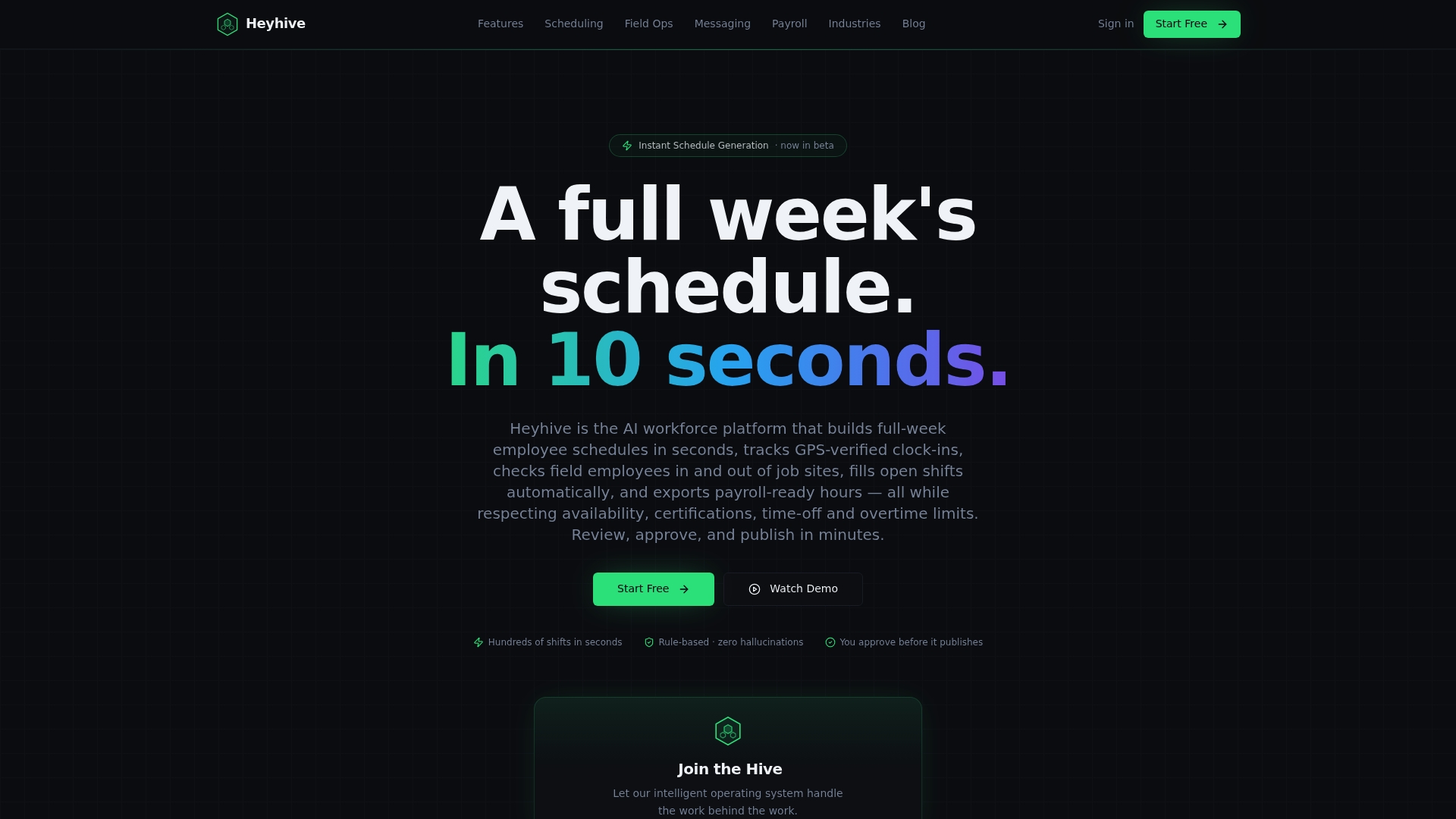
Once a schedule is approved and published, the system sends automatic notifications, keeps a timestamped log of every change, and exports payroll-ready hours that flag which shifts triggered a premium event. GPS-verified clock-ins add another layer of accuracy for field and multi-site teams. For a technical look at how scheduling software supports posting and predictability more broadly, MPulse's scheduling features guide is a useful comparison point.
None of this replaces reading your own city or state ordinance, or checking with counsel when the language is ambiguous. What it does is give you a system that can prove compliance instead of hoping it holds up. Run your next scheduling cycle through Heyhive's approval and notification workflow and see how it stacks up against your local checklist.
Sources
- BOLI : Predictive scheduling : For Workers : State of Oregon
- 6-110-040 Advance notice of work schedules.
- How much advance notice do workers need? A review and theoretical framework for determining advance notice periods for unpredictable work
FAQ
How Far in Advance Should I Know My Work Schedule?
Most predictive-scheduling ordinances require employers to post or transmit written schedules at least 14 days ahead of the work period, though some allow shorter windows for specific exceptions. Oregon's rule and Chicago's ordinance both set that 14-day standard as their baseline.
Which States Have Predictive Scheduling Laws?
Predictive scheduling rules exist at the state level in Oregon, and at the municipal level in cities including Chicago and Seattle, with other jurisdictions adopting similar frameworks over time. Because there's no single federal standard, employers operating across state lines need to check each location's ordinance separately rather than assume one policy covers them all.
How Much Notice Does an Employer Have to Give for a Schedule Change in Oregon?
Oregon requires 14 calendar days of advance notice for the initial schedule, and it requires timely notice of any changes made after that, with specific rules on when a modification counts as a "change" for pay purposes under OAR 839-026-0030. Employers should check that provision directly since some schedule adjustments are excluded from premium-pay calculations.
How Much Notice Does an Employer Have to Give for a Schedule Change in NY?
New York does not have one statewide predictive scheduling law; instead, its rules are concentrated in fast food and retail sectors within New York City, which impose their own notice and change-pay requirements separate from Oregon's or Chicago's frameworks. Employers should confirm the specific city or industry rule that applies to their business rather than relying on a general state standard.
Can Scheduling Software Help With Advance Notice Compliance?
Yes. Platforms that combine a manager approval step, automatic employee notifications, and immutable change logs, like Heyhive's scheduling workflow, give employers the timestamped records regulators ask for during a compliance audit. Manual posting can meet the same legal requirements, but it rarely produces the same auditable trail.