
Fair workweek laws, also called predictive scheduling laws, require employers in covered industries to post schedules in advance, pay premiums when they change those schedules late, and give workers the right to decline added shifts without penalty. Estimates suggest these laws now cover over 1.8 million workers across the United States, concentrated in retail, fast food, and hospitality. If you work or operate in one of the jurisdictions below, this guide tells you exactly what applies to you and what to do next.
For employees:
- Check whether your city or state is on the jurisdiction list below.
- Keep every written schedule notice, text, or email about shift changes.
- Request a written good-faith estimate of your expected hours if you never received one at hire.
For employers:
- Publish schedules at least 7–14 days in advance (the exact window depends on jurisdiction).
- Capture written or electronic consent when you change a posted schedule.
- Maintain timestamped audit logs of every posting, change, and consent.
Jurisdictions with active fair workweek or predictive scheduling laws:
| Jurisdiction | Law type |
|---|---|
| New York City | Local ordinance (fast food & retail) |
| San Francisco | Local ordinance (retail) |
| Seattle | Local ordinance (retail, food service, hospitality) |
| Chicago | Local ordinance (retail, restaurants, hotels) |
| Evanston, IL | Local ordinance |
| Philadelphia | Local ordinance (retail) |
| Los Angeles City | Local ordinance (retail) |
| Los Angeles County | Local ordinance |
| Berkeley, CA | Local ordinance |
| Emeryville, CA | Local ordinance |
| San Jose, CA | Local ordinance |
| Oregon | Statewide (retail, hospitality, food service) |
Table of Contents
- What do fair workweek laws actually require?
- Which U.S. jurisdictions have predictive scheduling laws?
- Who is covered, and what are the common exemptions?
- What are the core employer obligations under fair workweek laws?
- How does enforcement work, and what remedies are available?
- How should employers build a compliance program?
- What should employees do if their scheduling rights were violated?
- Key Takeaways
- The operational reality of fair workweek compliance
- How Heyhive helps you stay ahead of scheduling compliance
- Authoritative sources and primary references
What do fair workweek laws actually require?
Fair workweek laws across U.S. jurisdictions typically require advance notice of schedules, predictability-pay premiums for late changes, the right to decline added shifts, required rest periods between shifts, and good-faith estimates at hire. The policy rationale is straightforward: hourly workers in retail and fast food often can't plan childcare, a second job, or a monthly budget when their schedule arrives two days before the week starts.
Here are the core terms you'll encounter across ordinances:
- Good-faith estimate: — A written document provided at hire that describes the employee's expected schedule, including typical days, hours, and location. Many ordinances require employers to update it when long-term changes occur; Seattle requires a more detailed interactive process for certain major life events.
A concrete example: Suppose you work at a fast food restaurant in New York City. Your employer posts a schedule on Monday for the following week. On Thursday, your manager calls and asks you to add a Saturday shift. Under NYC's Fair Workweek Law, you have the right to decline that shift. If you agree to work it, your employer owes you a predictability-pay premium on top of your regular wages. If accepting that Saturday shift also means you'd be closing Friday night and opening Saturday morning with fewer than 11 hours in between, an additional clopening premium applies.
These laws most commonly target retail and fast food, though some jurisdictions extend coverage to hospitality, building services, and food service more broadly.
Which U.S. jurisdictions have predictive scheduling laws?
Predictive scheduling laws have been enacted in multiple U.S. cities and one state (Oregon statewide), and ordinances vary on who's covered and which industries are targeted. The table below captures the headline requirements for each major jurisdiction. Always verify current thresholds and effective dates against the official ordinance text, since amendments are common.
| Jurisdiction | Who's covered | Notice window | Predictability pay (typical) | Rest/clopening rule | Enforcement |
|---|---|---|---|---|---|
| New York City | Fast food (10+ locations globally); retail (20+ employees) | 14 days | 1 extra hour at regular rate (added time); half pay for reduced/cancelled time | 11 hours between shifts; premium if employee consents to less | NYC Dept. of Consumer & Worker Protection (DCWP) |
| San Francisco | Retail (20+ employees globally, 1+ SF location) | 2 weeks | 1–4 hours pay for changes depending on timing | 11 hours between shifts | SF Office of Labor Standards Enforcement |
| Seattle | Retail, food service, hospitality (500+ employees globally) | 14 days | 1 hour at regular rate (added time); half pay for reduced time | 10 hours between shifts; premium if waived | Seattle Office of Labor Standards |
| Chicago | Retail, restaurants, hotels (100+ employees) | 10 days | 1 hour at regular rate for changes; additional pay for clopening | 11 hours between shifts | Chicago BACP |
| Evanston, IL | Retail, restaurants, hotels | 10 days | Similar to Chicago model | 11 hours | Evanston Human Rights Division |
| Philadelphia | Retail (250+ employees, 30+ locations) | 10 days | 1 hour at regular rate for late changes | 9 hours between shifts | Philadelphia Office of Worker Protections |
| Los Angeles City | Retail (300+ employees globally) | 14 days | 1 hour at regular rate for changes | Not specified separately | LA Bureau of Contract Administration |
| Los Angeles County | Retail (300+ employees globally) | 14 days | 1 hour at regular rate for changes | Not specified separately | LA County Dept. of Consumer & Business Affairs |
| Berkeley, CA | Retail, food service | 2 weeks | Premium for late changes | 11 hours | Berkeley Office of Labor Standards |
| Emeryville, CA | Retail, fast food (56+ employees globally) | 2 weeks | Premium for late changes | 11 hours | Emeryville City Manager's Office |
| San Jose, CA | Retail | 2 weeks | Premium for late changes | Not specified separately | San Jose Office of Equality Assurance |
| Oregon (statewide) | Retail, hospitality, food service (500+ employees globally) | 7 days (increasing to 14) | 1 hour at regular rate for changes | 10 hours between shifts | Oregon Bureau of Labor & Industries (BOLI) |
A running list of states and localities with predictive scheduling mandates shows this is still a patchwork of local laws rather than uniform state-level coverage. Most states have no statewide law, which means a multi-site operator in California might face Berkeley's rules at one location and no ordinance at all at another.
Why one-size templates fail: Employer-size thresholds are calculated differently across jurisdictions. Some count global corporate employees; others count only workers at the specific establishment. A chain with 400 employees nationwide might be covered in Los Angeles (300+ global) but not in a city that uses a local-site headcount. Industry carve-outs add another layer: Chicago covers hotels and restaurants, while Philadelphia covers only retail. Before applying any template, confirm the exact threshold and industry definition in the local ordinance text.
Who is covered, and what are the common exemptions?
Coverage depends on four factors: industry, employer size, geography, and whether a collective bargaining agreement (CBA) applies. Work through this checklist to determine whether a specific ordinance covers your situation.
- Industry: Is the employer in retail, fast food, food service, hospitality, or building services? Most ordinances target one or more of these sectors. Healthcare and public safety are typically excluded.
- Employer size: Does the employer meet the headcount threshold? Confirm whether the ordinance counts global employees, corporate-wide employees, or only workers at the local establishment. Oregon and Seattle use a 500-employee global threshold; Philadelphia uses 250 employees and 30 locations.
- Geographic scope: Does the employee work at a covered location within the jurisdiction? Remote workers assigned to a covered location may still qualify; check the ordinance's definition of "work location."
- Establishment vs. corporate count: Some ordinances count employees at the specific site; others aggregate across all locations of the same brand or franchisor. A franchisee may be counted together with the franchisor's total under some laws.
- Union/CBA exception: Many ordinances allow a collective bargaining agreement to waive or modify fair workweek requirements, provided the waiver is explicit and the CBA was negotiated after the ordinance's effective date. This is a significant carve-out: unionized workplaces often operate under their own scheduling rules, and the ordinance defers to those rules when the CBA clearly addresses the relevant provisions.
Example threshold calculation: A national retail chain has 350 employees across 12 states, with 8 employees at its Los Angeles store. Under the LA City ordinance (300+ global employees), the chain is covered even though the local store is small. Under a hypothetical ordinance that used a 50-employee local-site threshold, that same store would not be covered. Getting this wrong in either direction creates real risk: under-counting leads to violations; over-counting wastes compliance resources.
Common exemptions beyond CBAs:
- Small employers below the size threshold
- Public safety and emergency services
- Certain healthcare workers (some jurisdictions carve out clinical staff)
- Employees hired specifically for a fixed-term project
Pro Tip: Before assuming an exemption applies, read the ordinance's definition of "employee" and "employer" carefully. Some laws count part-time and temporary workers toward the size threshold; others exclude them. A single misread definition can flip your coverage determination.
What are the core employer obligations under fair workweek laws?
The most commonly required obligations are: post schedules in advance, pay predictability premiums for late changes, provide adequate rest between shifts, issue a good-faith estimate at hire, and maintain detailed records of every scheduling action.

Notice windows and schedule posting
Most ordinances require schedules to be posted 10–14 days in advance. NYC requires 14 days; Chicago requires 10 days; Oregon started at 7 days with a phased increase. "Posting" typically means written notice to each affected employee, not just a break-room bulletin. Electronic delivery is generally accepted, but you need a record that the employee received it.
Predictability pay: how the math works
Two quick examples:
- Added shift (NYC model): — An employee earns $18/hour. The employer adds a 4-hour shift after the 14-day window closes. The employee is owed $18 × 1 extra hour = $18 in predictability pay, on top of the $72 for the 4 hours worked.
- Reduced shift (Seattle model): — The same employee was scheduled for 6 hours but the employer cuts the shift to 4 hours with less than 14 days' notice. The employee is owed half the lost time: 1 hour at $18 = $18 in predictability pay.
These premiums can also affect your overtime calculation. Under the FLSA, scheduling-law penalty payments can be excluded from the regular rate if they are infrequent, sporadic, and not prearranged; however, payments for hours actually worked must be included in the regular rate. If predictability pay becomes a regular pattern, it may need to be folded into the regular rate for overtime purposes, compounding the liability.
Rest periods and clopening premiums
Most ordinances require 9–11 hours between the end of one shift and the start of the next. An employee who closes at 11 PM and is scheduled to open at 7 AM has only 8 hours off, triggering either a mandatory schedule change or a clopening premium (often time-and-a-half for the opening shift). The employee also has the right to decline the clopening without retaliation.
Good-faith estimates and recordkeeping
At hire, employers must provide a written good-faith estimate of the employee's expected schedule: typical days, hours per week, and work location. This isn't a contract, but it sets the baseline. When the actual schedule consistently deviates from the estimate, that deviation can itself trigger scrutiny.
| Recordkeeping item | What to capture | Retention period (typical) |
|---|---|---|
| Schedule postings | Date/time posted, method of delivery, employee acknowledgment | 3 years |
| Schedule changes | Date/time of change, reason, employee consent or refusal | 3 years |
| Good-faith estimates | Original document, any updates, employee signature | Duration of employment + 3 years |
| Predictability pay | Amount, calculation basis, payroll period | 3 years |
| Clopening waivers | Employee written consent, shift times | 3 years |
Maintain these records in a digital, timestamped format. Courts and agencies look for documented evidence that the employer followed the posting rule and obtained or attempted to obtain consent before assessing whether premiums applied.
Sample policy language employers can adapt:
Adjust the notice window to match your jurisdiction. The key elements are the posting deadline, the consent requirement, and the payroll line-item commitment.
How does enforcement work, and what remedies are available?
Employees have two main paths: file an administrative complaint with the relevant city or state agency, or bring a private civil action where the ordinance permits it. Both paths are available under most ordinances, and employees can often pursue back pay, civil penalties, and reinstatement through either route.
Agency complaints and civil penalties
NYC's Department of Consumer and Worker Protection (DCWP) handles fast food and retail complaints. Oregon's Bureau of Labor and Industries (BOLI) administers the statewide law. Seattle's Office of Labor Standards covers the Secure Scheduling Ordinance. Chicago's Department of Business Affairs and Consumer Protection (BACP) enforces the Chicago Fair Workweek Ordinance. Each agency accepts written complaints, investigates, and can order back pay, civil penalties, and injunctive relief.
Civil penalties vary. NYC can assess penalties per violation per employee per week. Chicago's ordinance allows for civil fines in addition to back pay. Some ordinances also allow employees to sue directly in court, bypassing the agency process, and to recover attorney's fees if they prevail.
Anti-retaliation protections are strong. Every major ordinance prohibits employers from firing, demoting, reducing hours, or otherwise penalizing an employee for exercising scheduling rights or filing a complaint. Retaliation is itself a separate violation, often carrying its own penalty. If you experience retaliation, document it immediately and include it in your complaint.
What evidence employees should preserve
The strength of a complaint depends almost entirely on documentation. Here's what to keep:
- Posted schedules: Save every physical or digital copy. Screenshot the scheduling app if that's how your employer posts shifts.
- Change notifications: Keep every text, email, or in-app message about schedule changes, including the date and time you received them.
- Payroll records: Retain pay stubs and any payroll summaries. If predictability pay was owed but not paid, the gap between what you received and what the formula requires is your damages.
- Good-faith estimate: Keep the document you received at hire. If you never received one, note that in your complaint.
- Your own records: A contemporaneous log of your actual hours worked, shift start and end times, and any verbal conversations about schedule changes carries real weight when written records are incomplete.
Complaint filing deadlines vary by jurisdiction, typically ranging from 1–3 years from the date of the violation. File promptly; waiting reduces your recoverable period.
How should employers build a compliance program?
The highest-impact steps are: publish schedules on time, capture written consent for every change, store timestamped records, and configure location-specific rules in your scheduling system before violations accumulate.
Prioritized employer action checklist
Immediate (within 30 days):
- Identify every jurisdiction where you have employees and confirm whether a fair workweek ordinance applies.
- Pull your current scheduling process and measure it against the applicable notice window. If you're posting schedules 3–4 days out, that's the first thing to fix.
- Audit your payroll system to confirm it can calculate and code predictability pay as a separate line item.
- Provide good-faith estimates to any employee who hasn't received one.
Short-term (30–90 days):
- Draft or update your written scheduling policy using the sample language above, tailored to each jurisdiction.
- Train every manager who touches scheduling on the notice window, the consent requirement, and what triggers a premium.
- Set up a digital recordkeeping system that timestamps every schedule posting, change, and consent.
- Create a clopening tracking process so managers can see at a glance when a proposed shift would violate the rest requirement.
Longer-term (90+ days):
- Build location-specific scheduling rules into your software so the system flags violations before they happen.
- Establish a quarterly compliance review: pull a sample of schedule changes, verify premiums were paid, and check that records are complete.
- Update your manager training annually or whenever a jurisdiction amends its ordinance.
Manager training: what to cover
Managers are the compliance front line. Training should cover three scenarios every manager is likely to face:
- Scenario 1: A customer surge requires calling in an extra employee on short notice. The manager must understand that the employee has the right to decline, and that accepting triggers a premium.
- Scenario 2: A slow week prompts the manager to cut a shift. The manager must know the formula for reduced-hours predictability pay and how to document the change.
- Scenario 3: A manager wants to schedule a closing shift followed by an opening shift for the same employee. The manager must check the rest-period rule before posting and get written consent if the employee agrees to waive it.
Each scenario should end with the manager creating a written record: the reason for the change, the employee's response, and the premium calculation if applicable.
Software features to require
Operators that set location-specific rules inside scheduling software reduce the risk of inadvertent violations when they operate across multiple ordinance boundaries. When evaluating scheduling platforms, require these specific capabilities:
- Schedule locking: The system should prevent managers from modifying a published schedule without triggering a consent workflow.
- Audit logs with timestamps: Every posting, change, and approval must be logged with a date/time stamp and the user who made the change.
- Consent capture: Employees should be able to accept or decline a schedule change within the platform, with that response stored automatically.
- Location-specific rule sets: The system must support different notice windows, premium formulas, and rest-period rules by location, not just a single global setting.
- Payroll export with predictability pay: The export should flag predictability-pay amounts as separate line items so your payroll processor can handle them correctly under the FLSA regular-rate rules.
Pro Tip: Before rolling out new scheduling software company-wide, run a 30-day pilot at one location in your most complex jurisdiction. Test every scenario: a late change, a clopening, a refused shift, and a payroll export. Fix rule-set errors at the pilot stage, not after a compliance audit.
What should employees do if their scheduling rights were violated?
If you believe a fair workweek law applies to your job and your employer isn't following it, take three steps immediately: preserve every schedule notice and change notification you have, request a written explanation or corrected good-faith estimate from your employer, and file a complaint with the relevant agency if the issue isn't resolved.

Step-by-step: from documentation to complaint
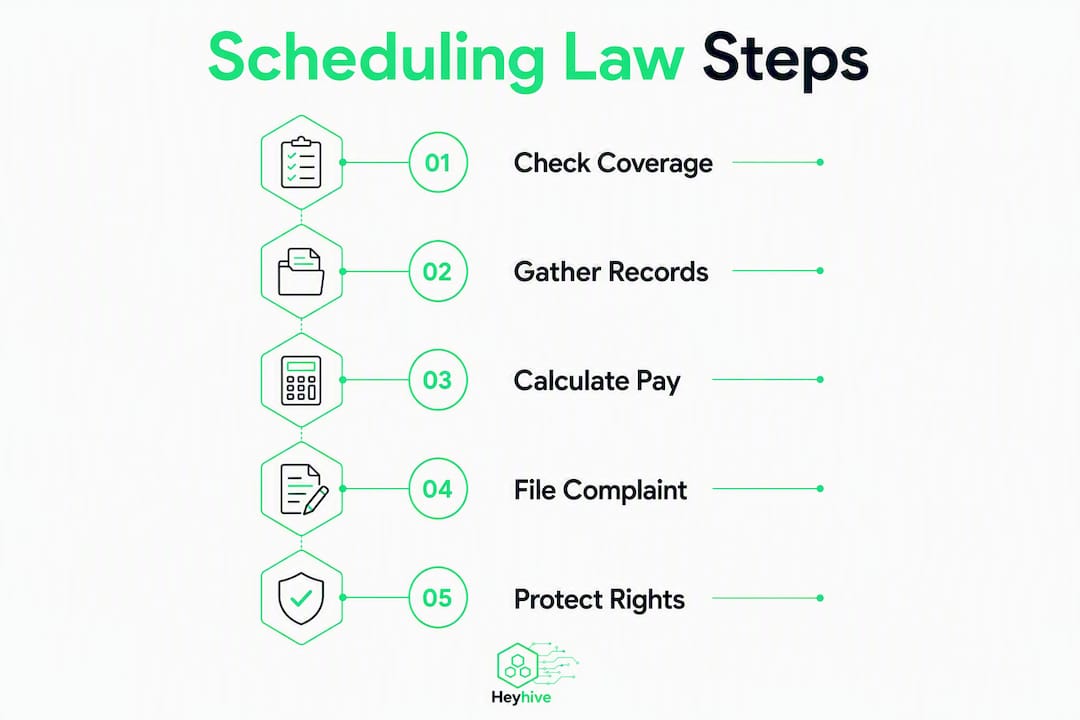
Step 1: Confirm coverage. Use the jurisdiction table above to check whether your city or state has an ordinance. Then verify your employer's size and industry against the thresholds. If you're unsure, the enforcement agency's website often has a coverage FAQ.
Step 2: Gather your records. Collect posted schedules, change notifications, pay stubs, and your good-faith estimate. If you don't have a good-faith estimate, send your employer a written request for one. Keep a copy of that request and any response.
Step 3: Calculate what you're owed. Use the predictability-pay formula for your jurisdiction. If your employer added a shift after the notice window and didn't pay the premium, the gap between what you received and what the formula requires is your claim amount.
Step 4: Raise it internally first (optional but documented). Sending a written message to HR or your manager creates a paper trail and sometimes resolves the issue without a formal complaint. Keep the response.
Step 5: File with the enforcement agency. Links to the major agency intake pages:
- NYC DCWP Fair Workweek
- Oregon BOLI Predictive Scheduling
- Seattle Office of Labor Standards
- Chicago BACP Fair Workweek
Most agencies accept online complaints. Include dates, amounts, and copies of your documentation. Anti-retaliation protections apply from the moment you file.
Time limits matter. Most ordinances have a statute of limitations of 1–3 years from the date of the violation. Don't wait to see if the situation improves; file within the window to preserve your full claim.
Key Takeaways
Fair workweek laws require covered employers to post schedules in advance, pay predictability premiums for late changes, and maintain timestamped records of every scheduling action, or face agency complaints and civil penalties.
| Point | Details |
|---|---|
| Jurisdiction determines everything | Laws vary by city and state; confirm coverage thresholds, notice windows, and industry scope for each location before applying any template. |
| Predictability pay has a formula | Common formulas include one extra hour at the regular rate for added shifts or half the lost time for reduced shifts; clopening premiums are often time-and-a-half. |
| Records are your defense | Timestamped logs of every schedule posting, change, and employee consent are what agencies and courts examine first in an enforcement action. |
| Employees have real remedies | Back pay, civil penalties, and anti-retaliation protections are available through agency complaints or private civil action in most jurisdictions. |
| Heyhive automates the audit trail | Heyhive captures timestamped schedule postings, consent responses, and payroll-ready predictability-pay line items, reducing manual recordkeeping risk. |
The operational reality of fair workweek compliance
The conventional wisdom treats fair workweek compliance as a legal checkbox: get the notice window right, pay the premium when you miss it, and move on. That framing misses the bigger risk.
The violations that generate the largest penalties aren't usually the ones where a manager knowingly ignored the rule. They're the ones where no one documented anything. A manager calls an employee on a Tuesday to swap a Friday shift, the employee agrees verbally, the shift gets worked, and no record exists of when the change was made, whether the notice window had closed, or whether a premium was owed. When an agency investigator asks for records, the employer has nothing. That absence of documentation is treated as evidence of a violation, not just a recordkeeping gap.
Compliance is often a culture and process problem, not just a software problem: managers need training to treat scheduling as a formal, documented process because recordkeeping and documented consent are common targets in enforcement actions. Software helps enormously with the mechanics, but a scheduling platform that logs every change is only useful if managers actually use it for every change. The operator who runs a pilot, trains managers on the consent workflow, and then audits a sample of records each quarter is far better positioned than the one who bought the software and assumed the problem was solved.
One more thing that gets underestimated: the good-faith estimate. Most compliance conversations focus on the notice window and the premium calculation. But the good-faith estimate is the document that sets the baseline for everything else. An employee whose actual schedule consistently deviates from their estimate has a standing argument that the estimate was never genuine. Document the estimate carefully at hire, update it when the role changes, and keep the update records.
How Heyhive helps you stay ahead of scheduling compliance
Compliance with fair workweek laws comes down to three things: posting schedules on time, capturing consent when plans change, and keeping records that hold up under scrutiny. Manual scheduling processes make all three harder than they need to be.
Heyhive's AI scheduling platform generates full weekly schedules in seconds and locks them for publication only after manager approval, so the posting timestamp is automatic and accurate. When a change is needed after the schedule goes live, Heyhive routes the change through a consent workflow, logs the employee's response, and flags whether the change triggers a predictability-pay premium based on your location-specific rules. The payroll export separates predictability-pay amounts as distinct line items, keeping your regular-rate calculation clean under DOL Fact Sheet #56B guidance. Multi-site operators can configure different notice windows, premium formulas, and rest-period rules by location, so a manager in Chicago and a manager in Philadelphia are each working within the right ruleset automatically.
You can explore Heyhive's features and start a free trial at useheyhive.com.
Authoritative sources and primary references
Use these sources to verify the specific ordinance text, current thresholds, and enforcement procedures for your jurisdiction. Always check the statute first, then the agency FAQ, then any implementing regulations.
Federal guidance:
- DOL Fact Sheet #56B: State and Local Scheduling Law Penalties and the Regular Rate under the FLSA — Essential for employers calculating whether predictability pay must be included in the FLSA regular rate for overtime purposes.
Municipal and state agency pages:
- NYC DCWP Fair Workweek Law — Overview of NYC's fast food and retail ordinances, including the 2021 and 2022 amendments.
- Oregon BOLI Predictive Scheduling — Oregon's statewide law, covering retail, hospitality, and food service employers with 500+ employees globally.
- Chicago BACP Fair Workweek — Chicago's ordinance covering retail, restaurants, and hotels with 100+ employees.
- Seattle Office of Labor Standards: Secure Scheduling — Seattle's ordinance for retail, food service, and hospitality employers with 500+ employees globally.
Legal analysis and secondary sources:
How to use these sources: Start with the statute or ordinance text for your specific jurisdiction to confirm current thresholds and effective dates. Then check the enforcement agency's FAQ for practical guidance on how investigators interpret the rules. Finally, review the implementing regulations for any penalty schedules or procedural requirements not spelled out in the ordinance itself. Effective dates and amendment histories matter: NYC's law has been amended twice since 2017, and any compliance template built on the original text may be out of date.
This article provides general information about fair workweek and predictive scheduling laws and is not legal advice. Ordinance text, thresholds, and enforcement procedures change. Confirm current requirements with the relevant enforcement agency or a qualified employment attorney before making compliance decisions.