
Prioritize four moves: data-driven demand forecasting for accurate coverage, flexible scheduling to boost retention, cross-training to absorb demand swings, and digital automation to cut the admin hours managers lose to spreadsheets. Each delivers a specific win: forecasting protects your peak hours, flexibility keeps good people from quitting, multiskilling closes gaps without overtime, and automation hands back your week. Below you'll find the tactics, the rollout steps, the metrics, and the compliance rules that make this work.
TL;DR:
- Scheduling based on hourly demand forecasts from traffic and sales data outperforms daily planning, protecting peak hours and improving service reliability.
- Flexible scheduling methods like shift bidding or self-scheduling foster staff retention by giving employees more control within predefined rules.
- Digitizing availability, certifications, and overtime rules reduces conflicts and no-shows, while cross-training staff decreases understaffing during demand fluctuations.
- Enforcing overtime and scheduling regulations through automated rules engines minimizes compliance risks and helps avoid costly penalties.
- Using AI-driven scheduling software that automatically respects rules, captures availability, and tracks performance metrics enhances efficiency and reduces manual workload.
Table of Contents
- Build your retail scheduling playbook
- Turn strategy into a working schedule
- Pick technology that enforces the rules for you
- Stay ahead of fair workweek compliance risk
- How Heyhive puts these strategies into practice
- Chasing the lowest labor cost backfires
- Let Heyhive handle the scheduling behind the schedule
- Where these numbers and rules come from
- Sources
- FAQ
Build your retail scheduling playbook
Good retail scheduling strategies stack on top of each other rather than replacing one another. Here's the order that works for most stores.
Start with demand. An hourly forecast built from historical sales and foot traffic tells you exactly when you need four people on the floor instead of two. Research modeling retail workforce planning under demand uncertainty found that stochastic, uncertainty-aware scheduling outperformed fixed, deterministic schedules on both cost and service reliability. Protect your known peak windows first, then fill around them.
Flexibility is your retention lever. Shift bidding, self-scheduling within guardrails, and predictable shift blocks give staff a sense of control that rigid schedules never will. Predictable and flexible scheduling has been linked to stronger retention among frontline workers, which matters more than almost any single policy you can adopt.

Move off paper. A rules engine that encodes availability, certifications, and overtime caps catches conflicts before they become no-shows. Mobile publish and consent workflows mean your team sees and confirms shifts without a group text chain.
Cross-train your core staff. Multiskilled employees are the shock absorbers of your schedule: when register coverage runs light, a cross-trained stock associate can step in without calling someone off their day off.
Here's the shortlist to put into practice:
- Forecast hourly, not daily: build demand curves from sales and traffic data to staff peak windows precisely.
- Offer shift bidding or self-scheduling: give staff visibility and some choice within approved rules.
- Digitize the rules engine: encode availability, certifications, and overtime limits so conflicts surface automatically.
- Cross-train for coverage: multiskilled staff reduce understaffing risk during demand variance.
- Standardize shift templates: a role-coverage matrix keeps planning consistent across weeks and managers.
- Set a publish cadence: post schedules on a consistent cycle with good-faith hour estimates.
- Build a shift-fill workflow: real-time messaging fills last-minute gaps faster than phone trees.
- Track coverage and turnover metrics: measure what the schedule is actually doing to cost and retention.
- Use floaters and shift pools: keep a small bench of cross-location or on-call staff for volatile weeks.
- Pay targeted premiums: reserve extra pay for the hardest-to-fill or highest-value shifts instead of blanket raises.
Encoding overtime rules into the approval step, rather than catching overtime after payroll closes, is one of the simplest fixes most stores skip. Pair that with overtime-prevention tactics and you close one of the most common cost leaks in retail labor.
Turn strategy into a working schedule
Converting a strategy list into a live schedule takes a defined sequence, not a one-off project.
- Set goals and KPIs: target service level, an overtime cap, and a retention number you can track monthly.
- Build an hourly demand profile and map which roles are critical at each hour.
- Create shift templates and a skills-and-availability matrix for every employee.
- Decide your publish cadence, 14 days out where local law allows, and define who approves exceptions.
- Pilot in one store: compare planned versus actual coverage and log variance reasons.
- Train managers on the new workflow and document consents and exceptions as they happen.
- Run the loop weekly: forecast, schedule, execute, recalibrate.
A retail schedule template speeds up step three, and documenting your approval workflow early avoids rework once you scale past the pilot store.
Pro Tip: Log every schedule variance by reason code (no-show, demand miss, training gap) from day one. That log becomes the input that makes next month's forecast better.
Pick technology that enforces the rules for you
The right software does the enforcement so managers don't have to remember every rule by hand. Look for demand forecasting, a configurable rules engine, availability capture, mobile shift-fill tools, payroll export, and an audit log for every schedule change.
A 2025 operations research paper on retail workforce planning found that multiskilling combined with controlled overtime produced measurably more cost-effective staffing under demand uncertainty than fixed schedules, which is exactly what a rules engine is built to enforce automatically.
Track these core metrics monthly:
- Coverage rate: scheduled staff against the demand-based target for each hour.
- Schedule-change premiums: dollars paid out for last-minute changes, a direct signal of planning gaps.
- Voluntary turnover: a leading indicator of whether your flexibility policies are working.
- Time-to-fill open shifts: how fast gaps close once they appear.
When evaluating vendors, prioritize clean data export, rules you can configure per location, and human approval before anything publishes. For a breakdown of which features matter most, see this guide to retail scheduling software. The operating loop stays simple: forecast, schedule, execute, log variance, recalibrate.
Stay ahead of fair workweek compliance risk
Predictable-scheduling and fair-workweek rules are not uniform. Coverage, notice periods, and premium formulas differ by city and state, and a 2026 legal analysis of fair workweek ordinances found many jurisdictions require 14-day advance posting, a good-faith estimate of hours, consent for post-publication changes, and premium pay for last-minute edits.
The Department of Labor's fact sheet notes that whether a scheduling penalty payment counts toward the FLSA regular rate depends on specific conditions, so managers should check the underlying regulations before assuming a payment is exempt.
Reduce your exposure with a few concrete controls:
- Encode local rules into approvals: build notice periods and premium triggers into your workflow, not into memory.
- Log every consent: keep a record whenever an employee agrees to a post-publication change.
- Watch for clopening and short-rest risk: some jurisdictions penalize closing-then-opening shifts directly.
- Keep an audit trail: every schedule change should be timestamped and attributable.
For location-specific detail, our fair workweek laws guide and employer HR compliance resources are good starting points before you finalize policy.
How Heyhive puts these strategies into practice
Heyhive's AI Scheduling generates full weeks of shifts while enforcing availability, certifications, and overtime limits automatically. You approve every schedule before it publishes, GPS Time Clock verifies arrivals for field and multi-site teams, and Payroll-Ready Hours export closes the loop from shift to paycheck.

Chasing the lowest labor cost backfires
The instinct to cut hours during a slow forecast often costs more in lost sales than it saves in payroll. Protect your service-critical shifts first, use targeted premiums to hold onto core staff during hard-to-fill hours, and let automation handle routine rule-checking so your judgment stays free for the decisions that actually need it, like which cross-training investment pays off fastest.
— Heyhive
Let Heyhive handle the scheduling behind the schedule
Heyhive brings AI Scheduling, rules enforcement, and Payroll-Ready Hours together so you're not rebuilding the week from scratch every Sunday night.
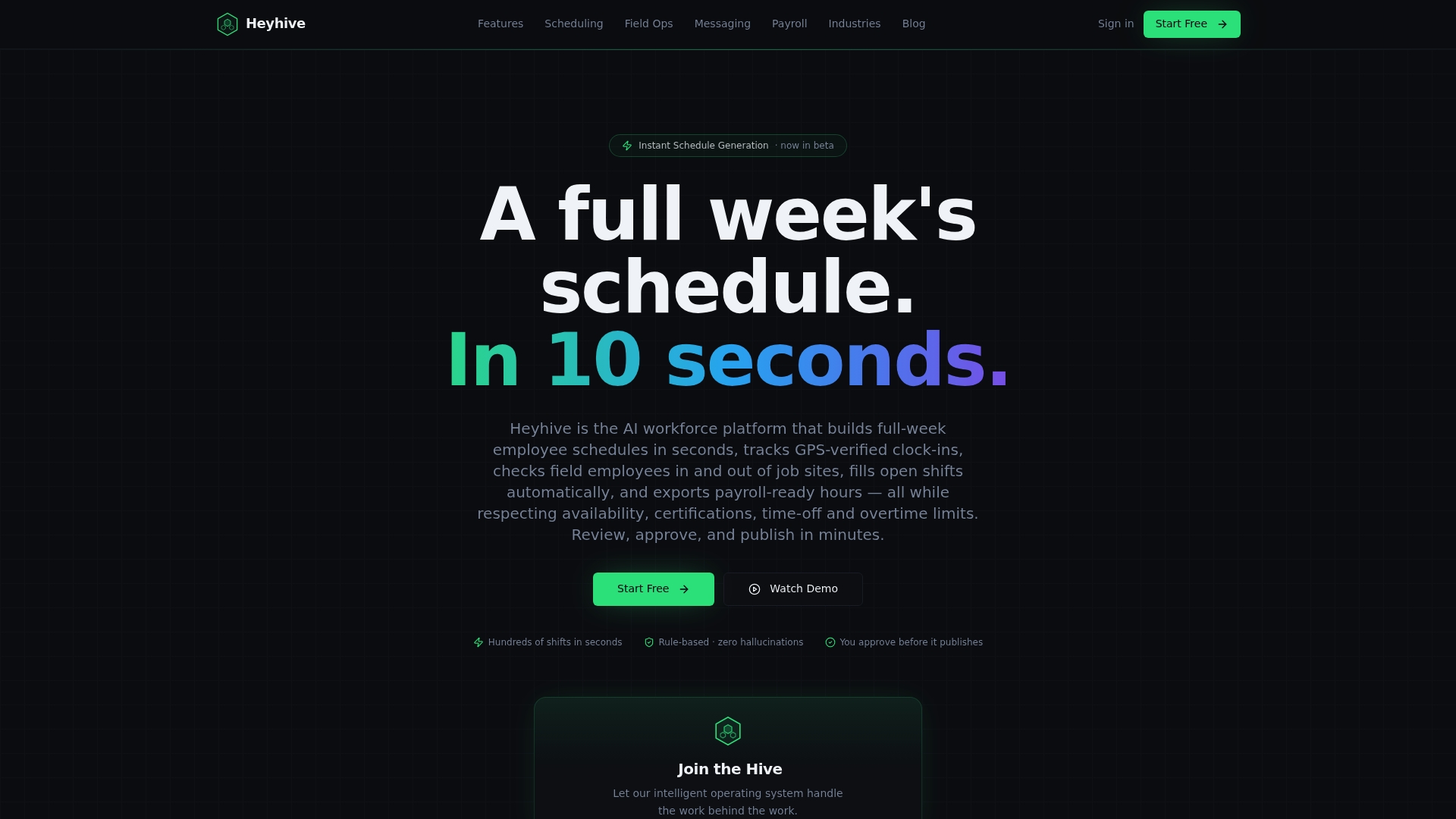
Here's what that looks like in practice:
- AI Scheduling builds full weeks of shifts in seconds while respecting availability and overtime caps.
- Manager approvals keep you in control of every schedule before it goes live.
- GPS Time Clock verifies clock-ins for field and multi-location teams.
- Payroll-Ready Hours export turns approved shifts into payroll data without manual re-entry.
If you're ready to see the coverage and retention gains these strategies promise, visit Heyhive to start a free trial or book a demo.
Where these numbers and rules come from
For deeper reading on the research and legal guidance behind this playbook, see the DOL fact sheet on scheduling penalties, the 2025 workforce flexibility study, the ScienceDirect retail scheduling research, and the Mondaq fair workweek summary.
Sources
- Improving the robustness of retail workforce management with a labor flexibility strategy and consideration of demand uncertainty
- Fact Sheet #56B: State and Local Scheduling Law Penalties and the Regular Rate under the FLSA | U.S. Department of Labor
- Determining optimal workforce size and schedule for retail stores (ScienceDirect)
- Untangling the varying requirements of state and local fair workweek laws - Mondaq
FAQ
What is a 5 2 5 3 work schedule?
A 5 2 5 3 schedule is a rotating pattern where employees work five days, get two off, work five more, then get three off, cycling continuously rather than following a fixed weekly calendar. It's used in operations that run every day of the week and need staggered coverage without a single fixed rest day for everyone.
What is a 4-3-3-4 work schedule?
A 4-3-3-4 schedule splits the month into alternating blocks: four days on, three off, three on, four off, repeating across a cycle. It's common in continuous-coverage retail or distribution settings where staff rotate through predictable but non-standard blocks of work and rest.
What are some effective strategies for scheduling?
The strategies with the strongest backing are hourly demand forecasting, flexible scheduling options like shift bidding, cross-training for coverage flexibility, and a digital rules engine that enforces availability and overtime limits automatically. Research on workforce flexibility under demand uncertainty found this combination more cost-effective and robust than fixed, manually built schedules. Platforms like Heyhive apply these rules automatically while keeping manager approval in the loop.
What is a 3/2/2/3 work schedule?
A 3/2/2/3 schedule rotates employees through three days on, two off, two on, then three off, repeating on a consistent cycle. It's designed to spread weekend and holiday coverage evenly across a team instead of assigning the same people to every weekend.
How do fair workweek laws affect retail scheduling?
Fair workweek and predictive-scheduling laws vary by location, and many require advance posting, often 14 days, a good-faith estimate of hours, and premium pay for last-minute changes, according to legal analysis of these ordinances. Managers should check local rules and the DOL's guidance on scheduling penalties before finalizing any schedule-change premium policy.