
The fastest reliable way to fill open hourly shifts is to use an AI-enabled scheduling system that auto-fills qualified staff while enforcing availability, certifications, and overtime rules. An AI-powered scheduling system can build a full week of shifts quickly, check every assignment against your rules before publishing, and pair that speed with GPS-verified clock-ins. You still approve the final schedule, so speed never comes at the cost of control.
TL;DR:
- Automated rule engines filter eligible and available staff before shifts are offered, reducing manual effort and ensuring compliance with overtime and certification requirements.
- Posting open shifts with a clear deadline and using auto-fill followed by prioritized contact lists can fill most openings within minutes rather than hours.
- Every shift must have recorded credentials verified at assignment, GPS clock-in data, and approval timestamps to create a legally defensible audit trail.
- Running automatic overtime checks and tracking last-minute schedule changes prevent violations and support adherence to local predictability and premium-pay laws.
- Pilot programs should start small, focus on one site or shift type, and take four to six weeks to refine data accuracy and staff processes before scaling.
Table of Contents
- How AI Scheduling and Rule Engines Actually Speed Coverage
- What Should You Do Right Now to Fill an Open Shift?
- Compliance and Payroll Guardrails You Can't Skip
- What Records Do You Need for a Defensible Audit Trail?
- What to Expect When You Pilot This Approach
- How Heyhive Puts This Playbook Into Practice
- Primary Sources for Legal and Operational Guidance
- Sources
- FAQ
How AI Scheduling and Rule Engines Actually Speed Coverage
Filling a shift fast used to mean texting five people and hoping one answers. A rule engine replaces that guesswork with a filter that runs before a shift ever gets offered to anyone.
Think of the rule engine as a bouncer at the door of your schedule. It checks three things automatically: is this person available at this time, do they hold the certification the shift requires, and would this assignment push them past a legal or policy overtime limit. If any answer is no, the system never surfaces that person as an option, so a manager isn't the one catching the mistake after the fact.
The engine works from a few core inputs:
- Historical demand patterns — past sales or foot traffic data that predicts how many people you actually need on a given shift.
- Employee availability — the hours each worker has marked as open, updated in real time as life changes.
- Certifications and licenses — tied directly to shift requirements, not just stored in a file somewhere.
- Fairness constraints — rotation rules that stop the same person from always getting stuck with closing shifts.
AI systems that pull from availability, skills, and demand forecasts generate optimized rosters and adjust automatically when a shift suddenly opens up. That means less time spent matching names to slots by hand, fewer back-to-back closing-then-opening shifts (commonly called "clopenings"), and a coverage gap that closes in minutes instead of hours.
Pro Tip: Set your rule engine to flag "near-miss" overtime cases, not just violations. A worker two hours from the cap today might be the wrong pick for a shift tomorrow, and catching that early avoids a scramble later.
What Should You Do Right Now to Fill an Open Shift?
An open shift at 6 a.m. for a noon start is a different problem than one that opens three days out. The steps below work for both, but the clock matters most in the first two.
- Post the opening in one channel with a clear deadline. Fragmenting the request across text, email, and a group chat only slows down responses. Give workers a specific window, like 30 minutes, to claim it.
- Let the rule engine auto-fill first. Before you call anyone, let the system surface only workers who are available, certified, and under their overtime threshold. This alone eliminates most of the manual back-and-forth.
- Fall back to a prioritized contact list. If no one bites through auto-fill, the system should escalate to a ranked list, prioritizing workers who've historically picked up shifts or who are closest to full time but not over it.
- Route swap requests through manager approval with a timestamp. A worker offering to cover a shift isn't official until someone signs off. Timestamped approval protects you if a dispute comes up later about who was actually scheduled.
- Verify credentials again at the point of assignment, not just at hiring. A license that was valid in January might have lapsed by June. Credential verification needs to happen per shift, not once at onboarding, especially for mobile or multi-site teams.
- Require a verified clock-in before the shift counts toward payroll. GPS or geo-fenced clock-ins confirm the person who was scheduled is the person who showed up, and where.
For daily operations, the same sequence becomes a routine rather than a fire drill. Post schedules early, keep a running list of workers who've opted into extra shifts, and let swap requests flow through the same approval chain every time so nobody has to remember a different process during a crisis.
Pro Tip: Keep a standing "opt-in for extra shifts" list separate from your general roster. When something breaks last minute, you're pulling from people who already said yes to more hours, not guessing who might.
Coverage gaps that follow this order close faster because each step either narrows the candidate pool or confirms the assignment. You're not skipping compliance to move quickly. You're building compliance into the speed.
Compliance and Payroll Guardrails You Can't Skip
Speed that ignores labor law turns into a payroll correction, or worse, a wage claim. The Fair Labor Standards Act requires overtime pay at 1.5 times a worker's regular rate for any hours worked past 40 in a workweek, and that rule applies no matter how urgently you needed someone to cover a shift.

Some states go further. California, for example, applies daily overtime thresholds on top of the weekly rule, so a single long shift can trigger overtime pay even if the worker's weekly total stays under 40 hours. Many cities and counties also enforce Fair Workweek or predictive-scheduling ordinances, which commonly require posting schedules with ample advance notice and paying a premium when you change a shift with less notice than that.
Three practical controls keep you inside these lines:
- Run an automated overtime check on every shift assignment, not just at the end of the pay period.
- Build your posting calendar around your local advance-notice window, even if your state doesn't legally require one yet.
- Pay predictability premiums automatically when a last-minute change triggers one, instead of calculating it manually after payroll closes.
Roughly a third of hourly employees say unpredictable scheduling has cost them money through missed shifts or short notice, based on the scheduling research Gettysburg College management faculty have compiled on retention and turnover. Audit-log every premium payment and schedule change. When a payroll question comes up six months later, that log is what saves you from a manual reconstruction.
What Records Do You Need for a Defensible Audit Trail?
A rule engine that runs invisibly doesn't protect you unless it also leaves a record. Shift compliance combines three things: live eligibility checks, accurate pay rules applied per shift, and an audit trail connecting the two.
Capture this for every shift:
- The original published schedule, timestamped before any changes.
- Swap or pickup approval timestamps, with the approving manager's name attached.
- The exact time credentials were verified for that specific shift.
- GPS or geo-fenced clock-in and clock-out punches.
- The payroll export line that ties back to the approved, worked shift.
Geo-fenced clock-ins reduce buddy-punching and time theft, which matters most in the moment payroll actually runs. Real-time validation, checking certifications and hours before a shift is even offered, stops an uncertified or over-hours worker from reaching the schedule in the first place, rather than catching the problem in a post-payroll audit.
What to Expect When You Pilot This Approach
Setting this up takes real work. Cleaning up availability data, configuring certification rules, and getting staff comfortable with a new swap process won't happen in an afternoon.
Run the pilot on one site or one shift type for four to six weeks, with a single person owning approvals. That narrow scope surfaces your actual fill-time and overtime numbers fast, without disrupting your whole operation while you learn.
— Heyhive
How Heyhive Puts This Playbook Into Practice
Heyhive is the direct answer to every step in this playbook, not a separate tool you'd need to bolt on top of it. Instead of building schedules by hand and hoping your rules hold up, Heyhive generates a full week of shifts in seconds while its rule engine checks availability, certifications, and overtime caps automatically.
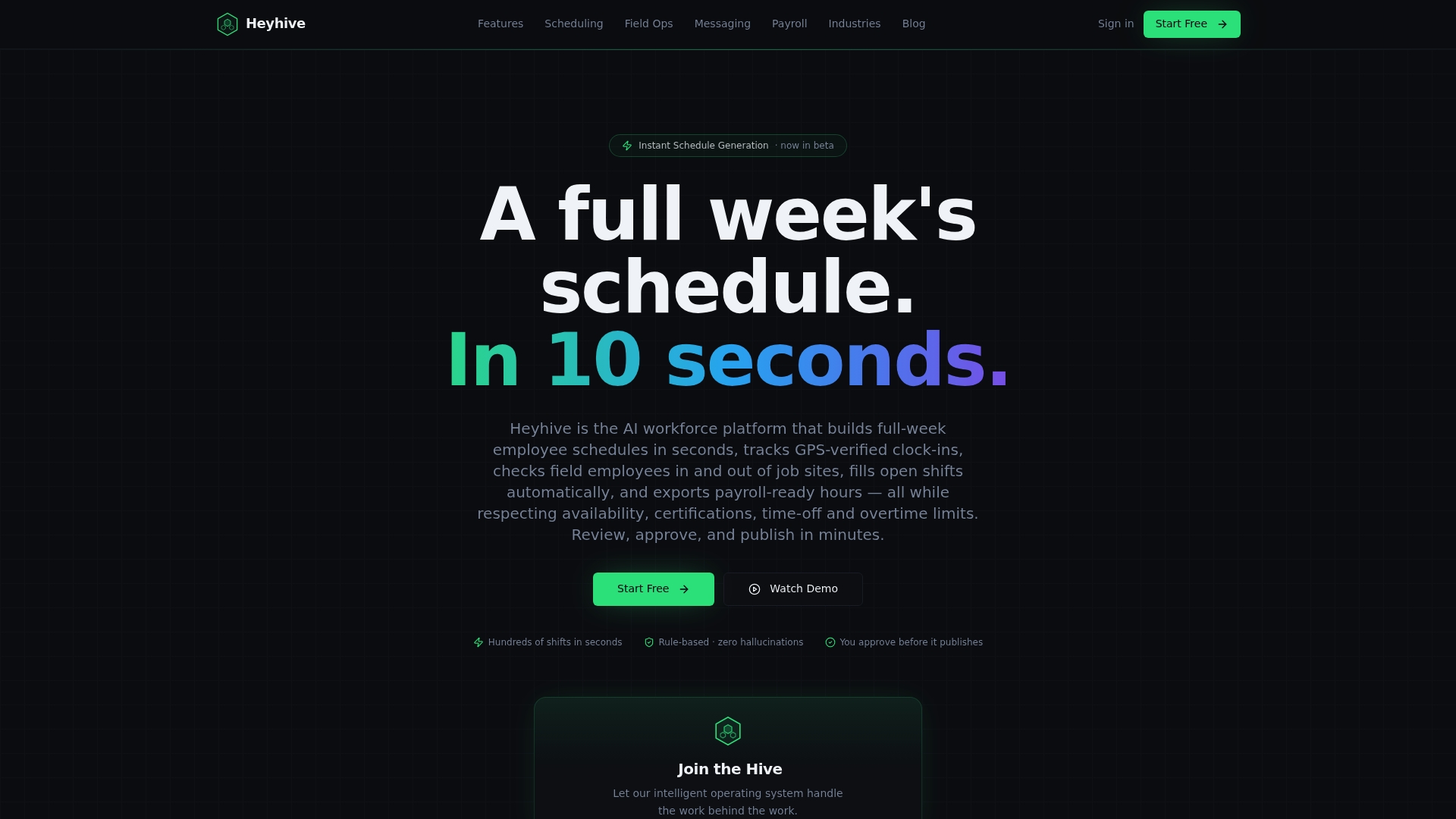
You still approve every schedule before it goes live, so the AI handles the matching and you keep the final say. Open shifts route through the same auto-fill and swap-approval flow described above, GPS-verified clock-ins confirm who actually showed up and where, and payroll-ready hours export without a manual reconciliation step. If you're evaluating how AI scheduling builds a full week in seconds, or want a closer look at eliminating coverage gaps in practice, Heyhive's blog walks through both in more depth. Start a free trial at Useheyhive and run your own four-to-six-week pilot on one site before rolling it out further.
Primary Sources for Legal and Operational Guidance
For the overtime and posting-window rules referenced above, consult the U.S. Department of Labor's overtime guidance directly. For general shift-management practices, FirstHR's small business guide covers scheduling and payroll basics in more detail. Managers comparing broader HR software options may also find this comparison of HR software for small businesses useful context.
Sources
- U.S. Department of Labor — Overtime
- Employee retention and scheduling research — Gettysburg College management faculty
- Shift Management: A Small Business Guide | FirstHR
FAQ
How Fast Can You Fill an Open Hourly Shift?
With rule-based auto-fill and a prioritized contact list, most open shifts can be filled within minutes rather than hours, since the system only surfaces workers who are already eligible and available.
Does Filling Shifts Quickly Risk Overtime Violations?
Not if overtime checks run automatically at the point of assignment. The FLSA requires 1.5 times pay for hours over 40 in a workweek, and some states add daily thresholds, so a rule engine needs to check both before confirming any pickup.
What Records Prove a Shift Was Filled Compliantly?
A defensible trail includes the original published schedule, the swap approval timestamp, credential verification time, and GPS-verified clock-in data tied to the payroll export.
How Do Predictive Scheduling Laws Affect Fast Hiring?
Many Fair Workweek ordinances require posting schedules roughly 14 days in advance and paying a premium for last-minute changes, so urgent fills should trigger an automatic predictability-pay check where those laws apply.
Can Heyhive Help With Both Speed and Compliance?
Some platforms combine AI-generated weekly schedules, configurable rule engines for certifications and overtime, manager approvals, and GPS-verified clock-ins to help ensure fast coverage and payroll accuracy.