
Overtime is cheaper for short-term spikes lasting a few weeks. Hiring wins once extra hours become steady and cross a break-even threshold, usually when total overtime across your team adds up to a full-time role for several months running. The FLSA sets the baseline at time-and-a-half past 40 hours a week, and a proper break-even calculation, not a gut feeling, should decide which side of that line you're on.
TL;DR:
- The break-even point for hiring typically occurs after about four months or when weekly overtime reaches a full-time workload for four to six months.
- Fatigue, safety risks, and turnover significantly increase the true costs of sustained overtime beyond simple wage calculations.
- Short-term demand lasting a few weeks should be addressed with overtime or temporary staffing, while ongoing needs favor hiring once cumulative overtime costs outweigh recruitment expenses.
- State-specific labor rules may impose stricter overtime regulations, requiring careful compliance checks beyond federal standards.
- Automated scheduling systems can reduce unnecessary overtime by optimizing shift coverage and improving data accuracy for cost analysis.
Table of Contents
- Overtime vs Hiring: Comparing the Direct Costs
- The Hidden Costs of Sustained Overtime
- Should You Choose Overtime, Full-Time Hiring, or Temp Staff?
- How Do You Run a Break-Even Calculation?
- What Compliance Rules Should You Check First?
- Your One-Page Decision Checklist
- How Scheduling Technology Cuts Unnecessary Overtime
- A Faster Way to Cut Overtime Before You Hire
- Sources
Overtime vs Hiring: Comparing the Direct Costs
The math starts with two numbers: your overtime hourly cost and your fully burdened hire rate.
Overtime cost is straightforward. The FLSA requires 1.5 times the regular rate for hours beyond 40 in a workweek. An employee earning $22 an hour costs you $33 for every overtime hour. Ten overtime hours a week runs $330, not counting payroll tax on that extra pay.
A fully burdened hire costs more than the number on the offer letter. You're stacking:
-
Base salary or hourly wage
-
Payroll taxes (Social Security, Medicare, unemployment insurance)
-
Benefits (health coverage, retirement match, paid leave)
-
Overhead (equipment, software seats, workspace)
-
Onboarding and training, amortized over the first several months
-
Hiring Cost Comparison Calculator](https://www.ultimatefinancecalculator.com/calculators/overtime-cost-vs-hiring-cost-comparison-calculator/).
The break-even formula is simple: divide the one-time hiring cost (recruiting, onboarding, ramp-up productivity loss) by the difference between your overtime hourly rate and your burdened hire rate. That tells you how many overtime hours you'd need to "spend" before a new hire pays for itself.
Say hiring costs $4,000 upfront and the gap between overtime pay ($33) and burdened hire pay ($28) is $5 per hour. Break-even lands at 800 overtime hours. Spread across five employees working 10 overtime hours weekly, that's about 16 weeks, or roughly four months.
Statistic Callout: Practical break-even models built into calculators like CalcRegistry's tool consistently show the break-even month arrives faster than raw wage math predicts once fatigue and onboarding assumptions are factored in.
The Hidden Costs of Sustained Overtime
Wage math is only half the picture. Extended overtime carries costs that never show up on a pay stub but hit your bottom line anyway.
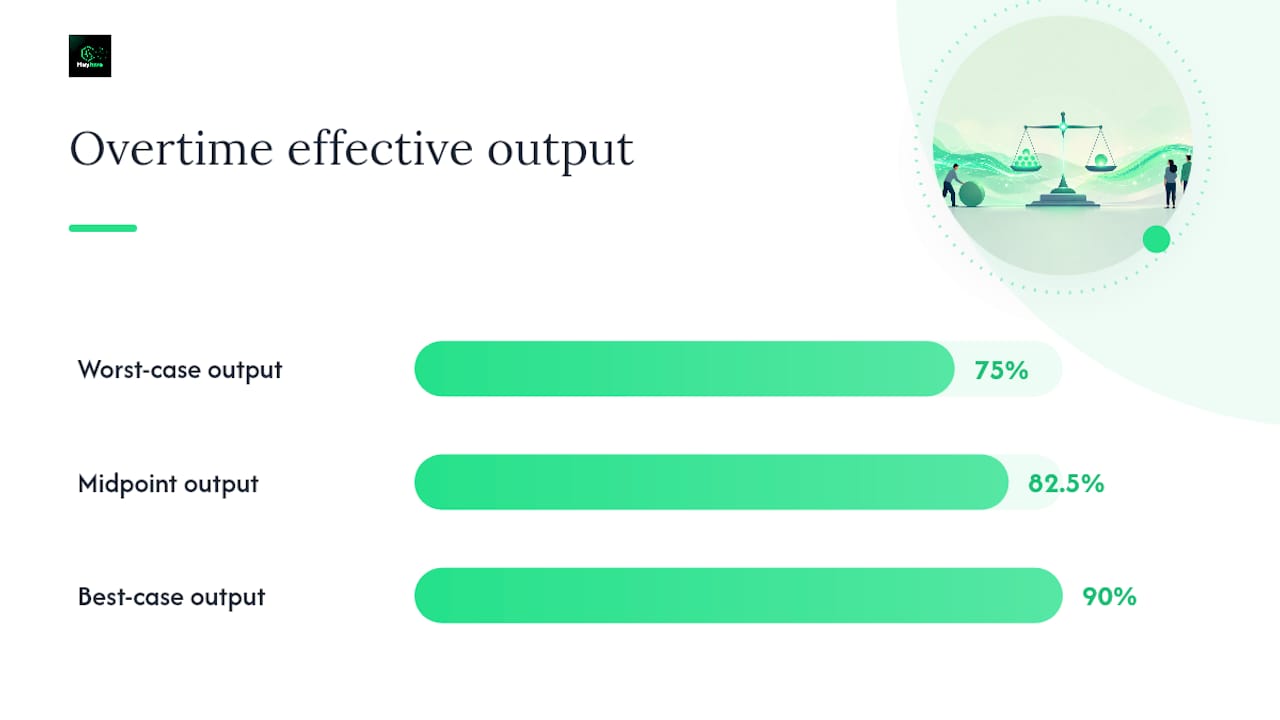
Fatigue eats productivity. Workers logging heavy overtime weeks make more errors, work slower on complex tasks, and need more supervision. A break-even model built by TrueStep HR applies a fatigue "leakage" factor of 10% to 25% against overtime hours, meaning an hour of overtime often delivers only 75 to 90 cents of a regular hour's output.
Safety risk climbs too. Industry data tied to OSHA-referenced calculators links extended hours to higher incident rates, which means higher workers' compensation exposure on top of wages.
Then there's turnover. Employees who feel overworked leave, and replacing them costs recruiting fees, training time, and the institutional knowledge that walks out the door.
- Fatigue leakage: apply a 10% to 25% efficiency discount to overtime hours before comparing costs
- Injury risk: expect elevated workers' comp exposure during sustained OT stretches
- Turnover: factor in recruiting and retraining costs when overworked employees quit
If your break-even calculation still favors overtime after that adjustment, you're on genuinely solid ground. If it flips, hire sooner rather than later.*
Should You Choose Overtime, Full-Time Hiring, or Temp Staff?
Duration is the variable that decides this, more than any other single factor. Match your staffing response to how long the extra demand will actually last.
- Days to a few weeks: Use overtime or a short-term temp. The onboarding cost of a new hire won't pay off before the spike ends.
- One to six months: Consider temp-to-hire or part-time staff while you track the trend. Run your break-even calculation weekly, since demand that looked temporary in month one sometimes turns out to be permanent by month three.
- Steady, ongoing demand: Hire once cumulative overtime plus soft costs (fatigue, turnover, injury risk) exceed the loaded cost of a new employee, typically when weekly overtime hours across your team equal a full-time role for four to six months straight, based on the practical thresholds practitioner calculators converge on.
Watch for operational signals beyond the raw math: rising error rates, more sick-day usage, or a supervisor telling you the same three people are covering every open shift. Those are early warnings that your break-even point has already passed, even if the spreadsheet hasn't caught up yet.
How Do You Run a Break-Even Calculation?
Pull these numbers from your last payroll cycle before you start:
- Current overtime hours per week, by employee and in total
- Regular and overtime hourly rates
- Estimated fully burdened hire rate (add 25% to 30% to base pay)
- One-time hiring costs (job postings, interview time, onboarding, training)
Then follow this sequence:
- Calculate your current weekly overtime spend across the team.
- Calculate what a new hire would cost weekly, loaded rate times standard hours.
- Divide one-time hiring costs by the weekly savings difference to get your break-even week.
- Apply a 10% to 25% fatigue leakage adjustment to overtime hours and recalculate. This usually moves break-even earlier.
If your break-even lands under three months, hiring is very likely to win. Free tools like the CalcRegistry break-even calculator and the Overtime vs. Hiring Cost Comparison Calculator let you plug in your own numbers without building a spreadsheet from scratch.
What Compliance Rules Should You Check First?
The FLSA sets the federal floor: non-exempt employees earn 1.5 times their regular rate past 40 hours in a workweek. Several states layer on daily overtime triggers or stricter thresholds, so check your state labor department before assuming the federal rule is the whole story.
- Confirm exempt vs. non-exempt classification. Misclassifying a non-exempt employee as exempt to avoid overtime pay is one of the most common sources of back-pay claims and penalties.
- Keep accurate time records. Incomplete records are the first thing investigators request during a wage-and-hour audit.
- Audit the last six months of payroll for overtime patterns before making a hiring decision. Chronic overtime concentrated in a few roles usually means you've already crossed break-even.
Your One-Page Decision Checklist
Before your next staffing meeting, run through this list:
- Forecast horizon: Is the extra demand likely to last weeks, months, or indefinitely?
- Average weekly overtime hours: Total them across the affected team.
- Break-even result: Run the calculation. Does hiring pay off within six months?
- Onboarding capacity: Can you actually train a new hire right now, or is your team too stretched to ramp one up?
- Budget authority: Do you have sign-off for a new headcount, or only for overtime spend?
- KPIs impacted: Are error rates, safety incidents, or resignations already climbing?
Red flags that should trigger hiring immediately: overtime chronically above 10 hours per week per employee, a rising incident rate, or resignations tied to burnout. When you see any of these, stop recalculating and start recruiting.
How Scheduling Technology Cuts Unnecessary Overtime
Most overtime isn't a capacity problem. It's a scheduling problem. AI-powered scheduling builds full weeks of shifts quickly while respecting employee availability, certifications, and overtime limits, so hours don't creep past 40 by accident.
When someone calls out, the system fills open shifts quickly instead of forcing a scramble that ends in overtime. GPS-verified clock-ins provide clean attendance data, which helps make break-even inputs accurate instead of guesswork. That combination gives you a clearer signal for when overtime has genuinely become a hiring problem. For deeper prevention tactics, Heyhive's guide on preventing unnecessary overtime walks through policy changes that pair well with the math above.
— Heyhive
A Faster Way to Cut Overtime Before You Hire
Scheduling control tools can make the overtime vs hiring decision easier to get right the first time. Instead of manually juggling availability, certifications, and overtime caps, AI-powered scheduling builds compliant weekly schedules quickly, with managerial approval before publishing.
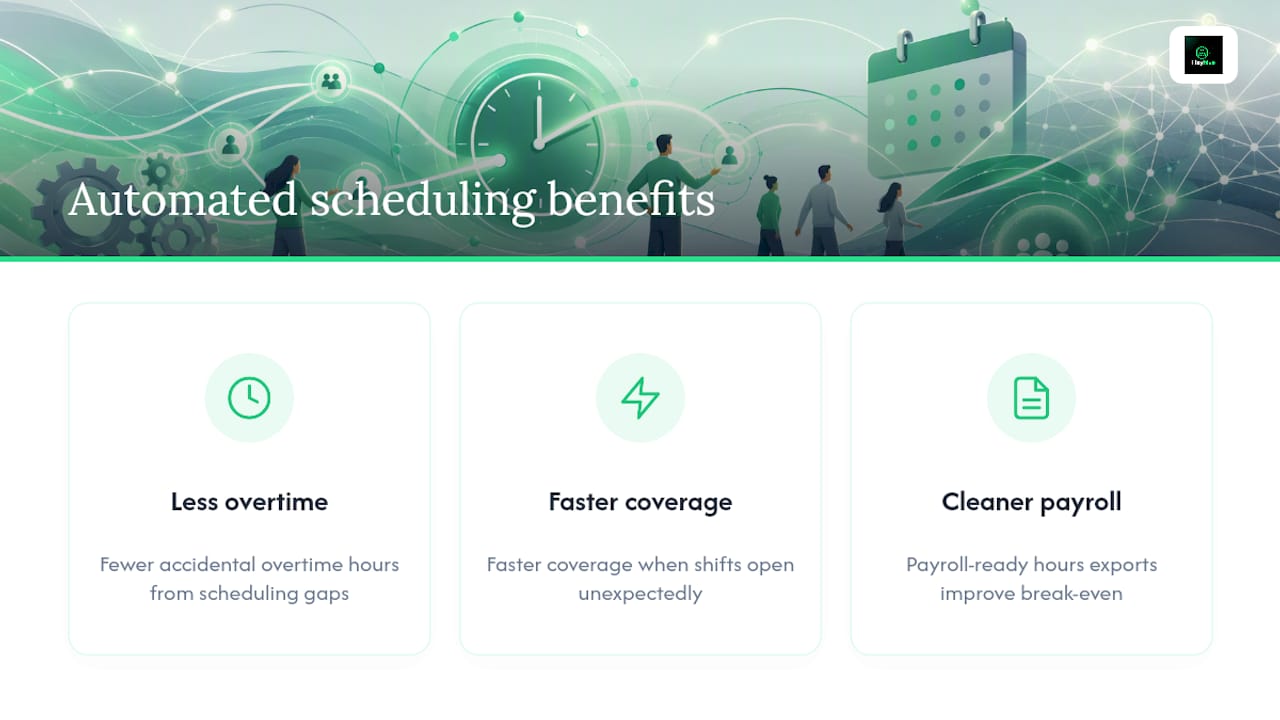
Managers using automated scheduling typically see three concrete outcomes: fewer accidental overtime hours from scheduling gaps, faster coverage when shifts open unexpectedly, and payroll-ready hours exports that improve the accuracy of break-even calculations. If you're weighing overtime against a new hire right now, cleaner scheduling data makes that call easier to defend to finance. Ramp-up speed matters here too. If hiring is your answer, tightening your recruiting funnel, as outlined in this guide to speeding up hiring, shortens the gap where you're still stuck paying overtime while a new hire trains up.
Start a free trial at Heyhive and see how automated scheduling changes your overtime numbers within a few pay cycles.
Sources
Run your own figures through the CalcRegistry break-even calculator, the TrueStep HR manufacturing calculator for fatigue-adjusted modeling, and the peer-reviewed research on overtime versus hiring dilemmas for the underlying economics. Bookmark them for your next quarterly staffing review.
- Manufacturing overtime vs new hire calculator | TrueStep HR
- Overtime vs. Hiring break-even calculator | CalcRegistry
- Overtime vs. Hiring Cost Comparison Calculator