
Yes, employee GPS tracking is legal in the United States, but only within limits that shift by state and by whose vehicle or device you're tracking. Company-owned vehicles are generally fair game to monitor. Tracking an employee's personal vehicle without consent is usually illegal and, in some states, criminal. The single highest-priority move for HR is drafting a written GPS policy with clear notice or consent language and a defined retention schedule before you turn on a single device.
TL;DR:
- Most states require written notice or employee consent before monitoring, especially when tracking personal vehicles or off-duty movements.
- Tracking company vehicles during work hours is generally legal, but off-duty use or personal trips can lead to privacy claims and should be carefully controlled.
- Retain GPS data for three to four years if tied to payroll and keep access limited to authorized personnel with proper logging.
- Avoid using GPS logs for broad surveillance, union targeting, or disciplinary actions; instead, focus on attendance verification and safety purposes.
- Implement clear policies with specific purposes, contractual safeguards, and regular audits to ensure compliance and minimize legal risks.
Table of Contents
- Is Employee GPS Tracking Legal Under Federal Law?
- Company Vehicles vs. Personal Vehicles: Where the Legal Line Falls
- When Do You Need Written Notice or Employee Consent?
- How Long Should You Keep GPS Data, and Who Gets Access?
- Does GPS Tracking Create Wage-Hour or Union Risk?
- Building a Compliant GPS Tracking Policy: Step-by-Step
- Using GPS to Prove Attendance, Not to Micromanage
- How Heyhive Supports Compliant GPS Tracking
- Sources
- FAQ
Is Employee GPS Tracking Legal Under Federal Law?
No single federal statute regulates workplace GPS tracking directly. The Electronic Communications Privacy Act covers wiretapping and electronic interception, but it specifically excludes GPS tracking devices from its interception rules, leaving the field to state law. The Fourth Amendment matters mostly for government employers and law enforcement, not private businesses tracking their own workforce.
That gap is why GPS tracking law in the US looks like a patchwork rather than a single rulebook. States have filled the space with their own statutes, privacy torts, and criminal codes, and the requirements diverge sharply:
- New York, Connecticut, Delaware, and California require written notice or explicit consent before electronic monitoring, including GPS tracking.
- Several states criminalize installing a tracker on a vehicle you don't own without the owner's consent, regardless of employment status.
- Some states allow employer tracking of company vehicles with no notice requirement at all, provided there's no unreasonable intrusion into private life.
If you operate in more than one state, the safest posture is to treat each jurisdiction's law as controlling for the employees working there, rather than adopting a single national policy and hoping it covers every state's floor.
Company Vehicles vs. Personal Vehicles: Where the Legal Line Falls
Owning the vehicle you're tracking dramatically lowers your legal exposure, but it doesn't erase it. Employees still carry a reasonable expectation of privacy during off-duty use of a company vehicle. Tracking someone's commute home, weekend errands, or doctor's appointments, even in a truck with your company's logo on it, invites a privacy claim you don't need.
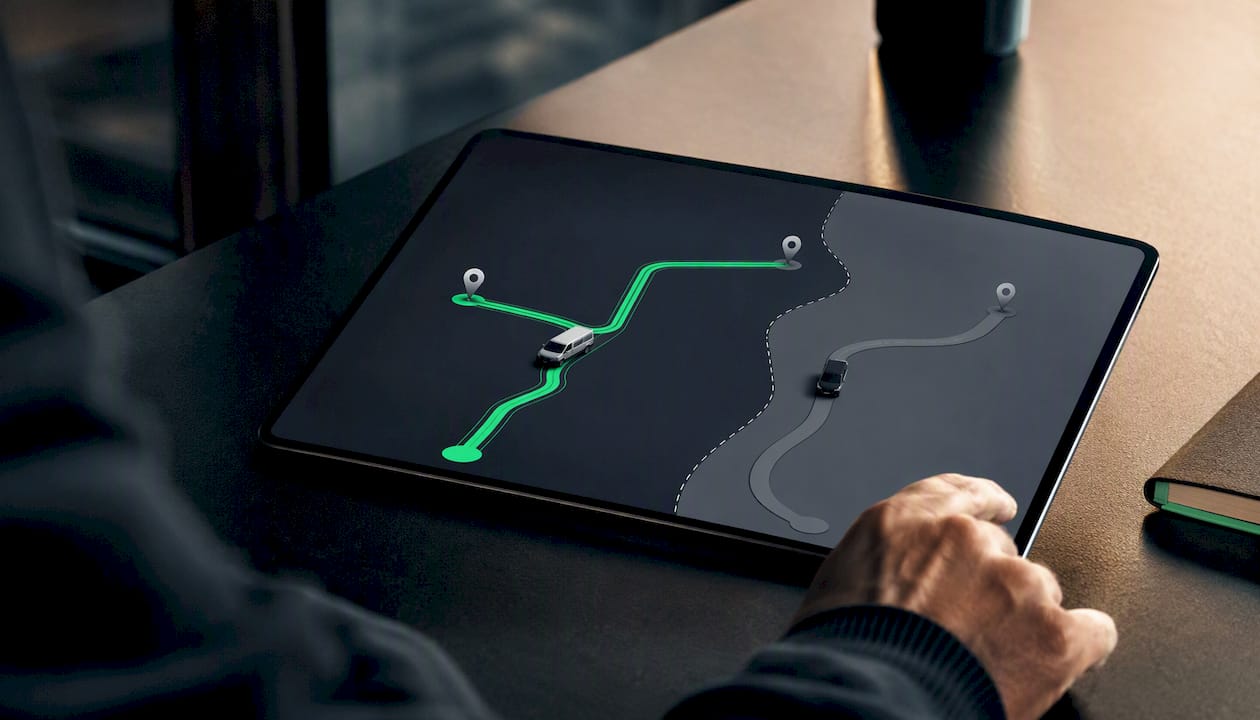
Tracking a personal vehicle or personal phone without the employee's knowledge is a different category of risk entirely. It's usually prohibited under state stalking or tracking statutes, and courts have treated covert tracking of personal property as a privacy tort even when the employer had a legitimate business reason in mind.
The fix is technical, not just legal. Build guardrails into how the system runs:
- Geofence-only tracking that activates near job sites, not a continuous location feed.
- Work-hour toggles that automatically stop logging location the moment a shift ends.
- Auto-pause features tied to clock-out, so off-duty driving never enters the system.
Pro Tip: If a device can't distinguish between a work trip and a personal errand, that's a policy problem, not a technology problem. Fix the settings before you fix the wording.
When Do You Need Written Notice or Employee Consent?
Several states, including New York, Connecticut, Delaware, and California, already require written notice before electronic monitoring begins. Even where the law doesn't demand it, written consent is the strongest protection you have if an employee later challenges the practice.
Consent has to say what it's actually for. A signature that only says "GPS tracking for business purposes" holds up better when the policy spells out specific uses like safety monitoring, payroll verification, or fleet routing. If you later repurpose that same data for a disciplinary investigation without saying so upfront, you risk invalidating the original consent entirely.
Building a defensible acknowledgment process comes down to three habits:
- Collect the signed acknowledgment during onboarding, before any device is activated.
- Store every signed form in the employee's personnel file, not just a shared drive.
- Reissue and re-collect consent whenever the policy's purpose or scope changes.
How Long Should You Keep GPS Data, and Who Gets Access?
Retention should match the reason you're keeping the data in the first place. Federal recordkeeping expectations from the IRS and DOL push employers toward multi-year retention for anything tied to payroll or mileage substantiation, which is why many employers land on a 3 to 4 year window for GPS logs connected to pay records. Operational trip logs with no payroll purpose don't need that long a shelf life and can usually be pruned much sooner unless there's an active investigation.
Access matters as much as duration. Location data is personnel data, and it should be treated with the same restrictions as any other sensitive employee record:
- Limit viewing rights to fleet managers and HR, not general supervisors.
- Log every access event so you can show who viewed what and when.
- Require vendor contracts to specify breach notification timelines, data deletion on termination, encryption standards, and jurisdiction.
Employers stay responsible for compliance even when a third-party vendor hosts the data, so contract language matters as much as internal policy.
Does GPS Tracking Create Wage-Hour or Union Risk?
GPS logs can quietly turn into wage evidence you didn't intend to create. If a device shows an employee traveling between job sites during what payroll recorded as unpaid time, that discrepancy can support an FLSA claim for unpaid compensable travel. Check GPS data against timesheets before you use it in any payroll decision, not after.
Union risk is the other blind spot. Under the NLRB's Stericycle standard, a monitoring rule with a reasonable tendency to chill protected concerted activity can be presumptively unlawful, even without proof that a manager targeted an organizer. The safest approach:
- Keep tracking scope narrow and tied to a documented business purpose, not general oversight.
- Never use location data to isolate or discipline employees engaged in union organizing.
- Consult labor counsel before deploying or expanding tracking in a unionized workforce.
Building a Compliant GPS Tracking Policy: Step-by-Step
A defensible policy needs specific elements, not vague reassurances. Include the purpose of tracking, the scope of vehicles or devices covered, the hours tracking is active, the retention period, who has access, and the limits on disciplinary use. Every employee should sign an acknowledgment that matches that exact language.
Rolling it out works best as a sequence, not a launch:
- Run a small pilot with one team before expanding company-wide, and use that window to measure acceptance and adjust settings.
- Communicate the policy transparently, including why it exists and what it does not cover.
- Train supervisors on what they can and cannot do with location data.
- Configure geofencing and work-hour limits so tracking never captures off-duty movement.
- Review vendor contracts for breach notification and deletion terms before signing.
- Set a recurring audit schedule to confirm access logs and retention limits are actually being followed.
Pro Tip: Draft two short documents before rollout: a one-page onboarding acknowledgment employees sign at hire, and a limited-use checklist investigators must follow before pulling historical GPS data for any disciplinary review.
Using GPS to Prove Attendance, Not to Micromanage
The employers who get GPS tracking right treat it as attendance verification, not surveillance. A short pilot, measured honestly for employee acceptance, tells you far more about the right hours and geofence settings than any policy drafted in a vacuum.
GPS-verified clock-ins solve a real payroll problem, disputed hours, without building a continuous location history nobody asked for. Narrow scope beats broad monitoring every time it's tested. For managers building this out, our guides on running a GPS pilot and configuring geofences walk through both in practice.
— Heyhive
How Heyhive Supports Compliant GPS Tracking
Every compliance step in this guide, work-hour limits, geofencing, retention controls, documented access, maps directly onto how Heyhive's platform is built. GPS-verified clock-ins confirm attendance at the job site without logging a continuous trail of an employee's day, and configurable geofences mean tracking only activates where and when work actually happens.
Payroll-ready exports pull from verified clock-in and clock-out times, helping to reduce the back-and-forth of manual timesheet reconciliation. Retention settings allow alignment of data storage with the actual policy instead of defaulting to indefinite retention, which can pose liability risks. For field teams specifically, Heyhive frames GPS as attendance proof rather than continuous vehicle surveillance, the same distinction this whole guide has been building toward.
If you're ready to move from policy draft to practice, start with a two-week pilot on Heyhive, using the configurable geofence and work-hour settings covered above, and collect signed acknowledgments as you go.
Sources
- University of Florida Law Review — employee location tracking article
- Is it legal to track employees with vehicle GPS tracking? — American Bar Association
- Employee GPS tracking laws by state — Spytec
- GPS tracking laws and vendor guidance — GeoTracking
FAQ
Is Employee GPS Tracking Legal in Every State?
It's legal nationwide in some form, but the requirements differ by state. New York, Connecticut, Delaware, and California require written notice or consent, while other states allow tracking of company vehicles with fewer restrictions.
Can I Track an Employee's Personal Vehicle?
Generally, no. Installing a tracker on a personal vehicle without the owner's consent is prohibited in most states and criminal in several, regardless of your business reason.
Do I Need Written Consent for GPS Tracking?
Several states require it by law, and it's a best practice everywhere else since a signed acknowledgment describing the specific purpose of tracking is your strongest defense if challenged.
How Long Should We Keep GPS Location Data?
Retention should match the purpose. Data tied to payroll or mileage substantiation often justifies a 3 to 4 year window, while routine operational logs can typically be pruned much sooner.
Can GPS Tracking Violate Labor Law?
Yes. GPS logs can create FLSA wage claims if they reveal unpaid compensable travel, and under the NLRB's Stericycle standard, overly broad monitoring can be presumed unlawful if it chills protected concerted activity.