
Dynamic scheduling AI automatically generates and adjusts hourly and field team schedules while enforcing availability, certifications, and labor rules, so managers can review proposed schedules instead of building them manually. A Springer Nature study found that automated scheduling that accounts for skills and preferences improved productivity and cost outcomes in service operations, and the U.S. Department of Labor outlines the penalty rules that make compliant scheduling matter. We built our own Workforce OS around that same combination of speed and oversight.
TL;DR:
- The Springer Nature restaurant case study recorded a 12.3% labor cost reduction when schedules accounted for worker skills and preferences.
- Configure legal hours, certifications, and availability as hard limits, while treating weekend balance and preferred days as goals the solver can optimize.
- Predictive scheduling rules vary by location; covered employers may need 14 days’ notice, consent records, change logs, and premium pay calculations.
- Pilot during a normal demand period, measure publication time, coverage, overtime, labor costs, and satisfaction, then expand locations one at a time.
Table of Contents
- How dynamic scheduling AI works for hourly and field teams
- Business benefits and measurable impact
- How AI enforces constraints, fairness, and schedule quality
- Predictive-scheduling laws and compliance actions managers must take
- Practical implementation checklist for adopting dynamic scheduling AI
- Human-in-the-loop practices: how managers keep control and preserve employee trust
- Evidence and examples: study results and practical outcomes
- Publisher perspective: how Heyhive approaches dynamic scheduling AI
- How Heyhive can help you schedule with less effort
- FAQ
- Sources
How dynamic scheduling AI works for hourly and field teams
A scheduling system like this needs several inputs before it can build anything useful: demand forecasts, employee availability, certifications and skills, overtime limits, historical shift patterns, and standby or on-call lists. Once those are in place, the system blends two techniques. Machine learning spots patterns in past demand and staffing, while a constraint solver locks in the rules that cannot be broken, like licensing requirements or maximum weekly hours.
This combination lets the system handle cases that trip up manual spreadsheets: shifts that cross midnight, multi-site staff availability, and time slots broken into smaller increments than a standard shift.
For hourly and field operations, the output works best as a proposal, not a finished product:
- The AI drafts a full week of shifts based on forecasted demand and worker constraints.
- You review flagged exceptions, like a certification gap or an overtime risk.
- You approve the week, or set rules that let low-risk shifts auto-publish while anything unusual waits for your sign-off.
That approval gate is what keeps automation useful instead of risky.
Business benefits and measurable impact
A Springer Nature case study found a 12.3% reduction in labor costs at a dining restaurant after introducing a two-stage scheduling model that factored in worker skills and preferences, alongside gains in productivity and employee satisfaction.
For managers of hourly and field teams, the metrics worth tracking during a rollout include:
- Time to publish a compliant week, measured from draft to manager approval.
- Labor cost as a percentage of sales, tracked weekly against your target range.
- Coverage rate and open-shift fill rate, especially during peak demand windows.
- Overtime hours logged against your approved limits.
- Employee satisfaction, often visible in fewer last-minute swap requests.
Operations can track early signals during a pilot, with results potentially changing as more locations adopt the workflow and the system gathers historical data.
How AI enforces constraints, fairness, and schedule quality
Not every rule in a schedule carries the same weight. Hard constraints, like legal hour limits, required certifications, and stated availability, cannot be violated under any circumstance. Soft objectives, like fair distribution of weekend shifts or honoring a worker's preferred days, get optimized as much as possible without breaking the hard rules.

Research on declarative constraint frameworks shows this distinction can be built directly into the system's architecture. The CP-WSP framework demonstrates zero hard-constraint violations by construction, meaning the solver simply will not generate a schedule that breaks a legal or contractual limit, while still optimizing for fairness and quality on the soft side.
On the fairness side, modern systems use:
- Workload balancing, so high-demand shifts are not stacked on the same few people.
- Inter-week stability, which keeps a worker's schedule reasonably consistent from one week to the next.
- Machine learning and hybrid optimization methods, which the nurse rostering survey discusses as approaches that can improve solution quality and computational efficiency.
Pro Tip: Before trusting an automated roster, check that the system exposes its constraint rules in plain settings or a readable configuration, so you can audit exactly what it is and is not allowed to do.
Predictive-scheduling laws and compliance actions managers must take
Several states and cities now require advance notice before a shift goes live, often 14 calendar days, along with good-faith estimates of hours, consent before adding shifts, and premium pay for short-notice changes or "clopening" shifts worked back to back. Oregon's BOLI guidance spells out these posting, consent, and rest-period rules for covered employers, and a practitioner summary of fair workweek laws notes that documentation is central to proving compliance across jurisdictions.
The Department of Labor's fact sheet also clarifies when state or local scheduling penalty payments must be included in the FLSA regular rate calculation, which affects how overtime gets computed. Getting that wrong creates real liability, which is why audit logs and proof-of-notice records matter as much as the schedule itself; using an AI chatbot appointment booking setup can also enhance communications and consent capture workflows.
An automated scheduler built for this needs to offer:
- Location-specific rule configuration, since requirements vary by city and state.
- Automatic premium-pay calculations for qualifying changes.
- Posting and reissue logs that timestamp every schedule change.
- Consent capture for employee-approved shift additions.
- Direct integration with payroll so premium pay flows through without manual entry.
Four steps get most managers compliant:
- Identify which of your locations fall under predictive scheduling rules.
- Configure location-specific notice periods and premium-pay triggers.
- Pilot the system with audit checks on a sample of published schedules.
- Maintain records and review them periodically against your written policy.
Our fair workweek laws guide breaks down how these requirements vary by jurisdiction in more detail.
Practical implementation checklist for adopting dynamic scheduling AI
Rolling out automated scheduling works best in phases rather than all at once.
- Collect your data. Gather historical demand or point-of-sale data, current availability records, certifications, and your written scheduling policy.
- Design a pilot. Pick locations, define success metrics like coverage rate and admin hours saved, and run the test for a suitable pilot period.
- Configure your workflows. Set hard constraints, approval gates, on-call lists, and notification rules, then connect your time clock and payroll export.
- Scale deliberately. Add locations one at a time, set a regular governance cadence, and automate recurring audits.
Our automatic shift scheduling guide walks through the configuration details for step three in more depth.
Pro Tip: Run your pilot during a normal demand period, not your busiest week of the year, so the data reflects typical conditions rather than an outlier.
Human-in-the-loop practices: how managers keep control and preserve employee trust
Automation works when you decide upfront what the AI can publish on its own and what needs your eyes first. A few practices keep that balance healthy:
- Set clear rules for what auto-publishes versus what waits for manager approval.
- Post schedules early and let workers request swaps through a transparent process.
- Document consent whenever a schedule changes after it is posted.
- Use manual overrides sparingly, and log the reason each time you use one.
A short daily and weekly review, checking flagged exceptions and any override log, keeps the system accountable without adding real workload.
Evidence and examples: study results and practical outcomes
The Springer Nature study documented a 12.3% labor-cost reduction in a dining restaurant case study, driven by a scheduling model that weighed worker skills and preferences alongside demand. Separately, the CP-WSP research showed zero hard-constraint violations alongside measurable fairness gains using a declarative constraint model. For a pilot, these results suggest tracking labor cost percentage and fairness indicators like shift distribution from week one, since both responded quickly in the studies above.
Publisher perspective: how Heyhive approaches dynamic scheduling AI
We built our AI Scheduling to generate a proposed schedule while respecting availability, certifications, and overtime limits, then hand it to you for approval before anything publishes. GPS-verified field clock-ins and payroll-ready exports round out the same workflow. For hourly and field operations, that hybrid approach gives you speed without giving up the final say. If your team matches that profile, a short pilot is worth considering.
— Heyhive
How Heyhive can help you schedule with less effort
We handle schedule generation, GPS time tracking, and payroll-ready exports in one place, so you spend less time rebuilding spreadsheets and more time running your operation. Our AI employee scheduling builds a proposed schedule, and you approve it before it goes live.
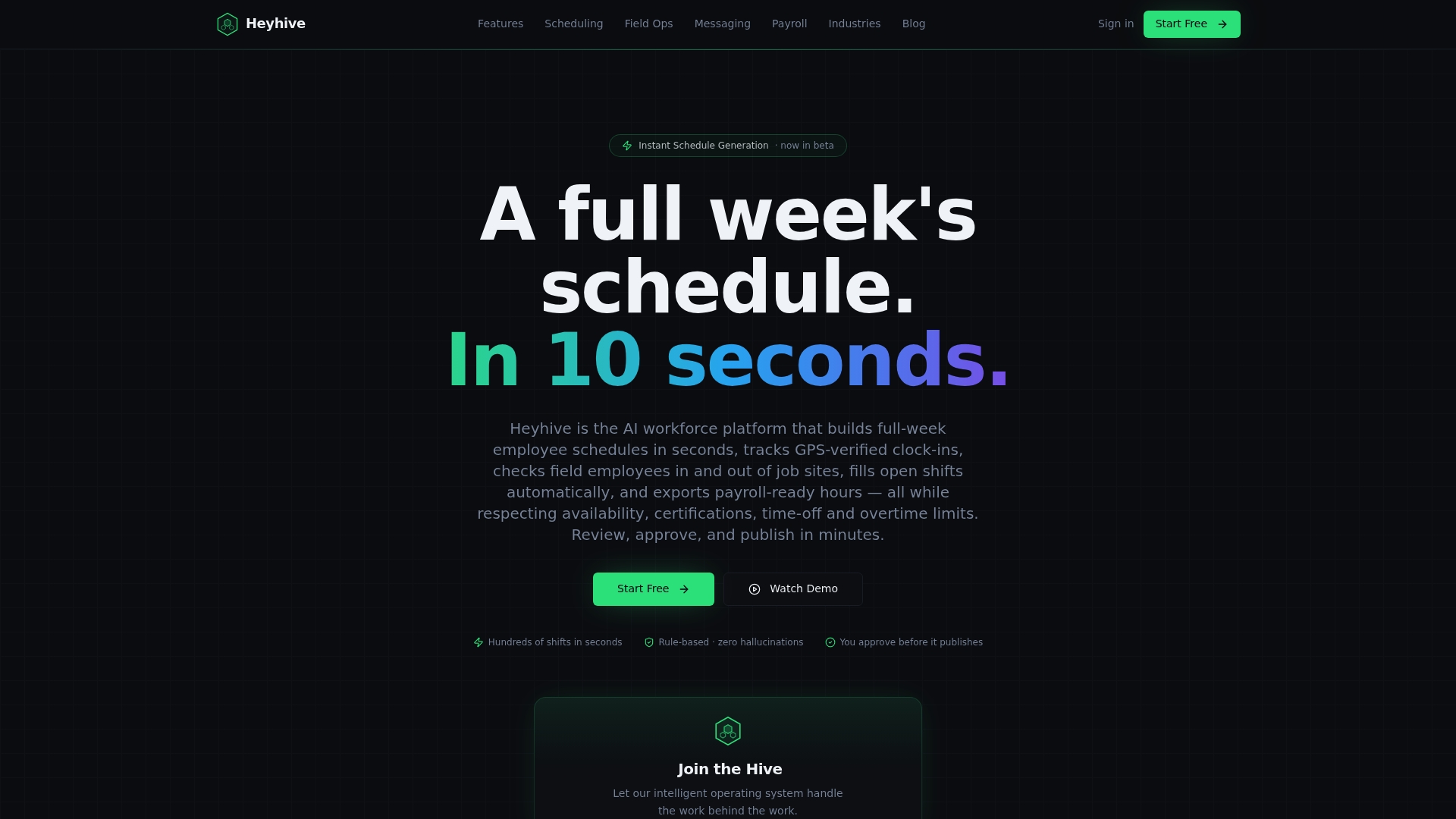
See how it fits your team on the Heyhive product page.
This article is general information, not a substitute for advice from a qualified lawyer. Consult a qualified legal professional about your own circumstances before acting on anything here.
FAQ
What is dynamic scheduling AI in simple terms?
Dynamic scheduling AI is software that automatically builds and adjusts employee shift schedules based on demand, availability, certifications, and labor rules. It is distinct from a personal calendar assistant: it is built for workforce shift planning, not meeting scheduling.
How much can automated scheduling reduce labor costs?
Results vary by operation, but a Springer Nature case study documented a 12.3% labor-cost reduction at a dining restaurant after adopting a scheduling model that accounted for worker skills and preferences. Your own results depend on current scheduling inefficiency and how closely your demand patterns match historical data.
Do predictive scheduling laws require advance notice of shifts?
Many state and local predictive scheduling laws require written schedules posted a set number of days in advance, commonly 14 calendar days under rules like Oregon's BOLI guidance. Requirements vary by jurisdiction, so check the specific rules covering each of your locations.
Can managers override AI-generated schedules?
Yes, a well-designed system keeps managers in the approval loop and allows manual overrides for exceptions. Our own workflow generates the week automatically, then requires your approval before anything publishes.
What does Heyhive cost?
Heyhive's AI Scheduling, GPS Time Clock, and related Workforce OS features do not have published pricing on our site. Current pricing details are available directly through Heyhive.
Sources
- Pareto-optimal workforce scheduling with worker skills and preferences | Operational Research | Springer Nature Link
- Fact Sheet #56B: State and Local Scheduling Law Penalties and the Regular Rate under the Fair Labor Standards Act (FLSA) | U.S. Department of Labor
- CP-WSP: A Declarative CP-SAT Framework forConfigurable Multi-Constraint Workforce Scheduling
- The Nurse Rostering Problem: Recent Advances and Future Perspectives