
Cross location scheduling means managing every site's shifts from one shared system instead of separate spreadsheets or local schedules, using unified employee profiles and availability data. Done well, it balances staffing across locations, cuts labor costs, and closes coverage gaps that hurt revenue. We recommend centralizing your schedule data and layering in rule-based automation with manager approval, rather than letting each site run its own process.
TL;DR:
- Centralized schedules help prevent double-bookings and availability drift by ensuring updates to employee records are consistent across all sites.
- Cross-location scheduling reduces labor costs and improves coverage by sharing staff pools and open-shift pools among nearby or related sites.
- Implementing automated conflict detection and overtime alerts before publishing schedules is essential to avoid payroll errors and legal violations.
- A phased rollout with KPIs, staff training, and feedback loops minimizes operational disruptions and maximizes schedule accuracy.
- Ensuring legal compliance requires tracking aggregate hours, understanding joint-employer risks, and properly counting travel time to avoid overtime violations.
Table of Contents
- Understanding the fundamentals of cross-location scheduling
- Key challenges and pitfalls to avoid
- Tangible benefits: what good cross-location scheduling delivers
- Technologies and features that enable cross-location scheduling
- Best practices for policy and operations
- Implementation strategy: a practical rollout plan
- Data-driven approaches and metrics to monitor
- Legal and compliance considerations (FLSA, joint-employer aggregation, travel time)
- Communication, employee self-service, and change management
- Industry-specific applications and quick examples
- Future trends and what to watch
- How Heyhive approaches cross-location scheduling
- Author's perspective: when centralizing schedules makes sense
- How Heyhive can help
- FAQ
- Sources
Understanding the fundamentals of cross-location scheduling
Before you change anything, it helps to know what "unified" actually means in practice. A shared employee profile holds one record per worker: their certifications, pay rate, availability, and the locations they're approved to work. Unified availability means that record updates everywhere at once, so a manager at Site B sees the same hours a worker entered for Site A.
Most multi-site operations organize this with a simple hierarchy: a region or district sits above individual locations, and each location can belong to one or more schedule groups. This structure lets you pool staff across a few nearby sites without blending your entire company into one giant roster.
The contrast with separate local schedules is stark. When each site keeps its own spreadsheet, nobody can see the full picture until payroll week, and that's usually too late to catch a problem.
Typical workflows once you centralize include:
- Floating staff who are pre-approved to pick up shifts at more than one site.
- Shared open-shift pools where any qualified worker at a nearby location can claim an opening.
- Regional on-call rotations that cover emergencies without pulling a manager away from their own site.
Key challenges and pitfalls to avoid
Centralizing schedules solves real problems, but it introduces new ones if you skip the guardrails. Here's what tends to go wrong first:
- Double-booking and availability drift. When local managers override a shared schedule without updating the master record, the same worker can end up booked at two sites the same day.
- Hidden overtime across sites. If each location tracks hours separately, nobody notices that a worker logged 25 hours at Site A and 20 at Site B until the paycheck is wrong, by which point you owe back pay.
- Payroll reconciliation headaches. Fragmented timekeeping systems force payroll teams to manually merge hours from multiple sources, which is slow and error-prone.
These aren't hypothetical. Success in multi-location scheduling depends on treating an employee's schedule as one unified object rather than separate local schedules, and the moment you fall back into siloed tracking, double-booking and overtime blind spots return.
Tangible benefits: what good cross-location scheduling delivers
The payoff for getting this right shows up in three places: coverage, cost, and worker satisfaction.
- Coverage improves because open shifts get filled from a wider pool instead of sitting empty while one site is short-staffed and another has idle hours.
- Labor costs drop when you stop overstaffing one location out of caution while another runs lean, since demand forecasting and shared staff absorb the swings.
- Workers gain flexibility when they can claim shifts at any approved location instead of being stuck with whatever their home site offers.
Giving employees the ability to claim open shifts across locations increases flexibility and engagement, according to a recent feature writeup on cross-location shift pools, though the writeup also notes this only works when paired with automated conflict detection.
Technologies and features that enable cross-location scheduling
A handful of features separate a system that can actually run cross-location scheduling from one that just looks like it can.
- Centralized availability and single employee profiles, so every site sees the same up-to-date record.
- Site hierarchies and schedule groups, which let you define exactly which locations can share staff.
- Open-shift offers with claim and approval flows, so workers can grab a shift at another site and a manager still signs off before it's final.
- Swap mechanics that let two workers trade shifts without a manager rebuilding the schedule from scratch.
- Demand forecasting tied to point-of-sale data, GPS-based timekeeping, and payroll export that turns hours into a payroll-ready file.
Microsoft's own rollout of a cross-location shift feature illustrates the point: letting employees pick up shifts across sites requires specific prerequisites and built-in conflict checks before it's safe to turn on.
Pro Tip: Before enabling cross-location shift claims, confirm your system flags overtime risk automatically. Otherwise a worker's second shift at another site can push them over 40 hours without anyone noticing until the pay period closes.

Best practices for policy and operations
Good technology doesn't fix a bad policy. These five practices keep cross-location scheduling predictable for both managers and staff.
- Set one canonical availability object per worker and define a cadence (weekly or biweekly) for updates, so nobody is scheduling off a stale record.
- Write explicit floating-staff rules: who gets priority for shared shifts, whether travel time between sites is paid, and a hard cap on weekly hours for anyone working multiple locations.
- Let automation suggest the schedule, but require manager approval before publishing. Automated suggestions move fast, but a manager catches context an algorithm misses, like a last-minute certification lapse.
- Publish clear shift claim windows so workers know exactly when an open shift becomes available to claim and how long they have to grab it.
- Define escalation rules for when a shift goes unclaimed past the window, including who gets notified and how quickly.
Pro Tip: Treat your floating-staff policy as a living document. Review it every quarter against actual overtime and travel-pay data instead of setting it once and forgetting it.
Implementation strategy: a practical rollout plan
Rolling out cross-location scheduling works best as a sequence, not a single switch-flip.
- Run a readiness assessment. Map your current operational hierarchy: which sites report to which region, which workers are already cross-trained, and where your worst coverage gaps sit today.
- Design a pilot. Pick a single region, function, or employee cohort rather than converting every site at once. A pilot surfaces problems while the stakes are still low.
- Set KPIs and dashboards before launch. Decide what you're measuring, coverage rate, overtime incidence, time-to-fill, before the pilot starts, not after.
- Roll out in phases, expanding to additional regions or departments only after the pilot's KPIs stabilize.
- Train managers on exceptions. Most failures in a rollout come from managers reverting to old habits when something unusual happens, so walk through edge cases explicitly.
- Build a feedback loop. Collect manager and worker input after each phase and adjust the policy before the next expansion.
Data-driven approaches and metrics to monitor
Once cross-location scheduling is live, a short list of metrics tells you whether it's actually working.
- Coverage rate and vacancy hours: the share of scheduled shifts filled versus the hours that went unstaffed.
- Time-to-fill for open shifts: how long a shift sits unclaimed before someone picks it up.
- Overtime incidence aggregated weekly across sites, flagged the moment any worker approaches 40 hours total.
- Labor cost variance by site, compared against forecast to catch overstaffing early.
- Payroll export reconciliation checks, confirming the hours sent to payroll match what was actually worked.
- Employee engagement indicators: claim rates on open shifts and swap frequency, which hint at whether the system is actually convenient for workers.
BLS employment and wage data offers a useful benchmark when you're validating whether your staffing levels and labor cost assumptions are reasonable for your industry and region.
Legal and compliance considerations (FLSA, joint-employer aggregation, travel time)
This is the part that turns a scheduling convenience into a legal exposure if you skip it. The Fair Labor Standards Act requires overtime at 1.5 times the regular rate for hours worked over 40 in a fixed 168-hour workweek, and that threshold doesn't reset just because a worker's hours are split across two of your sites.
- Aggregate hours across associated operations. A Department of Labor opinion letter found that when two operations are sufficiently associated, hours worked at both must be combined for overtime calculation, and both operations may be jointly liable for the resulting pay.
- Understand joint-employer risk factors. The DOL's Q&A on joint employer status describes the factors that can expand which situations require you to combine hours across sites, so cross-location scheduling should never be designed without legal input on this question.
- Count travel time correctly. Travel that's part of a worker's principal activity during the workday, like traveling between job sites, generally counts as hours worked and should be documented.
- Build overtime checks into the schedule before publishing, not after payroll runs, since catching a violation after the fact only means paying the back wages, not preventing them.
Our own guidance on FLSA overtime rules walks through the practical steps HR teams take to build these checks into a weekly process.
Communication, employee self-service, and change management
None of this works if workers can't see their own schedule or claim a shift without calling a manager. A few structural choices make the difference.
- Set clear notification rules so workers get an alert the moment a shift opens at a location they're approved to work.
- Build manager escalation paths for shifts that go unclaimed, so there's always a next step instead of a gap that nobody owns.
- Give workers self-service access to update their own availability and claim open shifts, which speeds up how fast coverage gaps get filled compared to routing every change through a manager.
- Keep an audit trail with timestamped approvals so disputes over who claimed a shift first have a clear record.
- Train managers on frontline messaging, especially for exceptions like a last-minute call-out that needs a cross-location fill within the hour.
Industry-specific applications and quick examples
The core model stays the same across industries, but the details shift.
- Retail: regional float pools absorb peak-season spikes, and POS-driven demand forecasting tells you which store needs the extra hands on a given Saturday.
- Restaurants: floating staff need certification awareness, a line cook certified for one kitchen's equipment isn't automatically ready for another location's setup.
- Field service: crew clustering and travel-time accounting matter more here than anywhere else, since a technician's day often spans several job sites.
- Healthcare: licensing requirements and continuity-of-care rules mean shift overlap has to be handled carefully, since a float nurse needs the right credentials for the specific unit they're covering.
Future trends and what to watch
AI-assisted schedule generation is moving from a nice-to-have to a baseline expectation, mainly because it respects availability and labor rules automatically instead of relying on a manager to catch every conflict by hand. Automated conflict detection for floating staff is becoming standard alongside it, specifically to stop overtime violations before a schedule ever gets published.
Expect tighter integration between GPS-based timekeeping and payroll export too. The less manual reconciliation your payroll team has to do between what was scheduled, what was worked, and what gets paid, the fewer errors slip through.
How Heyhive approaches cross-location scheduling
We built our scheduling platform around the exact problems this guide covers. An AI scheduling engine generates full weeks of shifts while respecting each worker's availability, certifications, and overtime limits, and nothing publishes without a manager's approval first.
- AI scheduling that accounts for cross-site availability and labor rules automatically.
- Manager approval workflow that keeps a human checkpoint before any schedule goes live.
- GPS-verified clock-ins for field and multi-site employees, so hours are accurate from the start.
- Payroll-ready hours export that removes the manual reconciliation step between timekeeping and payroll.
These features map directly to the challenges covered earlier: overtime blind spots, double-booking, and payroll fragmentation.
Author's perspective: when centralizing schedules makes sense
Centralizing your schedules makes sense the moment you're running more than two locations with any overlap in staff or demand. If you're seeing unexplained overtime, slow shift fills, or payroll surprises, those are the signals. The trade-off is upfront setup work: cleaning up employee records and agreeing on floating-staff rules before you flip the switch. If you're not ready for that groundwork, start there, not with the software.
— Heyhive
How Heyhive can help
If the challenges in this guide sound familiar, double-booking, hidden overtime, payroll that never quite reconciles, this type of platform can close those gaps without adding more manual work to your week. The system generates a full week of cross-location shifts respecting every worker's availability, certifications, and overtime limits, while you stay the final approver before anything publishes.
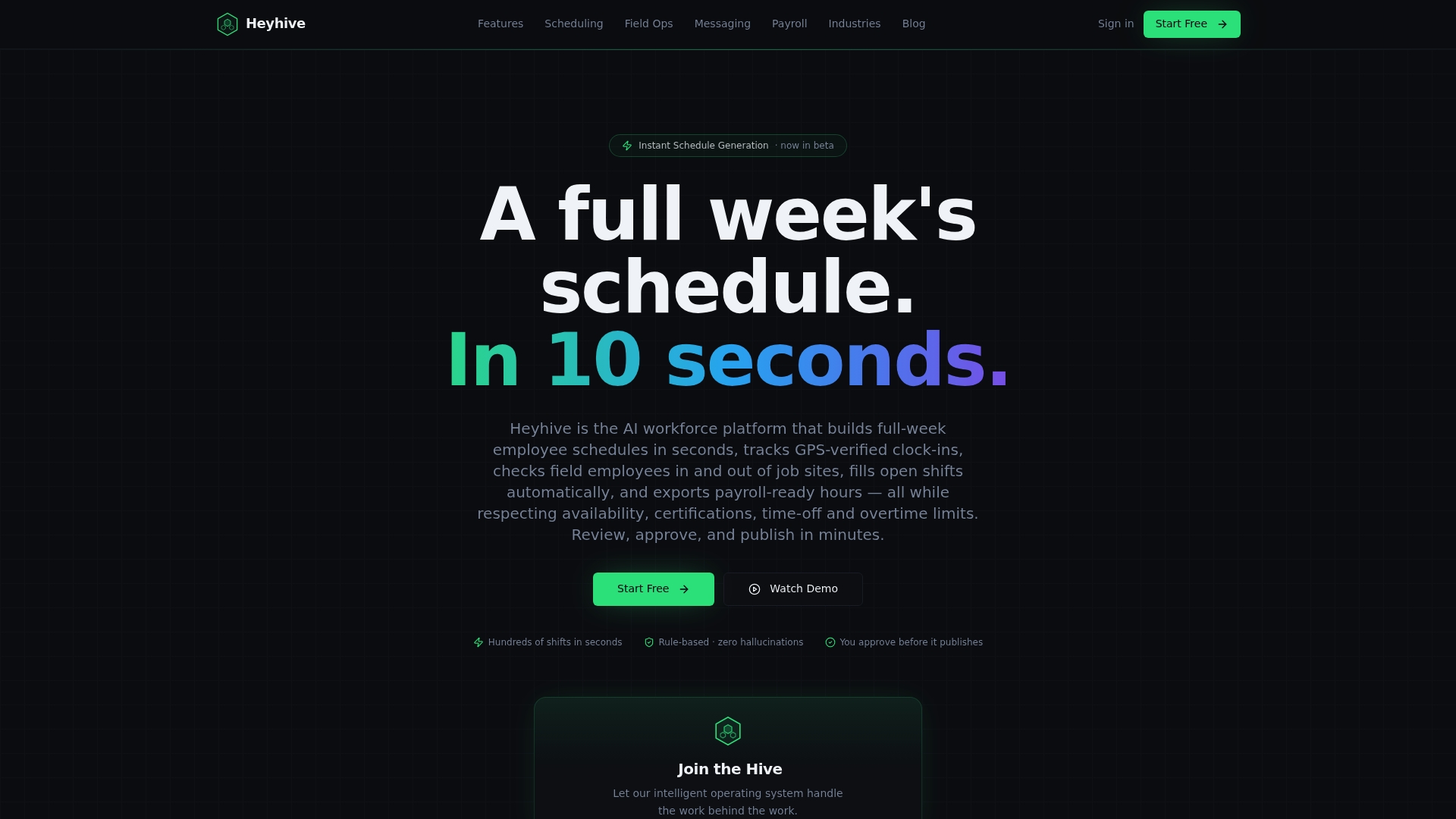
- AI scheduling handles the complexity of shared staff across sites automatically.
- GPS time clock provides verified, accurate hours from every location.
- Payroll-ready hours export cuts the reconciliation work out of your payroll cycle.
- Field Ops Check-In supports mobile and multi-site teams without extra paperwork.
If you're managing shifts across more than one location right now, see how Heyhive's workforce platform handles scheduling, time tracking, and payroll prep in one place, and book a demo to see it against your own schedule data.
FAQ
What is the best scheduling app for multiple locations?
The right choice depends on whether you need AI-generated schedules, GPS-verified time tracking, and payroll export built into one system, or whether a simpler shift-sharing tool covers your needs. Look for centralized availability, manager approval workflows, and built-in overtime safeguards, since those features determine whether cross-location scheduling actually reduces risk instead of adding to it.
What are the three types of scheduling?
Scheduling approaches generally fall into fixed scheduling, where shifts stay the same week to week, rotating scheduling, where shift patterns cycle through a team over set intervals, and flexible or on-demand scheduling, where shifts are offered and claimed based on real-time availability. Cross-location scheduling typically blends rotating and flexible models so staff can be shared across sites without constant manual rebuilding.
What does the 2-2 3-2 2-3 rotating schedule look like?
The 2-2 3-2 2-3 pattern is a rotating shift schedule where employees work two days on, two days off, then three days on, two days off, then two days on, three days off, repeating on a cycle. It's designed to give round-the-clock coverage with built-in rest days, and it's common in operations that run seven days a week, including some multi-site field and healthcare teams.
What is an overlapping schedule?
An overlapping schedule is one where two or more employees' shifts share part of the same time window, often used to ensure continuity during a shift change or to cover a peak demand period. In cross-location scheduling, overlapping shifts can also refer to a worker being booked at two locations during the same hours, which is exactly the double-booking error that unified availability tracking is meant to prevent.
Sources
- U.S. Department of Labor opinion letter (FLSA-2025-05)
- Questions and Answers – NPRM: Joint Employer Status Under the FLSA, FMLA, and MSPA | U.S. Department of Labor
- Fact Sheet #23: Overtime Pay Requirements of the FLSA | U.S. Department of Labor
- Employment and Wages Online Annual Averages, 2025 : U.S. Bureau of Labor Statistics
- Microsoft Teams: Cross-Location Shifts update (feature writeup)