
An attendance points system assigns a numeric value to each unexcused absence event, such as a tardy, early departure, or no-call/no-show, and triggers progressive discipline once an employee's total crosses defined thresholds. The single most important action you can take right now: draft a written policy that uses a rolling 12-month lookback window, explicitly excludes protected leave, and logs every event with a timestamp and the name of the supervisor who recorded it.
Before you write a single policy clause, confirm you have these four elements in place:
- Point scale: defined values for each infraction type (tardy, partial shift, full absence, no-call/no-show)
- Rolling window: a 12-month lookback period so points expire rather than accumulate permanently
- Exclusions list: FMLA, ADA accommodations, jury duty, military leave, workers' comp, and applicable state sick-leave statutes
- Recordkeeping method: a timestamped, auditable log that employees can access on request
Key Takeaways
A defensible attendance points system requires a written policy with a rolling 12-month window, protected leave exclusions, timestamped recordkeeping, and consistent manager application before any discipline is issued.
Table of Contents
- What is an attendance point system and when should you use one?
- How an attendance points system operates: scales, windows, and examples
- Key components every attendance point policy must include
- How to implement an attendance point system step by step
- Legal and compliance considerations in the United States
- What should you log for attendance tracking and recordkeeping?
- How workforce technology supports a fair attendance point system
- Best practices and common pitfalls to avoid
- Practical sample policy and copy-ready templates
- The real tension in attendance management
- Heyhive makes attendance tracking accurate and audit-ready
- Sources
What is an attendance point system and when should you use one?
An attendance point system, sometimes called a no-fault attendance policy, assigns points to unexcused attendance events without requiring a manager to judge the reason behind each absence. The "no-fault" label means the system tracks behavior, not intent. A tardy earns a set number of points whether the employee overslept or hit unexpected traffic.
The approach fits best in hourly and shift-driven environments where coverage gaps have direct operational consequences: restaurants, retail stores, distribution centers, manufacturing plants, and field service crews. If one person calls out and no one covers the shift, the business feels it immediately. A point system gives managers a consistent, documented basis for escalating discipline without relying on subjective judgment calls.
Key terms every HR team should know
- Occurrence: a single attendance event (one absence, one tardy, one early departure) that earns points
- Rolling lookback (rolling 12 months): points expire 12 months from the date of the incident, not at a fixed calendar year-end; this is the most common window in U.S. employer policies
- Point expiration: the automatic removal of points once the lookback period passes
- Excused absence: an absence pre-approved by management or covered by a protected leave statute; typically earns zero points
- Unexcused absence: an absence not pre-approved and not covered by protected leave; earns points per the policy scale
How an attendance points system operates: scales, windows, and examples
Typical point values and why proportionality matters
Most policies weight infractions proportionally. A full unexcused absence costs more points than arriving late, and a no-call/no-show costs the most because it gives the employer zero time to arrange coverage. Common point-threshold ladders show escalating consequences at 4, 6, 8, and 10–12 points on a rolling 12-month window, with some employers setting termination review at 10–12 points.
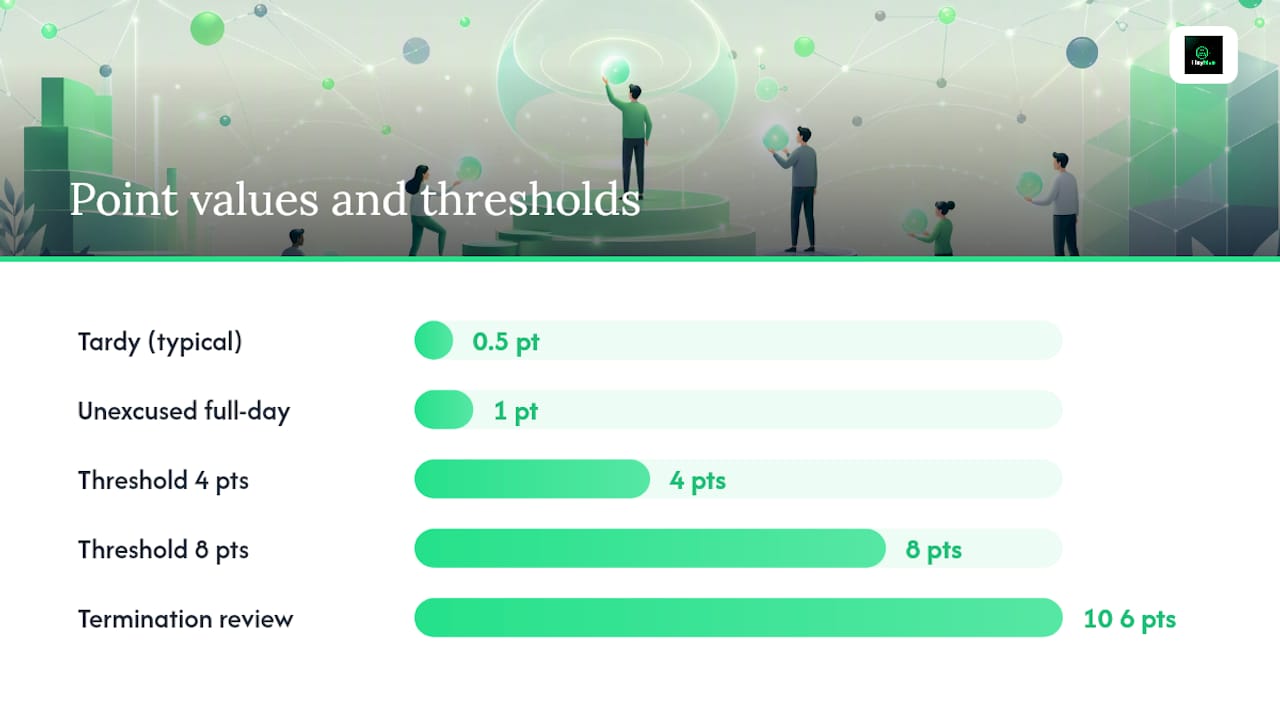
| Infraction | Typical Point Value | Notes |
|---|---|---|
| Tardy (1–30 minutes late) | 0.5 | Some policies use 0.25 for under 10 minutes |
| Tardy (over 10 minutes late) | 0.5 | Treated as a partial absence |
| Leaving early (unexcused) | 0.5–0.5 | Mirrors tardy scale | | Unexcused full-day absence | 0.5–— | Most common: 1 point per day | | No-call/no-show | — | Highest weight; zero notice to employer | | Failure to follow call-off procedure | +0.5 | Added on top of the earned infraction |
The call-off procedure penalty deserves special attention. Many employer policies add an additional half-point occurrence when an employee follows the wrong notification process, such as texting a coworker instead of calling the designated supervisor line. That half-point reinforces the procedure without doubling the penalty for the absence itself.
Rolling windows and how points expire
Under a rolling 12-month window, points expire 12 months from the date of the incident. An absence on March 3 disappears from the employee's record on March 3 of the following year, regardless of where the calendar year falls. This is more employee-friendly than a fixed calendar year because it prevents a cluster of late-year incidents from resetting to zero on January 1.
Worked example 1 — gradual accumulation: An employee earns 1 point in February, 1 point in May, and 0.5 points in August. By the following February, the first point expires. Their live total drops from 2.5 to 1.5 without any discipline action, assuming thresholds were not crossed.
Worked example 2 — threshold crossing: An employee accumulates 4 points by June (verbal warning issued). They add 2 more points in September, reaching 6 (written warning). If the policy sets termination review at 10 points and the employee adds 4 more before any points expire, the employer has a documented, timestamped record supporting each step of progressive discipline.
Some employers also use hour-accumulation triggers alongside occurrence counts, for example, six occurrences or an accumulation of 50 hours of unexcused absence within 12 months, whichever comes first. This dual-trigger approach catches both frequent short absences and occasional long ones.
Key components every attendance point policy must include
A defensible policy is not just a point table. It is a complete document that tells employees, managers, and, if necessary, a court exactly how the system works. SHRM's sample attendance point system templates structure point assignment and progressive discipline for nonexempt employees and are a useful starting reference.
Every policy should contain these components:
- Scope: which employees are covered (hourly, nonexempt, specific locations or job classifications)
- Definitions: occurrence, rolling window, excused vs. unexcused, no-call/no-show
- Point scale: the infraction-to-point table with values for each event type
- Rolling window: the exact lookback period and how expiration is calculated
- Call-off notification procedure: who to call, by what time, and through which channel
- Excused absence list: all protected categories (FMLA, ADA, jury duty, military, workers' comp, state sick leave) and any employer-approved categories
- Progressive discipline thresholds: the point totals that trigger each step (verbal, written, final written, termination review)
- Appeals process: how an employee can contest a point assignment, the timeline, and who reviews the appeal
- Confidentiality and record access: employee right to view their own attendance record
- Union and contract exceptions: any collective bargaining agreement provisions that supersede or modify the policy
Pro Tip: Run a calibration session with all managers before launch. Give them three or four hypothetical scenarios and ask them to score each one independently. Where scores diverge, you have a training gap. Consistent manager application is what keeps a point system legally defensible.
How to implement an attendance point system step by step
Design phase
Start by defining your operational goals. Are you targeting chronic tardiness, unplanned full-day absences, or no-call/no-shows? The answer shapes your point weights. Once goals are clear, draft the point scale, choose the lookback window, and map every protected leave category to its treatment in the system (excluded, frozen, or otherwise handled). If your workforce is unionized, align with your collective bargaining agreement before finalizing any language.
Pilot and calibration
Run a four-to-six-week paper pilot with one department or shift before going live. During the pilot, managers log events as they would under the real policy but hold all discipline decisions. At the end, review the data: Are point totals reasonable? Are any managers assigning points inconsistently? Did any protected leave events get flagged incorrectly? Fix the gaps before the policy goes live.
Training and communications
Managers need a short script for delivering each discipline step, not just a policy document. Employees need a one-page plain-language summary that explains what earns points, how points expire, and how to appeal. Hold brief Q&A sessions by shift or department so employees can ask questions before the policy takes effect. Guides recommend giving employees access to their attendance records on request, which reduces disputes and builds trust from day one.
Rollout documentation
Keep a dated record of every step: the draft policy, manager training sign-offs, employee acknowledgment forms, and any policy updates. This paper trail demonstrates good-faith implementation if a discipline decision is ever challenged.
Legal and compliance considerations in the United States
This is where most point systems fail. A well-designed scale and a clean rollout mean nothing if the policy penalizes absences that federal or state law protects.
Core legal rules to know
- FMLA: The Family and Medical Leave Act protects eligible employees' absences for qualifying medical and family reasons. Applying attendance points to FMLA-protected absences creates legal liability. Employers can freeze the rolling clock during FMLA leave, but they cannot count those absences against the employee's point total.
- ADA: The Americans with Disabilities Act may require reasonable accommodations, including modified attendance schedules. Points assigned to absences that are part of an approved ADA accommodation are a discrimination risk.
- Jury duty and military leave: Federal law (USERRA for military, various federal and state statutes for jury duty) protects these absences. They must appear on your excused list.
- Workers' compensation: Absences tied to a work-related injury are protected under state workers' comp statutes. Penalizing them with points exposes the employer to retaliation claims.
- State sick-leave laws: More than a dozen states and many cities mandate paid sick leave. Applying points to absences covered by these statutes is unlawful in those jurisdictions.
Legal checklist before enforcement
Run through this list before issuing any discipline under the policy:
- Was the absence potentially covered by FMLA or ADA? If yes, was it properly designated and excluded?
- Did the employee provide documentation that triggers a protected leave review?
- Has the policy been applied consistently to similarly situated employees?
- Are all point assignments timestamped and attributed to a named supervisor?
- Has employment counsel reviewed the policy language and the specific discipline decision for edge cases?
Consistent documentation is your primary defense. A policy that is applied differently to different employees, even unintentionally, creates disparate-treatment exposure.
What should you log for attendance tracking and recordkeeping?
Accurate time records for nonexempt employees are required under the Fair Labor Standards Act and must be maintained for audits. Your attendance records need to hold up in a discipline meeting, an EEOC charge, and a Department of Labor audit. That means every event needs more than just a date.
Minimum fields to capture for every attendance event
| Field | What to Record | Why It Matters |
|---|---|---|
| Employee ID and name | Full legal name, employee number | Ties the record to the right person |
| Event date and time | Exact timestamp of clock-in or call-off | Proves tardiness or absence occurred |
| Event type | Tardy, early departure, full absence, NCNS | Determines point value |
| Points assigned | Numeric value per policy scale | Audit trail for progressive discipline |
| Recorded by | Supervisor name and ID | Accountability; prevents after-the-fact edits |
| Call-off documentation | Who was notified, channel, time of notification | Verifies procedure compliance |
| Leave designation | FMLA, ADA, state sick leave, or none | Confirms protected events are excluded |
| Employee acknowledgment | Date employee was notified of the point | Supports discipline documentation |
Manual spreadsheets vs. timekeeping systems
Spreadsheets can work for very small teams, but they carry real risk: cells can be edited without a change log, formulas break, and version control is nearly impossible. A dedicated employee attendance tracking system generates immutable, timestamped records that cannot be quietly altered after the fact. For nonexempt employees especially, that audit trail is not optional.
Store attendance records for at least three years to align with FLSA retention requirements, and give employees a clear, simple way to request their own records. Transparency here prevents disputes before they start.
How workforce technology supports a fair attendance point system
Platforms like Heyhive reduce the operational friction of running a point system by automating the data capture that makes enforcement consistent. Pairing a point system with timekeeping software that provides timestamped records and employee visibility into point totals removes subjectivity and reduces disputes.
Here is what that looks like in practice:
- GPS-verified clock-ins: Heyhive's GPS time clock records the exact location and time of each clock-in and clock-out, so tardiness is a data point, not a manager's recollection.
- Immutable audit trail: Every entry is timestamped and attributed to the user who recorded it. No silent edits, no version confusion.
- Automated point math: The system calculates running totals against your defined thresholds, flagging employees who approach discipline triggers before a manager has to remember to check.
- Employee-facing balance view: Employees can see their current point total at any time, which reduces "I didn't know" disputes at discipline meetings.
- Exportable reports: When a discipline meeting happens, you pull a clean report showing every event, its timestamp, the points assigned, and the supervisor of record.
Trade-offs: automation vs. manual tracking
| Factor | Manual tracking | Automated system |
|---|---|---|
| Audit trail integrity | Editable; version risk | Immutable; timestamped |
| Manager consistency | Varies by individual | Enforced by system rules |
| Employee transparency | Requires manual sharing | Self-service access |
| Protected leave flagging | Manual review required | Can prompt review on designation |
| Setup effort | Low initially | Higher upfront; lower ongoing |
The honest trade-off is setup time. Configuring a platform to match your exact point scale and thresholds takes effort. But once it is running, the system enforces consistency that a spreadsheet never can.
Best practices and common pitfalls to avoid
What works
- Publish the full policy before enforcement. Employees cannot follow rules they have not seen. Distribute the policy, collect signed acknowledgments, and keep them on file.
- Audit point assignments quarterly. Pull a report by manager and look for outliers. Consistent enforcement across managers is both fair and legally protective.
- Set thresholds that reflect your actual tolerance. A termination threshold of 4 points in a 12-month window is too low for most operations and will generate wrongful termination exposure. Most defensible policies set termination review at 10–12 points.
- Build in a reset or reward mechanism. Some employers reduce an employee's point total after a defined period of clean attendance. This gives employees a path forward and reduces the feeling that the system is purely punitive.
- Train managers on protected leave recognition. A manager who assigns points to an FMLA absence because they did not recognize the designation is a liability, not just a training gap.
What to avoid
- Penalizing FMLA or ADA-protected absences. This is the single highest-risk error. Even one documented instance can anchor a federal lawsuit.
- Inconsistent enforcement. If one manager routinely overlooks tardiness while another writes up every minute, the policy is unenforceable and legally exposed.
- Relying solely on spreadsheets for records. A spreadsheet with no change log is not an audit trail. It is a document that can be questioned in any dispute.
- Setting thresholds without modeling outcomes. Before publishing, run your point scale against six months of historical attendance data. If 30% of your workforce would already be at a written-warning level, your thresholds are miscalibrated.
- Skipping the appeals process. An employee who has no formal way to contest a point assignment is more likely to escalate to an external complaint. A clear, fast appeals path protects both parties.
Warning: Never assign points to an absence without first checking whether the employee has submitted, or is eligible to submit, an FMLA or ADA request. Retroactive point removal after a legal designation is administratively messy and signals that the system was applied incorrectly.
Practical sample policy and copy-ready templates
The sections below are modular. Copy the language that fits your operation and adjust the bracketed fields.
[COMPANY NAME] Attendance Point Policy
Purpose: To maintain consistent, fair attendance standards for all [covered employee classification] employees and to provide a clear, documented process for addressing unexcused attendance events.
Scope: This policy applies to all [hourly / nonexempt / shift-based] employees at [location(s)]. Exempt employees and employees covered by a separate collective bargaining agreement are excluded unless the agreement incorporates this policy by reference.
Definitions:
- Occurrence: a single unexcused attendance event (tardy, early departure, full absence, or no-call/no-show)
- Rolling 12-month window: the 12-month period ending on the date of the most recent occurrence; points expire 12 months from the date of the incident
- Excused absence: an absence pre-approved by management or covered by FMLA, ADA, jury duty, military leave, workers' compensation, or applicable state sick-leave law
Point schedule:
Call-off procedure: Employees must notify [designated supervisor / call-off line] at least [X hours] before the start of their scheduled shift. Notification by text message to a coworker does not satisfy this requirement.
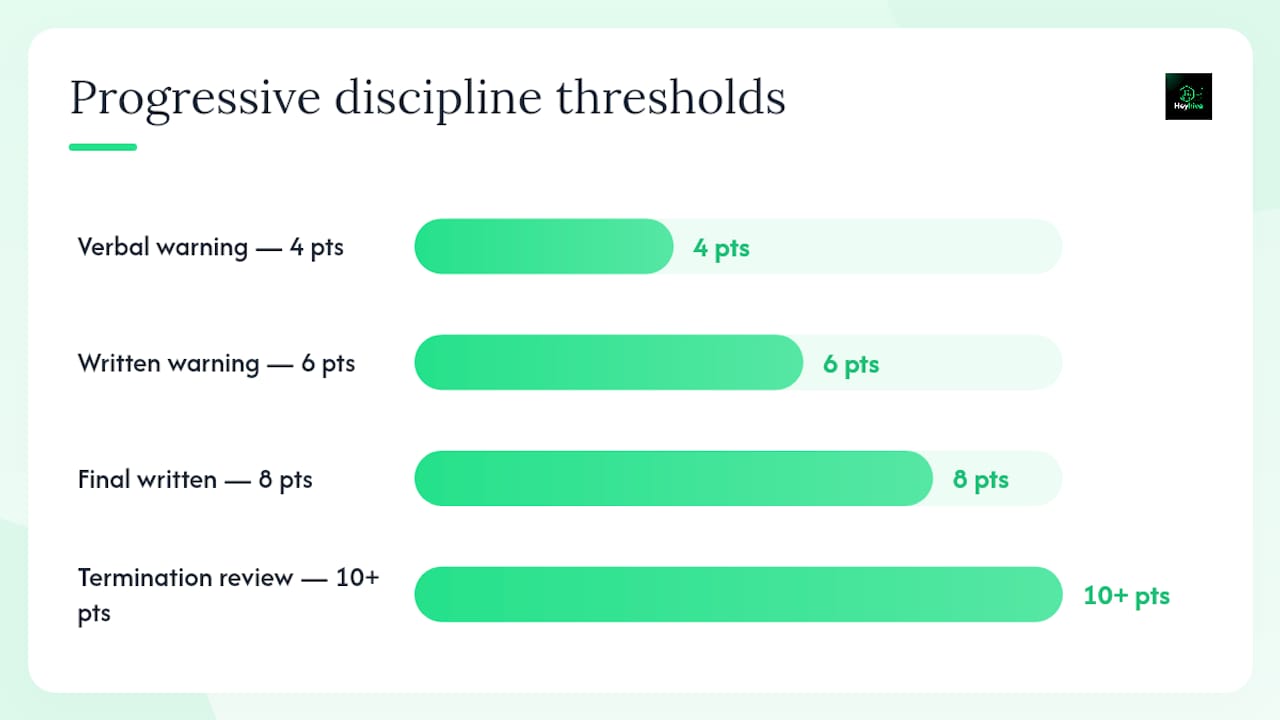
Progressive discipline thresholds:
| Points Accumulated (rolling 12 months) | Discipline Step |
|---|---|
| 4 points | Verbal warning |
| 6 points | Written warning |
| 8 points | Final written warning |
| 10+ points | Termination review |
Appeals: An employee who believes a point was incorrectly assigned may submit a written appeal to [HR / direct supervisor's manager] within [5] business days of receiving notice. Appeals are reviewed within [10] business days. The employee may present supporting documentation.
Recordkeeping: All attendance events are logged in [timekeeping system] with a timestamp and the name of the recording supervisor. Employees may request a copy of their attendance record at any time by contacting HR.
Customization notes
- Retail and food service: Shorter shifts mean tardiness has outsized impact. Consider weighting no-call/no-shows at 3 points and setting a verbal warning at 3 points rather than 4.
- Manufacturing and distribution: Hour-accumulation triggers (e.g., 50 hours of unexcused absence in 12 months) work well alongside occurrence counts to catch employees who take frequent partial-day absences.
- Field teams: GPS-verified clock-in data removes ambiguity about whether an employee was late or simply clocked in from an unauthorized location.
- Unionized workplaces: Any point scale or threshold must be negotiated or at minimum reviewed against the collective bargaining agreement. The CBA controls where it conflicts with this policy.
When a manager approves a discretionary exception (for example, waiving a point for an employee who had a documented car emergency), that decision must be recorded in writing, dated, signed by the manager, and filed with HR. Undocumented exceptions are the fastest way to create disparate-treatment claims.
The real tension in attendance management
Point systems get criticized for being cold. The counterargument is that they are actually fairer than the alternative, which is a manager deciding case by case who gets a pass and who gets written up. Inconsistency is not compassion. It is a liability.
That said, the most defensible point systems are not the most aggressive ones. A policy that terminates employees at 8 points in 12 months will generate more wrongful termination exposure than one set at 10–12, because the lower threshold leaves almost no room for a single bad month, a family emergency, or a protected leave event that was misclassified. The goal is a system that corrects chronic absenteeism, not one that catches every human moment of imperfection.
Automation helps, but it does not replace judgment. A platform that flags an employee approaching a threshold is useful. A manager who reviews that flag, checks for any pending leave designations, and then makes a documented decision is what actually keeps the policy defensible. The technology handles the data. The human handles the context.
Heyhive makes attendance tracking accurate and audit-ready
Running a point system manually is manageable for a team of 10. At 50 employees across multiple shifts, the administrative load becomes a real risk: missed entries, inconsistent point math, and spreadsheets that no one can audit cleanly.
Heyhive gives you GPS-verified clock-ins, an immutable audit trail, automated point calculations against your defined thresholds, and an employee-facing view of their attendance balance. When a discipline meeting happens, you pull one report. Every event, every timestamp, every supervisor of record, in one place. Managers spend less time reconstructing attendance histories and more time on the conversation that actually matters.
Field teams get geofencing-based verification so clock-in location is never a question. Payroll-ready exports mean your attendance data flows directly into your pay process without manual re-entry. You stay in control of approvals at every step.
Start tracking attendance with Heyhive and see how much simpler a defensible point system becomes when the data is already clean.
Sources
- Attendance Point System for Nonexempt Employees — SHRM
- Attendance Point System: How It Works & Stays Legal — AttenditAI Blog
- ATTENDANCE POLICY - HOURLY PERSONNEL
- Bargaining and Non-Exempt Employee Attendance Policy — Citizens (policy PDF)
This article provides general HR and operational guidance, not legal advice. Consult qualified employment counsel before finalizing your policy or making discipline decisions, particularly for FMLA, ADA, and state-specific leave compliance.