
An effective late to work policy defines exactly what counts as tardy, tracks it consistently, applies fair and escalating consequences, and leaves room for legally protected exceptions. Get any one of those wrong and you either lose enforcement credibility or invite a wage-hour complaint.
Before you write a single word of policy language, confirm you have covered these five things:
- A precise, measurable definition of "late" (minutes, clock-in method, grace period)
- A clear notification process for employees running behind
- A tracking system that produces an audit trail
- A progressive-discipline structure with defined thresholds
- Documented exceptions for FMLA, ADA, and other protected situations
Pro Tip: Set your grace period once, write it down, and never bend it case by case. A 5-minute buffer applied consistently protects you far more than a "use your judgment" approach that changes manager to manager.
Key Takeaways
A late to work policy only works when it pairs a precise, measured definition of tardiness with consistent tracking, escalating consequences, and documented legal exceptions.
| Point | Details |
|---|---|
| Define lateness precisely | Set a specific grace period (commonly 5 to 15 minutes) tied to your clocking method, and write it down. |
| Build in escalation | Use a rolling 30 to 90 day window with defined thresholds before moving from coaching to termination. |
| Check compliance first | Review FMLA, ADA, and wage-hour exposure before docking pay or disciplining a pattern of lateness. |
| Standardize documentation | Log the same fields every time: scheduled time, actual time, notification, reason, and manager action. |
| Automate the tracking | Tools like Heyhive's GPS time clock and AI scheduling remove manual logging and create a payroll-ready audit trail. |
Table of Contents
- What Counts as Late? Building a Precise Definition
- Key Elements Every Tardiness Policy Must Include
- Sample Late to Work Policy Templates You Can Copy
- How Should Consequences Escalate for Repeat Lateness?
- Documenting Tardiness: What to Record and for How Long
- What Legal Risks Should You Check Before Disciplining Tardiness?
- Handling Exceptions Without Breaking Consistency
- Rolling Out a New or Updated Tardiness Policy
- Technology That Makes Enforcement Actually Consistent
- How Heyhive Helps Enforce and Simplify Your Late-to-Work Policy
- Frequently Asked Questions
- Sources
What Counts as Late? Building a Precise Definition
"Late" only means something if you tie it to a specific, measurable moment. That moment is the scheduled start time, not the moment an employee happens to arrive at the building. A worker who badges in at 8:58 but doesn't reach their register until 9:07 is still late by any standard that matters for coverage.
Most workplaces draw the line using one of two approaches: a de minimis tolerance, often a few minutes or less, or a structured grace period that gets logged but doesn't trigger discipline on its own. One agency policy example defines de minimis tardiness explicitly as five minutes or under, paired with separate rules for no-call/no-shows, which is worth reviewing if you want to see how a documented threshold actually reads. Whichever number you choose, write it down. An undocumented tolerance is really just a manager's mood.
The rule also needs to flex by work type:
- On-site shift work: measured from physical clock-in or badge scan against the posted schedule.
- Remote work: measured from system log-in or the first scheduled meeting, whichever your team relies on for coverage.
- Meeting-based roles: measured from calendar start time, not from when someone opens their laptop.
Pro Tip: Match your definition to your clocking technology before you publish the policy. If your badge system rounds to the nearest six minutes but your policy says "one minute late is late," payroll and enforcement will never agree.
Key Elements Every Tardiness Policy Must Include
A policy that skips any of these pieces will eventually fail either in practice or in front of an attorney. Treat this as your build order.
- Scope and applicability. State whether the policy covers exempt and nonexempt employees differently, and whether remote or hybrid staff have separate rules.
- Definition and measurement. Lock in the grace period and clock-in method from the section above.
- Notification process. Specify how much advance notice is expected, who to contact (direct supervisor, not a group chat), and acceptable channels like phone call versus text.
- Tracking and recordkeeping. Assign ownership. Is HR pulling reports, or does each manager log incidents manually?
- Progressive discipline and reset windows. Define how many incidents trigger each escalation step and how long a "clean" period resets the count.
- Appeals process. Give employees a documented path to contest a tardiness mark they believe is inaccurate.
- Manager responsibilities. Require consistent application across shifts and locations, with documentation standards that don't vary by supervisor.
SHRM's guidance on managing tardiness backs this structure directly, pointing to clear definitions and consistent documentation as the two levers that matter most for reducing both repeat lateness and perceived favoritism. Skip the appeals process and you'll find yourself defending individual manager decisions instead of a system. Skip manager training and the policy becomes eight different policies depending on who's running the shift that day.
The scope section deserves more attention than most HR teams give it. A policy silent on exempt employees invites confusion when a salaried manager shows up 20 minutes late. Salaried staff generally can't have pay docked for partial-day lateness without risking their exempt status, so the consequence for that group has to live in performance management, not payroll.
Sample Late to Work Policy Templates You Can Copy
Three versions cover most workplace needs. Adjust the specifics, but keep the structure.
A. Concise version (small teams, low-friction environments):
B. Standard version (mid-size operations needing documentation):
C. Strict version (healthcare, manufacturing, public safety, other coverage-critical roles):
Sample template libraries built around these structures, including specific grace-period and deduction language, are widely used starting points, and one useful reference is this late-coming policy template that walks through half-day deduction rules and biometric attendance handling.
Customize each template by adding a line specifying whether biometric clock-ins round up or down, and whether nonexempt employees are subject to pay deductions for partial-hour lateness (a question with real wage-hour exposure, covered in the compliance section below).
Pro Tip: Put your rounding rule in writing right next to your grace period. "We round to the nearest 5 minutes" sounds harmless until it's the reason an employee thinks they were marked late unfairly.
How Should Consequences Escalate for Repeat Lateness?
Consequences only work when they escalate predictably. Jumping straight to termination for a first offense invites a wrongful-termination claim; letting the tenth offense pass with a shrug guts the policy's credibility.
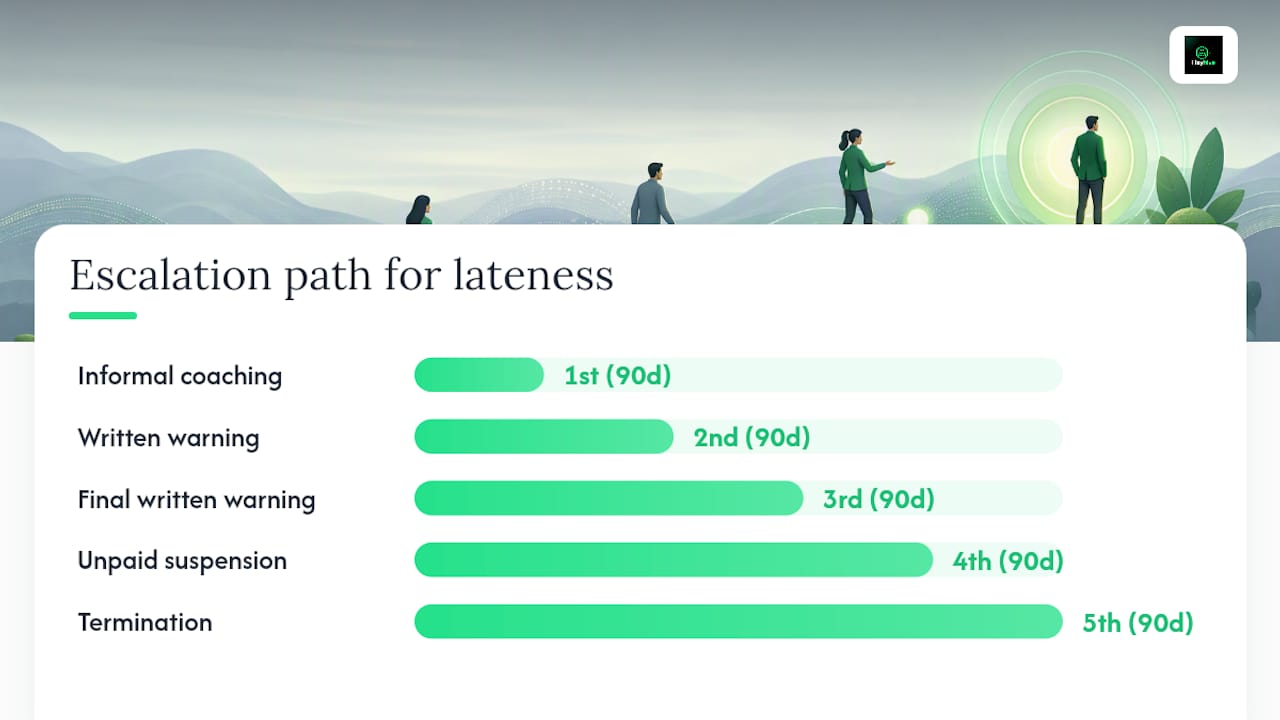
A standard escalation path runs coaching conversation, then written warning, then suspension, then termination, each triggered by a defined number of occurrences inside a rolling window. A commonly used threshold allows up to several late arrivals within a rolling one to three month period before formal corrective action begins, giving employees room for occasional tardiness without letting a pattern go unaddressed.
Choose your rolling window based on how much slack your operation can absorb. A 30 day window escalates faster and suits coverage-sensitive roles; a 90 day window is more forgiving and works for office-based teams where a single missed shift doesn't create a safety gap.
| Occurrence (rolling 90 days) | Action |
|---|---|
| 1st | Informal coaching conversation, documented in file |
| 2nd | Written warning with copy to employee file |
| 3rd | Final written warning plus performance improvement discussion |
| 4th | Unpaid suspension (nonexempt only, per wage-hour rules) |
| 5th | Termination |
Payroll deductions and half-day rules need extra care before you apply them. Docking a nonexempt employee's pay for partial-hour lateness is generally fine as long as you pay for all hours actually worked, but docking a salaried exempt employee risks converting them to nonexempt status under wage-hour rules, a risk that guidance on tardy policy and payroll compliance spells out clearly. Check your rounding practices too. Rounding that consistently favors the employer, rather than rounding neutrally, is a common source of wage claims.
Documenting Tardiness: What to Record and for How Long
A tardiness record only holds up under scrutiny if it captures the same fields every time. Build a standard incident form with these entries:
- Scheduled start time and actual clock-in or arrival time
- Method of notification (or lack of one) and who received it
- Stated reason, if any
- Supervisor name and any action taken
- Whether the incident falls inside an active rolling window
Retain these records for at least the duration your state's wage-and-hour statute of limitations requires, and longer if the employee is on a documented improvement plan. Keep them in the employee's personnel file, not scattered across manager notebooks or texts.
On tracking methods: badge clock-ins are cheap and simple but easy to buddy-punch. GPS-verified mobile clock-ins solve that problem for field and multi-site teams by confirming location at the moment of punch. App log-ins work for remote staff but say nothing about actual task readiness. Supervisor logs catch nuance a system can't, but they vary wildly in consistency from one manager to the next. Combining an automated capture method with supervisor sign-off tends to produce the strongest audit trail, since it removes the guesswork purely manual logs create. For a deeper breakdown of field-level tracking fundamentals, see this attendance tracking guide for hourly teams.
Pro Tip: Use one standardized incident form across every location and manager. The moment two supervisors record tardiness differently, you've created an inconsistency that any employee's attorney will find in about ten minutes.
What Legal Risks Should You Check Before Disciplining Tardiness?
Before you dock pay or issue discipline, run through the legal exposure points that trip up even well-meaning HR teams.
- Wage-and-hour rules. Nonexempt employees must be paid for all time actually worked; you cannot dock below minimum wage for a partial-hour lateness, and rounding practices must be neutral rather than consistently rounding down in the employer's favor.
- Protected leave. Under the FMLA, tardiness tied to a qualifying medical condition, including intermittent leave, may need to be treated as protected leave rather than disciplined as ordinary lateness.
- ADA accommodations. A pattern of lateness connected to a disability may require an accommodation conversation, not automatic escalation up the discipline ladder.
- State paid sick leave laws. Some states let employees use accrued sick time to cover a late arrival tied to illness, which changes how that occurrence should be logged.
- Disparate treatment. Applying the policy more strictly to one employee or group than another, even unintentionally, creates discrimination exposure. Consistency and documentation are your best defense.
Absenteeism and lateness carry real financial weight for employers, and health-related absence is a documented driver of that cost, which is part of why Kaiser Permanente's employer research frames absenteeism cost and prevention strategies as a business priority, not just an HR housekeeping issue. That framing matters when you're building the case internally for investing in tracking tools and manager training rather than treating tardiness as a minor nuisance.
Run this checklist before applying any discipline: confirm the employee isn't on active FMLA or ADA accommodation status, verify the incident was recorded using your standard method, check that the same threshold has been applied to comparable employees recently, and document the discipline conversation the same day it happens.
Handling Exceptions Without Breaking Consistency
Emergencies happen. Cars break down, transit lines stall, storms hit. A policy with zero flexibility just teaches employees to stop reporting problems honestly.
Common excused reasons include documented medical emergencies, severe weather affecting a wide area (not just one employee's commute), and pre-approved religious observance conflicts. Log these separately from standard tardy occurrences so they don't count against the rolling threshold, but still record them for pattern tracking.
- Require documentation for anything beyond a single isolated incident.
- Reserve "excused, no count" status for verifiable, non-repeating events.
- Treat repeated "emergencies" from the same employee as a pattern worth a direct conversation, not automatic sympathy.
If an employee's third "flat tire" this quarter starts to look like a scheduling conflict they haven't disclosed, that's a coaching conversation, not an accusation.
Rolling Out a New or Updated Tardiness Policy
A policy change lands better when employees see it coming rather than discover it mid-shift. Move through these steps in order:
- Pre-launch: Train managers on the exact definitions and thresholds first. Run a legal review, especially on payroll deduction language. Pilot the tracking system with one location or team for two weeks.
- Launch: Give managers a short talking-points sheet so every team hears the same explanation. Send a brief employee announcement that states the effective date, the grace period, and where to send late-notice calls.
- Post-launch: Audit the first two weeks of records for consistency across managers. Run a 30 to 60 day feedback loop to catch confusing language or unworkable thresholds before they calcify into habit.
Technology That Makes Enforcement Actually Consistent
Manual tardiness tracking works fine at ten employees. At fifty, it falls apart, because consistency across managers is exactly the thing manual systems can't guarantee.

Biometric and badge time clocks remove the "I forgot to write it down" problem for on-site teams. GPS-verified mobile clock-ins solve the equivalent problem for field crews and multi-site operations by confirming an employee actually arrived where they were scheduled to be. Scheduling software that publishes shifts automatically reduces the confusion that leads to disputed "I didn't know I was on at 8" claims, and automated late-arrival alerts let a manager address a gap in real time instead of discovering it at shift's end.
Heyhive's AI scheduling builds full weekly schedules in seconds while respecting availability and certifications, and its GPS time clock confirms arrival location automatically, so a tardiness record isn't just a manager's memory of what happened. Every clock-in rolls up into an exportable report, which means your documentation checklist from earlier in this article gets built automatically instead of assembled by hand at review time.
Pro Tip: Pick tracking technology before you finalize your grace period language. A GPS or badge system that logs to the second lets you enforce a tight 5 minute window fairly; a manual sign-in sheet doesn't give you that precision, so don't write a policy your tracking method can't back up.
Measuring Whether Your Policy Is Actually Working
Track four numbers: overall tardiness rate, repeat-offender rate, coverage costs from overtime or last-minute shift swaps, and a manager-consistency score comparing how evenly discipline gets applied across teams. BLS labor force data is a useful outside benchmark for setting realistic targets rather than guessing.
- Review the policy quarterly during year one.
- Shift to semiannual or annual review once thresholds stabilize.
- Adjust grace periods or escalation windows based on both the data and direct employee feedback.
Why Fairness and Consistency Aren't Actually in Tension
The instinct to treat every late arrival as a special case feels compassionate, but it's usually what erodes trust fastest. Employees don't resent a strict grace period. They resent watching one coworker get away with something they'd be written up for. Fairness, in practice, is just consistency applied without exception, and consistency requires data, not memory.
The best coaching conversations I've seen replace "you're always late" with a printed record: four occurrences, three of them Mondays, all within 40 days. That's not an accusation. It's a pattern the employee can respond to.
How Heyhive Helps Enforce and Simplify Your Late-to-Work Policy
Writing the policy is the easy part. Enforcing it consistently across every manager and every shift is where most employers lose the thread, especially once tracking depends on memory, paper logs, or a spreadsheet nobody updates in real time.
Heyhive closes that gap with GPS-verified time clocks that confirm exactly when and where an employee clocked in, AI-generated schedules that managers review and approve before anything publishes, and payroll-ready attendance exports that turn your documentation checklist into an automatic report instead of a manual chore. Managers stay in control of every shift; the platform just removes the guesswork behind who clocked in when. If your current tardiness tracking still runs on paper or memory, start a free trial and see how much of your progressive-discipline matrix gets easier to enforce once the data does the work for you.
Frequently Asked Questions
What should a late to work policy always include? It needs a precise definition of tardiness, a notification process, a tracking method, a progressive-discipline structure, and documented exceptions for protected leave situations like FMLA or ADA accommodations.
How many minutes late counts as tardy? There's no universal number, but many employers use a 5 minute de minimis tolerance or a 10 to 15 minute grace period, measured from the scheduled start time and documented clearly in policy.
Can you dock pay for being late? For nonexempt employees, you can generally dock in whole time increments actually missed, as long as you don't fall below minimum wage; docking exempt salaried employees risks their exempt status and should be avoided.
How many late arrivals before termination is reasonable? A common approach allows up to three occurrences within a rolling 90 day period before formal discipline, escalating through warnings and suspension before termination on repeat violations.
Does GPS time tracking help with tardiness disputes? Yes. GPS-verified clock-ins remove ambiguity about arrival time and location, which makes documentation more defensible than manual logs or supervisor memory alone.
Sources
- U.S. Department of Labor — FMLA overview
- SHRM — Taming tardiness: practical steps
- Bureau of Labor Statistics — Labor force statistics
- Kaiser Permanente — Absenteeism costs and strategies
- OnPay — Tardy policy guide and legal considerations