
Lock next week's crew plan by Thursday, confirm materials and subs the same day, and use software that connects your schedule to GPS-verified field data. That's the approach that keeps crews productive and projects on track.
Three things you can do today:
- Lock next week now. Open your schedule and assign every crew member to a specific task and site for Monday through Friday.
- Confirm long-lead orders. Check whether any materials with typical long lead times are on order before they become the reason your framing crew stands idle.
- Set backup tasks. Identify one contingency task per crew so a weather delay or inspection hold doesn't turn into a paid idle day.
Heyhive is the recommended platform for putting this into practice. The sections below explain why each step matters and how to build a system that holds up across multiple jobsites.
Table of Contents
- What is construction crew scheduling and why does it matter?
- Why automate crew scheduling: business benefits you can measure
- A practical 5-step construction crew scheduling process you can apply today
- What software features should a crew-scheduling tool include?
- Field-tested best practices for building resilient schedules
- How do you pilot and roll out crew scheduling software?
- How Heyhive solves your crew scheduling needs
- Key Takeaways
- The scheduling tradeoff most managers get wrong
- Ready to run a smarter crew schedule with Heyhive?
- Authoritative sources and further reading
What is construction crew scheduling and why does it matter?
Construction crew scheduling is the ongoing process of assigning the right workers, with the right skills and certifications, to the right tasks, at the right sites, in the right sequence. It's not a document you create once at project kickoff. As scheduling guides confirm, the schedule is a living control system that must be updated continuously with real field data as work progresses.
A complete schedule covers six components: activities, durations, task dependencies, resource assignments, milestones, and float (buffer time). Miss any one of them and you're not scheduling crews, you're guessing.
Why does this matter beyond the Gantt chart? Because crew scheduling directly controls labor cost, productivity, and client trust. When workers arrive at a site with no clear task, or when a sub shows up before the preceding trade has finished, you're paying for confusion. For multi-site contractors, the compounding effect of poor crew coordination across three or four active projects can erase margin fast.
Why automate crew scheduling: business benefits you can measure
Manual scheduling on spreadsheets works until it doesn't. The moment you're managing more than two active sites and a dozen workers, the administrative load becomes the bottleneck. Automated crew scheduling software cuts that load directly: less time building and rebuilding schedules, fewer no-shows because workers receive mobile notifications, better labor utilization because the system flags conflicts and overbooking before they happen.
The numbers back this up. Research cited in construction scheduling guides shows that collaborative scheduling methods like the Last Planner System can reduce project duration significantly when properly applied.
That kind of reduction doesn't come from working faster. It comes from eliminating the idle time, rework, and miscommunication that manual scheduling allows to accumulate. At the project level, the payoff shows up as fewer schedule slippages, tighter margins, and client updates you can actually stand behind because they're based on verified field progress rather than optimistic estimates.
Integrated scheduling platforms that connect field reporting with schedule logic also improve forecast accuracy across your entire portfolio, which matters when you're managing multiple concurrent projects and need to reallocate a crew on short notice.
A practical 5-step construction crew scheduling process you can apply today
A reliable scheduling workflow follows five steps. Here they are up front, then unpacked below.
- Gather constraints and scope
- Assess availability, skills, and certifications
- Build and level the schedule
- Communicate and dispatch
- Monitor and adjust
Step 1: Gather constraints and scope
Inputs: project drawings, contract milestones, permit status, material delivery dates, subcontractor commitments. Owner: project manager. Output: a work breakdown structure (WBS) with durations based on verified field production rates from past projects, not theoretical rates. This step takes a typical amount of time for a residential or light commercial project.
Step 2: Assess availability, skills, and certifications
Inputs: crew roster with certifications (OSHA cards, equipment licenses, trade certs), current assignments across all active sites, any approved time-off requests. Owner: superintendent or field manager. Output: a confirmed list of available workers matched to required skills for each task. Skipping this step is how you send an uncertified worker to a task that requires a licensed operator.
Step 3: Build and level the schedule
Map task dependencies, identify the critical path, assign crews, and then level resources so no worker or piece of equipment is double-booked. Base durations on real field data from comparable past work. Build in float after major phases, not just at the end. This step takes a moderate amount of time with software; considerably longer on a spreadsheet.

Step 4: Communicate and dispatch
Push the confirmed schedule to every crew member's mobile device before the workweek starts. Include site address, task, start time, and any special instructions. Written confirmation from subs, 48-hour reminders before their mobilization date, and a clear escalation contact for day-of issues are non-negotiable at this stage.
Step 5: Monitor and adjust
Track actual progress against the plan daily. GPS-verified clock-ins, daily logs, and real-time crew check-ins feed back into the schedule so you're working from verified data, not assumptions. When a task slips, adjust downstream assignments immediately rather than waiting for the weekly review.
Pro Tip: Run your weekly scheduling session on Thursday or Friday. A focused 30–45 minute block late in the week confirms sub readiness, material deliveries, and crew assignments for the following Monday. Managers who do this consistently report far less Monday-morning chaos.
What software features should a crew-scheduling tool include?
Not every feature in a crew-scheduling platform moves the needle equally. Here's how to separate must-haves from nice-to-haves.
Must-have features:
- Mobile schedule visibility. Crews in the field need to see their assignments, site addresses, and task details on their phones. A schedule that lives only on a desktop in the office trailer is already outdated.
- GPS time clock and site check-ins. GPS-verified clock-ins confirm that workers arrived at the right site at the right time, eliminate buddy-punching, and produce payroll-ready timecards without manual data entry.
- Real-time notifications and messaging. When a task changes or a crew needs to redirect to a different site, the message has to reach the right people instantly, not via a phone tree.
- Skill and certification tracking. The system should flag when an assigned worker lacks a required cert, before the schedule is published.
- AI-assisted shift building. Generating a full week of assignments manually is time-consuming. AI that respects availability, certifications, and overtime limits can produce a draft schedule in seconds for manager review and approval.
Value-add features (important as you scale):
- Payroll and accounting integrations. Verified hours flowing directly into your payroll system eliminates double-entry and reduces errors.
- Multi-site views and resource leveling. When you're running four projects simultaneously, you need a single view that shows where every crew member is assigned and where conflicts exist.
- Look-ahead and weekly plan support. A rolling two-to-four-week view helps you spot resource conflicts and long-lead procurement gaps before they become emergencies.
AI scheduling tools have matured to the point where the draft-and-approve model, where AI builds the schedule and a manager confirms it, is now the practical standard for field operations teams.
Field-tested best practices for building resilient schedules
Schedules that survive real jobsite conditions share a few consistent traits. Here's what separates them from plans that fall apart by Wednesday.
Use a rolling schedule format. Keep the coming week detailed and locked; keep weeks two through four as a rough outline that you refine as you get closer. Rolling schedules reduce wasted admin time and make it far easier to adapt when a sub cancels or a delivery slides.
Build float deliberately. Distributed buffers after major phases, such as after foundation, framing, and rough-in, control risk better than a single contingency block at the end of the project. Never schedule to a best-case assumption on a multi-site program.
Keep the schedule connected to field data. Daily logs, crew check-ins, and verified attendance must feed back into the schedule in near real time. A schedule that isn't updated with actual progress is just a wish list.
Enforce subcontractor coordination rules:
- Require written confirmation of mobilization dates, not verbal agreements.
- Send 48-hour reminders before every sub's scheduled start.
- Build a buffer day between sequential sub trades, especially for inspections that must pass before the next trade begins.
- Never assume a sub is ready because they haven't said otherwise.
Pro Tip: When a critical-path task slips, immediately identify which near-critical tasks are now at risk and communicate the change to affected crews the same day. Waiting for the weekly review to address a critical-path slip is how a one-day delay becomes a week.
How do you pilot and roll out crew scheduling software?
Moving from theory to deployment takes a structured pilot, clear success metrics, and a realistic timeline.
Pilot scope and success metrics
Run your pilot on a small number of crews across a few job sites for a standard multi-week period. Measure three things: schedule adherence (percentage of tasks completed on the planned day), idle hours per crew per week, and administrative hours saved per week. These three metrics give you a clear payback calculation before you commit to a company-wide rollout.
Rollout steps
- Weeks 1–2: Configure the platform, import your crew roster and certifications, and run the first AI-generated schedule for review.
- Weeks 3–6: Run the pilot, collect data, and refine schedule templates based on what the field actually produces.
- Weeks 7–8: Train crew leads, enforce the Thursday scheduling session cadence, and document the workflow.
- Post-pilot: Scale to all active projects, integrate with payroll, and assign a single owner for schedule governance.
Cost expectations
Most crew-scheduling platforms use subscription pricing, either per user per month or per crew per month, with tiers based on company size or feature depth. Calculate simple payback by multiplying saved admin hours per week by your burdened labor rate, then add the value of reduced idle time. For most contractors, the math closes quickly.
Long-lead item reference table
Ordering materials late is one of the most common reasons crews sit idle. Use industry typical lead times during pre-construction planning to set procurement triggers in your schedule, confirming current lead times with suppliers at project kickoff. Confirm current lead times with your suppliers at project kickoff, then set procurement deadlines in your schedule accordingly.
How Heyhive solves your crew scheduling needs
Heyhive maps directly to each step of the five-step process described above.
Step 1 (gather constraints): Heyhive's labor forecasting and roster management give you a real-time view of crew capacity before you commit to a project timeline.
Step 2 (assess availability and certs): The platform tracks certifications and availability for every worker, and the AI flags conflicts before a schedule is published. You approve the final plan, so quality control stays with you.
Step 3 (build and level): Heyhive's AI generates a full week of shift assignments in seconds, respecting overtime limits, skill requirements, and availability. What used to take an hour on a spreadsheet takes minutes.

Step 4 (communicate and dispatch): Workers receive mobile notifications the moment a schedule is approved. Shift swapping, open-shift coverage, and team messaging are all built in, so last-minute changes don't require a phone tree.
Step 5 (monitor and adjust): GPS-verified clock-ins confirm site arrivals and departures in real time. Payroll-ready hours export directly, eliminating manual timecard entry and the errors that come with it.
Contractors who run multi-site field teams use Heyhive to reduce administrative overhead, cut idle hours from missed communications, and produce accurate timecards without chasing down paper. The Heyhive platform is built for exactly the kind of rolling, field-verified scheduling this guide describes.
Before your demo, prepare a list of your 2–4 pilot projects, your current scheduling template, and the three KPIs you'll measure (adherence, idle hours, admin time). That prep makes the evaluation faster and the results cleaner.
Key Takeaways
Effective construction crew scheduling requires a rolling weekly plan locked by Thursday, GPS-verified field data feeding back into the schedule, and software that connects assignments, attendance, and payroll in one system.
| Point | Details |
|---|---|
| Lock the plan mid-week | Finalize next week's crew assignments by Thursday to confirm subs, deliveries, and task readiness. |
| Build float into every phase | Place buffer time after major phases, not just at project end, to absorb delays without cascading slippage. |
| Use GPS-verified attendance | GPS clock-ins confirm site arrivals, eliminate timecard errors, and keep the schedule aligned to real progress. |
| Pilot before full rollout | Run a 4–8 week pilot on 2–4 crews to measure schedule adherence, idle hours, and admin time saved. |
| Heyhive for implementation | Heyhive's AI scheduling, GPS time clock, and mobile dispatch cover all five scheduling steps for multi-site field teams. |
The scheduling tradeoff most managers get wrong
The conventional wisdom in construction scheduling is to build the most detailed plan possible before work starts. The problem is that a highly detailed plan created without verified field data becomes a liability the moment reality diverges from it, which it always does.
The smarter approach is to invest less in upfront precision and more in the feedback loop: daily check-ins, GPS-verified progress, and a Thursday session that resets the plan based on what actually happened this week. A schedule that's 80% accurate and updated daily outperforms a 100% accurate plan that's reviewed weekly.
The tradeoff managers resist most is adding float. Float lengthens the paper duration of a project, which can feel like admitting the team is slow. In practice, distributed buffers after major phases reduce rework, prevent cascading delays, and often result in earlier actual completion than an optimistic schedule that gets blown up by the first inspection hold.
On the automation question: more software control does reduce admin time, but it requires governance to work. Someone has to own the Thursday session, someone has to enforce the approval step before schedules go live, and someone has to review GPS data when a crew's clock-in pattern doesn't match the plan. The technology handles the work behind the work. The judgment still belongs to you.
When your project volume grows to the point where one person can't maintain that governance across all active sites, that's the signal to hire a dedicated dispatcher or field coordinator rather than simply adding more software features.
Ready to run a smarter crew schedule with Heyhive?
Scheduling across multiple jobsites doesn't have to mean hours of manual updates, missed communications, and timecards that don't match reality. Heyhive gives you AI-generated schedules in seconds, GPS-verified clock-ins that produce payroll-ready hours automatically, and mobile dispatch that reaches every crew member the moment a plan is approved.
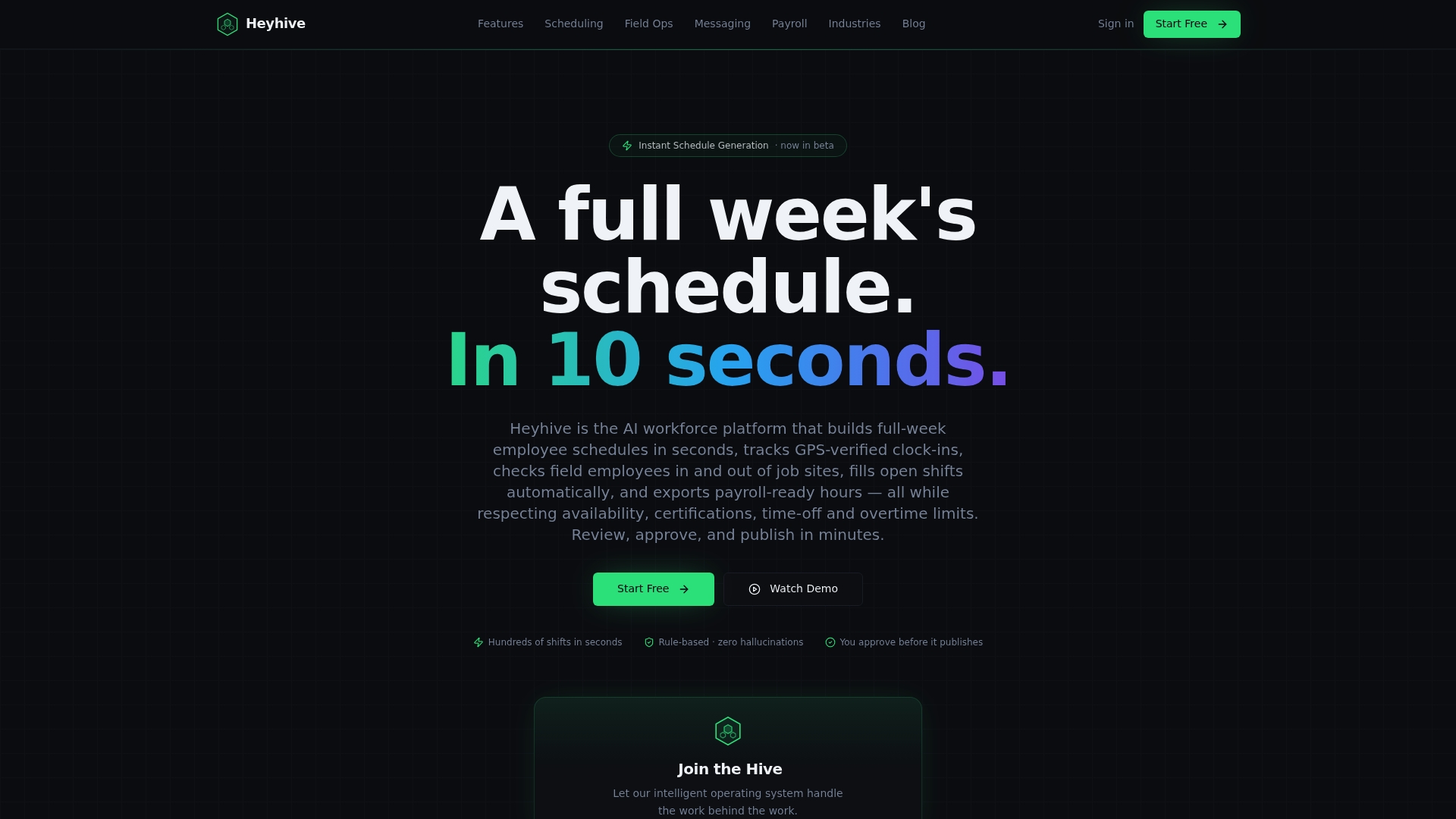
The gap between a schedule that holds and one that falls apart by Wednesday usually comes down to three things: a locked weekly plan, verified field data, and fast communication when something changes. Heyhive handles all three.
Before your demo, have these ready:
- A list of 2–4 pilot projects (site names, crew sizes, active dates)
- Your current scheduling template or spreadsheet
- Three KPIs you'll track: schedule adherence, idle hours per crew per week, and admin hours saved
- A list of certifications your crews currently hold
Start your Heyhive pilot and see how quickly a rolling, AI-assisted schedule changes the way your field teams operate.
Authoritative sources and further reading
- Construction Scheduling: Methods & Practical Guide (Remato) — Covers scheduling as a living document, LPS methods, and the importance of aligning schedules to real workforce capacity. Useful for understanding the foundational principles behind the 5-step process.
- How to Create a Construction Schedule in 5 Steps (Projul) — Step-by-step workflow with emphasis on field-verified duration estimates, resource leveling, and long-lead procurement. Includes the lead time reference data used in the implementation table above.
- Construction Crew Scheduling: Multi-Site Guide (Projul) — Practical guidance on rolling schedules, the Thursday/Friday scheduling session cadence, and subcontractor coordination rules for multi-site operations.
- 10 Best Practices for CPM Scheduling (RS&H) — Authoritative checklist for critical path method scheduling, including logic, calendars, and continuous monitoring of near-critical paths.
- How to Create a Construction Schedule: Step-by-Step Guide (Vitruvi) — Explains how integrated platforms connect field reporting with schedule logic for program-level oversight and better forecasting.
- Heyhive Blog: Workforce Scheduling, Attendance & Hiring Insights — Operational how-tos covering AI scheduling, GPS time tracking, attendance management, and open-shift coverage for field teams.
- Fill Open Shifts Fast: How Heyhive Eliminates Coverage Gaps — Practical guide to covering no-shows and sudden vacancies quickly, directly relevant to contingency planning in multi-site scheduling.